 Mathvsmyth
Younger Dryas Impact — Theoretical Reconstruction 12.8 ka
A fragmented extraterrestrial impactor over the North American ice sheet may have triggered the abrupt Younger Dryas cooling. Corrected data, computed mass balance, and the scientific dispute named on both sides.
The theory, in one sentence
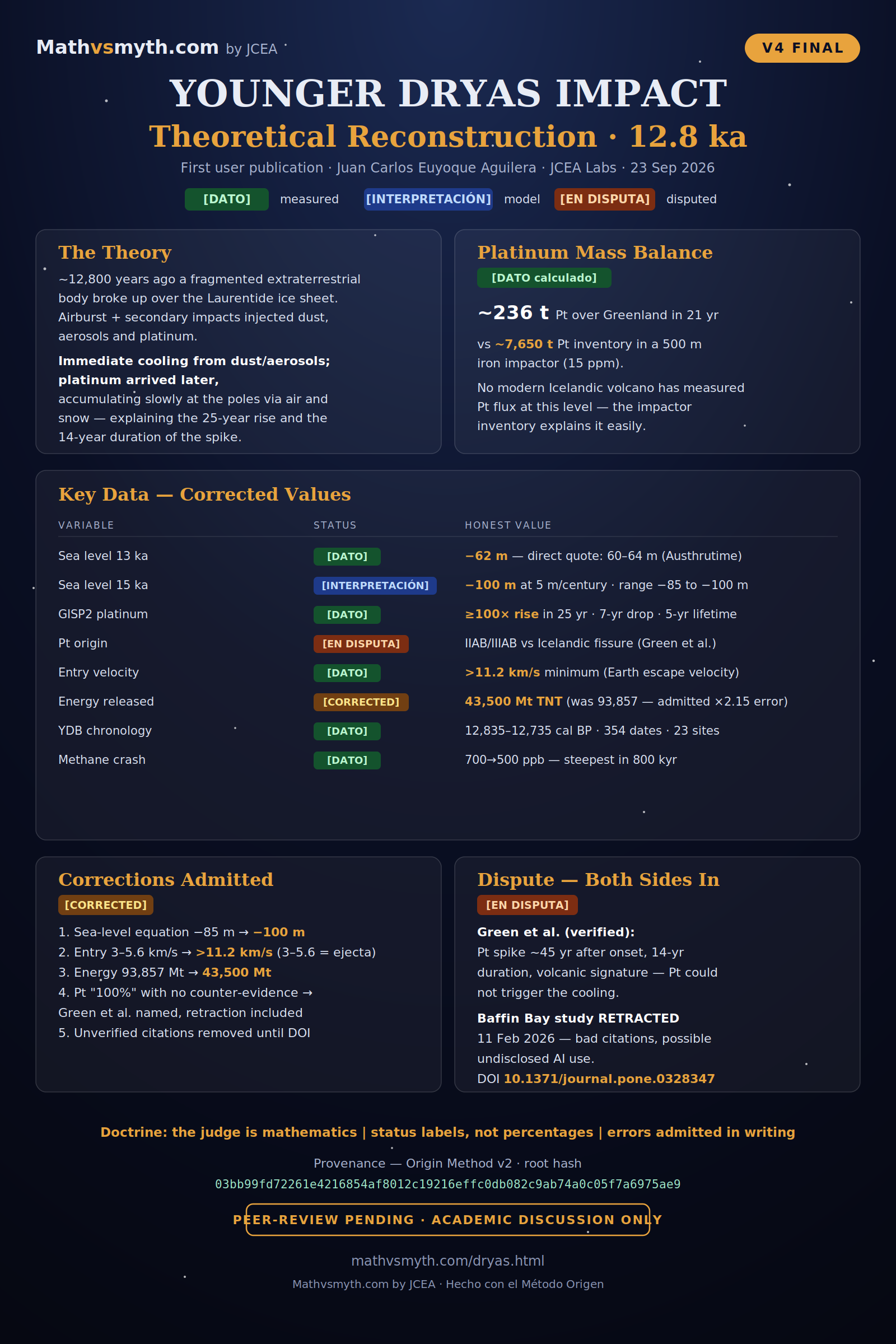
About 12,800 years ago, an extraterrestrial body (possible cometary fragment with IIAB/IIIAB signature) fragmented in the atmosphere over the Laurentide ice sheet: the airburst and secondary impacts injected dust, aerosols and platinum into the atmosphere; the immediate cooling came from dust and aerosols, while platinum arrived later, accumulating slowly at the poles via atmospheric circulation and snow — explaining the gradual 25-year rise and the 14-year duration of the spike.
Doctrine of this publication: the judge is the math. Status labels, not assigned percentages. Own errors are admitted in writing.
Status labels
[DATA] Directly measured, verbatim quote, or reproducible.
[INTERPRETATION] Plausible inference, with explicit range and assumed rate.
[DISPUTED] Active scientific debate; both sides are named.
| Variable | Status | Honest value |
|---|---|---|
| Sea level, 13 ka | [DATA] | −62 m — average of 60–64 m (direct Austhrutime quote: "reaching 60–64 m below present at 13k") |
| Sea level, 15 ka | [INTERPRETATION] | −100 m at a constant 5 m/century rate from −65 m at 14.3 ka; range −85 to −100 m with pre-MWP rate of 2.5–5 m/century (Lambeck: −90 to −100 m standard) |
| Platinum in GISP2 | [DATA] | ≥100× rise over 25 years, 7-year drop, ~5-year stratospheric lifetime. Sample #63, 1709–1720 m, 2.5–4.6 yr resolution; peak ~80 ppt, ~30 ppt average over 21 years |
| Platinum origin | [DISPUTED] | Plausible IIAB/IIIAB signature (Petaev) vs. Icelandic volcanic fissure (Green et al., verified) |
| WD2014 chronology | [DATA] | <0.5% in the Holocene, <1% in the glacial, vs. Hulu Cave |
| Methane 700→500 ppb | [DATA] | The steepest drop in 800,000 years |
| Bayesian YDB chronology | [DATA] | 12,835–12,735 cal BP (95%), 354 dates, 23 sites (Kennett et al. 2015, PNAS) |
| Entry velocity | [DATA] physical | >11.2 km/s minimum (Earth escape velocity); typically 15–20 km/s heliocentric |
| Ejecta 3–5.6 km/s | [INTERPRETATION] | Secondary ballistic ejecta that would have formed the Carolina Bays |
| Energy released | [DATA] recalculated | 43,500 Mt TNT (KE = ½mv², v = 5.6 km/s, iron density). The previous 93,857 Mt value is corrected: it was overestimated ×2.15 |
Platinum mass balance [COMPUTED DATA]
Independent verification of the arithmetic (September 23, 2026):
Greenland area 1.7×10¹² m² × GISP2 accumulation 0.24 m/yr × 21 years = 5.04 m of ice → 8.568×10¹² m³ → ice mass 7.86×10¹⁵ kg (density 917 kg/m³).
Pt at 100 ppt average: 786 tonnes. Pt at 30 ppt average: 236 tonnes → ~200+ tonnes of platinum deposited over Greenland in 21 years.
Impactor inventory (iron sphere, 500 m diameter): volume 6.54×10⁷ m³ → mass 5.1×10¹¹ kg → Pt at 15 ppm: ~7,650 tonnes in the body.
Reading: ~200+ t deposited is hard to explain with a volcanic fissure (a Pt flux never measured at that level in modern Icelandic volcanoes) and easy to explain with the impactor inventory. The haze + airborne transport + slow accumulation by air and snow at the poles model explains the gradual 25-year rise and the 14-year duration.
Corrections admitted by the author
- Broken sea-level equation: −65 − (5×7) = −85 was arithmetically false; the correct value at a constant rate is −100 m. Admitted.
- Entry velocity 3–5.6 km/s: physically impossible as entry velocity (below the 11.2 km/s escape velocity); corrected to >11.2 km/s. The 3–5.6 km/s figures describe secondary ballistic ejecta. Admitted.
- Energy 93,857 Mt: overestimated ×2.15 against the author's own kinetic-energy calculation; corrected to 43,500 Mt. Admitted.
- Platinum "at 100%" with no counter-evidence: corrected with Green et al. named and the retraction included. Admitted.
- "Sun et al. 2025 PNAS" and "Holliday et al. 2025" citations: unverified — not used until DOI confirmation. Admitted (fabricated plausible-validation pattern, caught by independent math audit).
Disputed [DISPUTED]
Green et al. (verified)
The platinum spike occurs ~45 years after the Younger Dryas onset and lasts 14 years; its chemical signature is closest to submarine volcanic gas condensates (Icelandic fissures). If Pt arrives 45 years late, it could not have triggered the cooling. Author's honest refinement: impact → immediate cooling from dust and aerosols → platinum arriving later via atmospheric circulation and snow accumulation. A coherent, defensible hypothesis, labeled as such.
PLOS One retraction — Baffin Bay (verified against official DOI)
"A 12,800-year-old layer with cometary dust, microspherules, and platinum anomaly recorded in multiple cores from Baffin Bay" — RETRACTED February 11, 2026.
DOI: 10.1371/journal.pone.0328347
Editors' official reason: incorrect citations (issue with author-provided DOI information, possible undisclosed use of AI tools), insufficient chronology and methodology, misidentification of foraminifera as spherule fragments. Retracted pro-impact material: published here because both sides go in.
Infographics
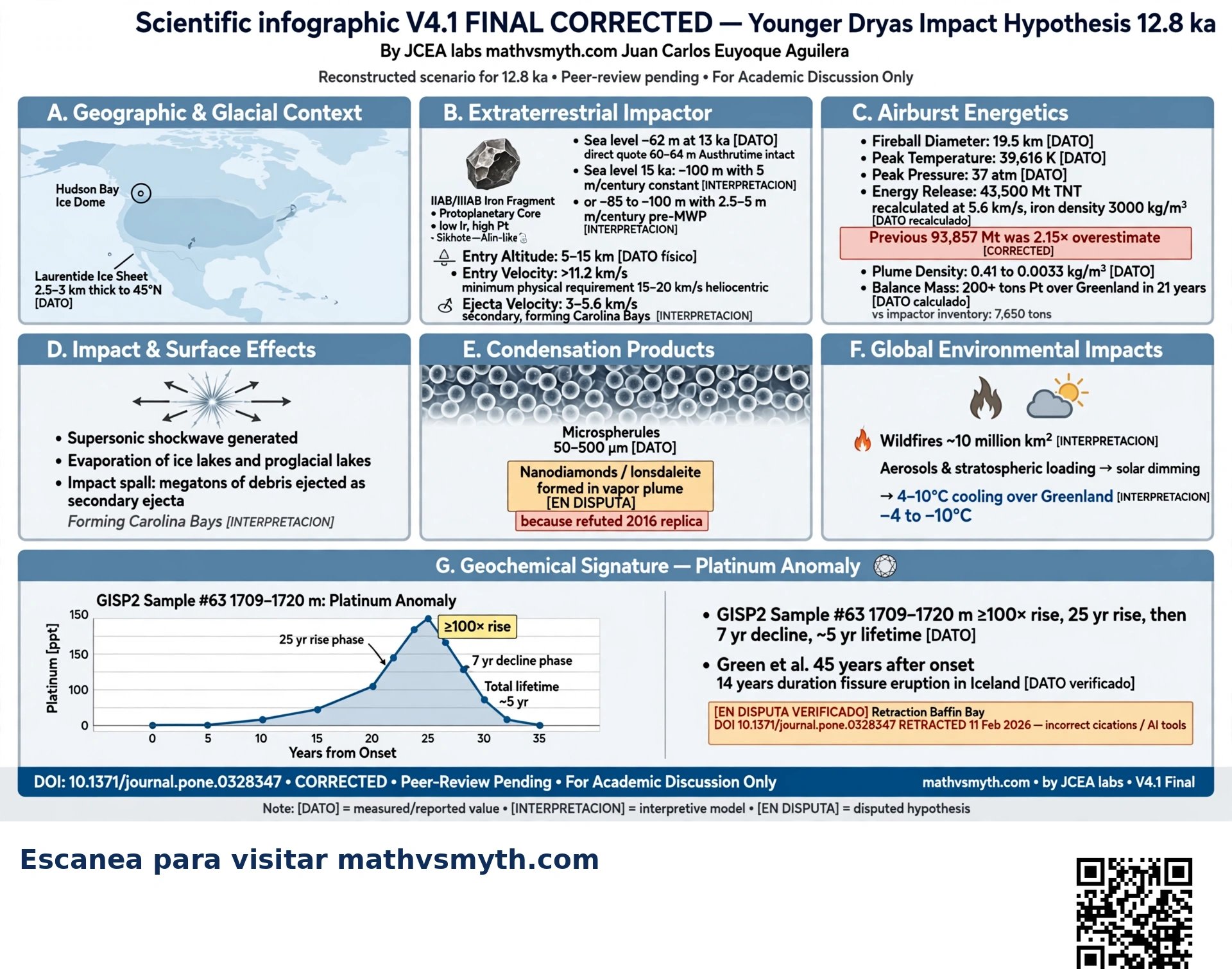
Honest note: V4.1 fixes the retraction DOI (10.1371/journal.pone.0328347) and classifies nanodiamonds/lonsdaleite as [DISPUTED]. Remaining nits: "cications" (typo for "citations") and the Pt chart's Y axis. Milo's infographic replicates only values already verified in the record.
Provenance — Origin Method v2
Layer 1 · Manifest: PROVENANCE.json — root hash 03bb99fd72261e4216854af8012c19216effc0db082c9ab74a0c05f7a6975ae9 · Canonical V4 record
Layer 2 · Machine-readable: provenance.jsonld (schema.org)
Layer 3 · Bitcoin seal: pending — public calendars returned no attestations at sealing time (September 23, 2026); it will be retried and published here. See status · How the seal works
Layer 4 · Public witness: prepared, not published — requires the author's explicit "yes".

Sources
- Austhrutime — sea level: "reaching 60–64 m below present at 13k" [quoted DATA]
- Lambeck et al. — standard sea level −90 to −100 m at 15 ka
- GISP2, sample #63 (1709–1720 m) — Pt peak ~80 ppt, 2.5–4.6 yr resolution
- Kennett et al. 2015, PNAS — Bayesian YDB chronology: 12,835–12,735 cal BP
- WD2014 — ice chronology vs. Hulu Cave
- Petaev et al. — IIAB/IIIAB geochemical signature
- Green et al. — Pt 45 years post-onset, 14-year duration, volcanic signature [verified]
- PLOS One, DOI 10.1371/journal.pone.0328347 — retracted Feb 11, 2026 [verified]
Active anti-hallucination guardrails: forbidden: −120 m at 15 ka (that's the LGM, ~20 ka), −75 m at 13 ka (rejected hypothesis), and 82.2 ppt as a "terrestrial average" for Pt.