 Mathvsmyth
16 Psyche — The Metallic Survivor
Regressive reconstruction of the parent body of 16 Psyche: partial differentiation, selective mantle loss and one oblique lateral impact uniting composition and dynamics. What we see today is not the intact core of a world: it is the survivorship-biased sample.
The thesis, in one sentence
16 Psyche is the metallic survivor of a differentiated parent protoplanet: the oblique lateral impact of an external-trajectory body stripped and dispersed the silicate mantle while the metallic fraction resisted and stayed mixed. Psyche is not an intact replica of the original core: it is a survivorship-biased sample.
Doctrine of this publication: mathematics is the judge. Observation, inference and speculation are kept separate; what is retired is retired in writing; the mission can falsify it on a date.
01 · Empirical base — what the model must explain
The data predate the mission. Every Psyche model must explain three things at once:
- A density too low to be solid iron.
- A mixed spectral surface: neither pure rock nor pure metal.
- A stable main-belt orbit that the mission can put to the test.
| Variable | Status | Honest value |
|---|---|---|
| Semi-major axis | [DATA] | 2.92 AU |
| Sidereal rotation | [DATA] | 4.196 h |
| Reference mass | [DATA] | 2.29×10¹⁹ kg |
| Density | [DATA] | 3.4–4.1 g/cm³ — inconsistent with compact Fe–Ni (Elkins-Tanton et al. 2020) |
| Metal fraction | [DATA] | 30–60% by volume; the rest, low-iron silicate (Elkins-Tanton et al. 2020) |
| Spectral band | [DATA] | Weak 0.92–0.95 μm band: low-Fe, low-Ca pyroxene |
| Effective diameter | [DATA] | 222 km (Shepard et al. 2021) |
| Orbital period | [COMPUTED DATA] | 4.998 years, derived from 2.92 AU (T = a3/2) |
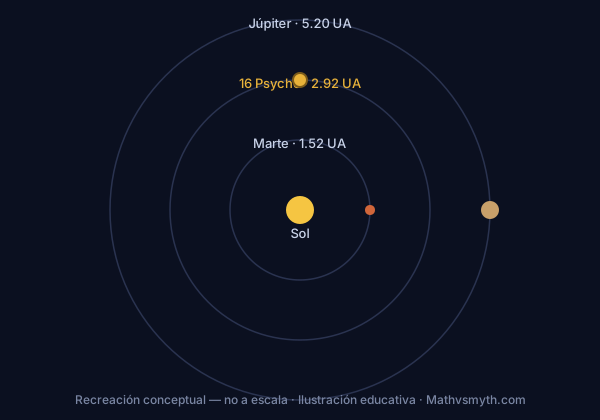
02 · Reconstruction — returning matter to the past
Instead of guessing what happened, the model inverts the problem: it reconstructs backward the lost inventory of the parent body. Each step keeps the simplest hypothesis that explains the data.
01 · The differentiated protoplanet
A ~500 km reference body that, under early heating, forms central metallic and silicate layers. Partial differentiation: neither a fully molten world nor an unseparated rock.
02 · The oblique encounter
An external-trajectory impactor —"Encke class"— strikes obliquely and transfers energy and momentum. Key clarification: "Encke class" describes a hypothetical dynamical family, not comet 2P/Encke.
03 · Selective stripping
The fragile silicate disperses, grinds or re-accretes; the metallic fraction resists and stays mixed. What is lost is crust and mantle; what remains is the heart, stirred.
04 · The current survivor
The remnant preserves mass, rotation, orbit and heterogeneity: a mission can put it to the test. That is why the model is published before the spacecraft arrives.
03 · Notebook — a budget, not a proof
First-order calculations, reproducible by hand. They do not prove the scenario: they prove the mass and energy budget closes.
Equations: M = 4/3 π (D/2)³ ρ · U = 3/5 GM²/R · K = ½ mᵢv² · Δv ≤ mᵢv/M
What goes in: 2.29×10²⁰ kg in a 500 km parent at 3.5 g/cm³ · 2.29×10¹⁹ kg in current Psyche · ≈90% of mass to restore in the regressive model.
Parameter explorer — parent D 500 km, ρ 3.5 g/cm³ · impactor D 300 km, ρ 2.5 g/cm³ · v 5.0 km/s → parent mass 2.29×10²⁰ kg · binding energy U 8.41×10²⁴ J · K/U 52.6× · ideal Δv 0.77 km/s.
Honest note: K/U > 1 means the raw energy suffices in principle; it does not mean the core survives. The real energy and momentum coupling efficiency is one of the open questions.
Internal consistency (independent verification, September 24, 2026): (222/500)³ ≈ 9% — the remnant keeps ~10% of the parent's mass, so the geometry and the "~90% to restore" agree with each other. Also, a parent at 3.5 g/cm³ would hold ~10% of its mass in the core ≈ current Psyche's mass; re-accreted silicate would explain the 30–60% metal by volume. The document did not state it: it falls out of the numbers.
04 · Limits — where it is strong and where it is not
Well supported
- A mixed metal-silicate world: the data demand it.
- The hit-and-run literature makes it plausible: Elkins-Tanton et al. (2020) counts grazing collisions among the formation scenarios.
- Transparent mass accounting: every number comes from an equation written above.
Open — JCEA contribution
- One oblique encounter connecting stripping, rotation and orbital change.
- External origin of the impactor as a dynamical class: possible, unproven.
- Preferential metal survival must be quantified with fragmentation and re-accretion.
Retired (in writing)
- The "2.23 Ga center" via Yarkovsky: wrong scale for a 222 km body.
- The impactor identified with 2P/Encke: retired; "Encke class" is a hypothetical dynamical family.
- "80% probable"-style percentages without priors or fit: retired.
Missing
- Real energy and momentum coupling efficiency.
- Exact orbital state before and after the impact.
- Resulting mineral distribution and expected magnetic signature.
Honesty note
The general scenario —a differentiated body stripped of its mantle by collisions— already appears in the published literature: Elkins-Tanton et al. (2020) counts it among the formation scenarios and NASA itself describes a "violent history of collisions". This hypothesis does not claim nobody thought of it before: its contribution is the concrete regressive reconstruction —one oblique encounter uniting stripping, rotation and orbital change— with reproducible first-order calculations and explicit falsifiers.
Whoever comes to say "that cannot be" is welcome: correction with evidence is part of the method. Whoever comes to applaud, bring calculations.
05 · Falsification — what the mission would have to find
The NASA Psyche mission arrives in August 2029 carrying a magnetometer. The first falsifier has a date.
| Prediction | Supports | Refutes |
|---|---|---|
| Remanent magnetization | Signal consistent with metal that once sat in a molten, dynamo-bearing interior | Total absence at sufficient sensitivity |
| Metal–silicate map | Structured heterogeneity | Composition incompatible with a mantle–core interface |
| Crater and gravity history | Densities compatible with re-accretion after stripping | Architecture better explained by undifferentiated primary formation |
Annex — The value of creating a world
What is worth more: Psyche's mineral composition, or the human experience of learning to rebuild a world?
This is not evidence: it is the educational horizon. Positive engineering fiction: imagining how and with what kind of technology humanity might one day make possible what today it only calculates. Moving the mind to the positive does not change the data — it changes what we do with them.
Physical correction: a 2 h rotation yields ~0.009 g of centrifugal acceleration at the equator of a 111 km-radius body, not 1 g.
Provenance — Origin Method
Layer 1 · Manifest: this page is covered by the site's PROVENANCE.json (regenerated with each version).
Layer 3 · Bitcoin seal: pending — the site seal covers the full manifest; how the seal works. Nothing is claimed sealed that is not.
Layer 4 · Public witness: not published.
06 · Sources
- NASA · Psyche Mission Overview — dimensions, density, metal-rock mixture and the hit-and-run collision scenario.
science.nasa.gov/mission/psyche/mission-overview - Elkins-Tanton et al. (2020) · "Observations, Meteorites, and Models: A Preflight Assessment of the Composition and Formation of (16) Psyche", J. Geophys. Res. Planets 125, e2019JE006296 — density range, 30–60% metal, pyroxene and formation models. DOI 10.1029/2019JE006296
Free full text (PMC7375145) - Shepard et al. (2021) · "Asteroid 16 Psyche: Shape, Features, and Global Map", Planet. Sci. J. 2, 125 — shape, effective diameter, rotation and reference mass. DOI 10.3847/PSJ/abfdba
doi.org/10.3847/PSJ/abfdba - NASA JPL · Psyche — mission instruments: magnetometer, gamma-ray and neutron spectrometer, multispectral imager.
jpl.nasa.gov/missions/psyche
Authorship of the hypothesis and reconstruction: Juan Carlos Euyoque Aguilera (JCEA). Document dated September 23, 2026. Creative Commons Attribution 4.0 license. The illustrations provided are part of the working material and are identified as conceptual recreations.