Fourteen pieces, from Australopithecus afarensis to Homo sapiens. Every claim carries its tag: [DATO], [TEORÍA] or [EN DISPUTA]. Nine pieces were corrected after a claim-by-claim audit; the author's theories will come later, in a separate, clean package.
The family tree
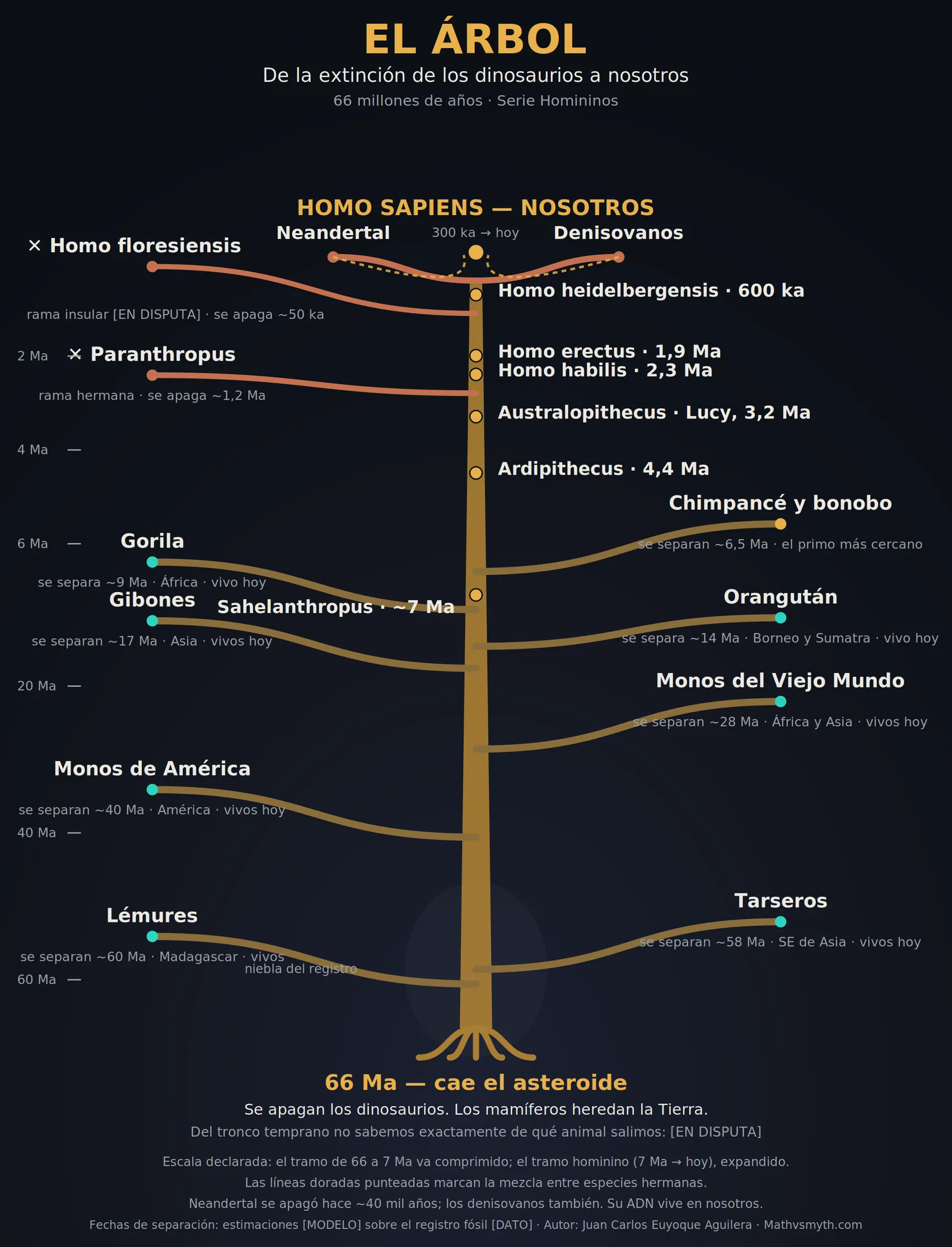
The trunk of this tree is the extinction of the dinosaurs, ~66 million years ago: from the mammal radiation that followed come the primates, and from one of their branches, us. Each cousin line branches off at its estimated date; branches that end are extinct lineages; and where two branches touch again at the crown, there was mixture (shared DNA).
The image itself is labeled in Spanish. Scale declared in the image: the stretch from 66 to 7 million years is compressed and the hominin stretch (7 Ma → today) is expanded — that is why the crown looks wide. The trunk's start (66–40 Ma) is drawn in fog and marked DISPUTED: we know we evolved; exactly which animal the line descends from is not settled. The fourteen profiles below hang from this tree's final branches.
01/14AUSTRALOPITHECUS AFARENSIS The mother of humanity02/14HOMO HABILIS The handy man03/14HOMO NALEDI The mysterious relative04/14AUSTRALOPITHECUS SEDIBA The link between two worlds05/14DENISOVANO The enigmatic human of Asia06/14HOMO HEIDELBERGENSIS The ancestor connecting worlds07/14HOMO LONGI The dragon man08/14YUNXIAN Homo erectus from Yunxian09/14EL CRÁNEO DE DALI A mystery of the Asian Pleistocene10/14EL CRÁNEO DE KABWE An ancient human of extreme features11/14HOMO ERECTUS The first human with a modern body12/14HOMO NEANDERTHALENSIS The cousin who lives on in us13/14HOMO FLORESIENSIS The hobbit of Flores14/14HOMO SAPIENS Us — the mixture
Origin
Hominin Series v2 — expansion sealed with the Origin Method (fingerprint 2b02d8f9df54be1b2fe462b8aec9dd25c171a29b766be13110bfb2686482952a, CC BY 4.0). It expands v1 (fingerprint ce3aa06928254ab81de6539c42bd5e6ec3c255a140825a359d698d510f45ab31), which stays untouched as the record. The v2 OpenTimestamps stamp is registered with 4 calendars and anchored in Bitcoin (blocks 974471, 974473, 974486 and 974488). The cards are illustrative portraits; the expanded profiles add real photographs of the fossils, each with its credit and license. One slot awaits a donation to knowledge: the Yunxian one.
Minor correction — November 4, 2026: the year beside the Dali photograph (2021) is its upload year on Wikimedia Commons; the work's own date is not declared. A precision of detail, not the correction of a wrong datum.
The profiles, one by one — expanded format
Version 2 of the series: each piece gains three fields — The fossil (the photograph of the actual remain, with its credit and license), Where it surfaced and Its world. The content of the fourteen original cards remains intact: this expands it, it does not rewrite it. Where no freely licensed photograph of the fossil exists, the slot stays empty and open — it is an image wanted, a donation to knowledge.
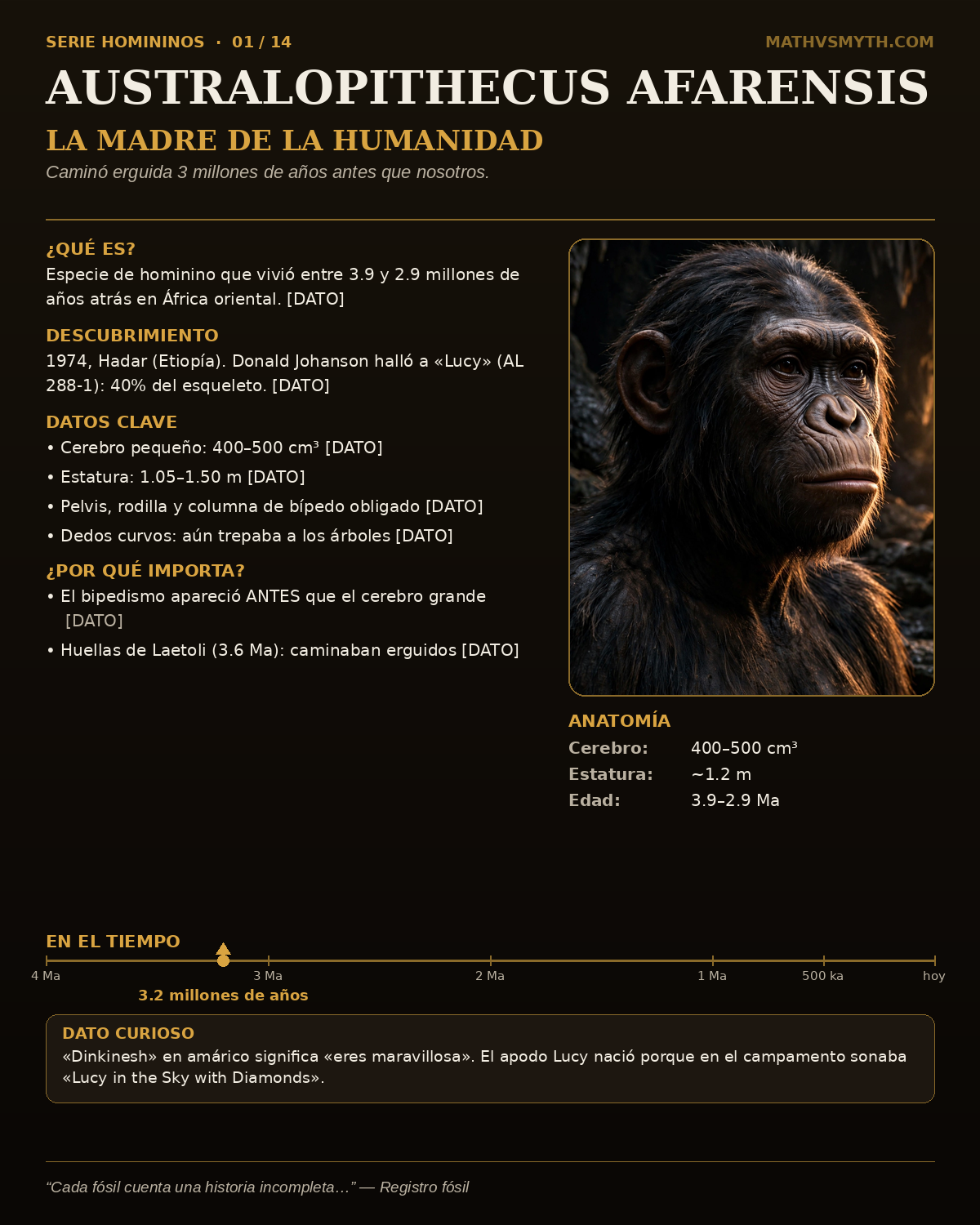
CARD 01 / 14
AUSTRALOPITHECUS AFARENSIS
The mother of humankind
She walked upright 3 million years before us.
What is it?
A hominin species that lived between 3.9 and 2.9 million years ago in East Africa. DATA
Discovery
1974, Hadar (Ethiopia). Donald Johanson found “Lucy” (AL 288-1): 40% of the skeleton. DATA
The fossil — photograph of the actual remain
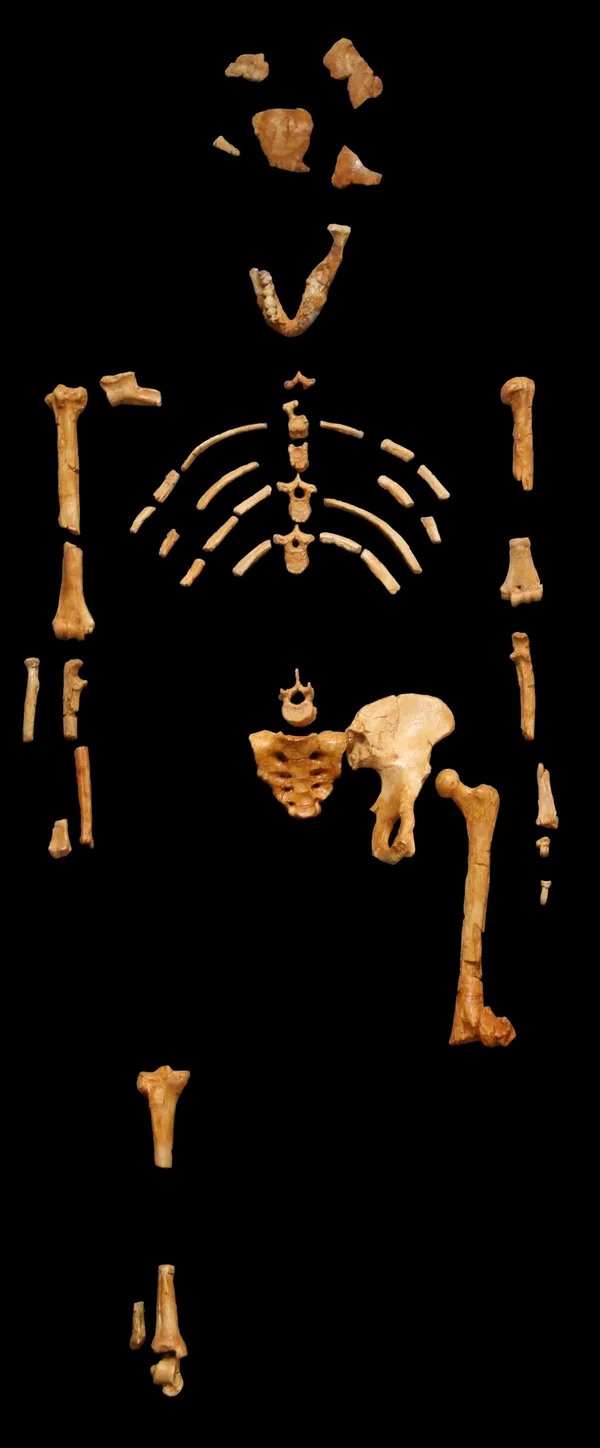
Lucy (AL 288-1): the bones recovered from a single individual — about 40% of the skeleton of a female who lived 3.2 million years ago. The photograph shows the official cast of the skeleton, exhibited at the National Museum of Natural History in Paris: the original fossil is kept at the National Museum of Ethiopia (Addis Ababa) and is almost never displayed — the world knows Lucy mostly through her casts. Photo: “120” · CC BY 2.5, via Wikimedia Commons · photo from 2007.
Where it surfaced
Hadar, Afar Depression (Ethiopia), on the eroded slopes by the Awash River. On 24 November 1974, Donald Johanson and Tom Gray — of his team — spotted an arm bone on the surface; the season gathered hundreds of fragments from a single skeleton: Lucy. The species also left the Laetoli footprints (Tanzania, 3.6 Ma): the steps of bipeds preserved in volcanic ash. DATA
Its world
Continent: East Africa. The sediments and fauna of Hadar mix forest and savanna animals in the same deposit. DATA The current reconstruction: a mosaic of riverbank forest along the Awash and its lakes, opening into wooded savanna — the exact habitat of a body that walked upright on the ground and still climbed trees with curved fingers. THEORY
Key facts
Small brain: 400–500 cm³ DATA
Height: 1.05–1.50 m DATA
Pelvis, knee and spine of an obligate biped DATA
Curved fingers: it still climbed trees DATA
Why it matters
Bipedalism appeared BEFORE the big brain DATA
The Laetoli footprints (3.6 Ma): they walked upright DATA
Anatomy
Brain400–500 cm³
Height~1.2 m
Age3.9–2.9 Ma
In time
4 Ma3.2 million yearstoday
CURIOUS FACT — “Dinkinesh” in Amharic means “you are wonderful”. The nickname Lucy was born because “Lucy in the Sky with Diamonds” was playing in camp.
Every fossil tells an incomplete story…— Fossil record
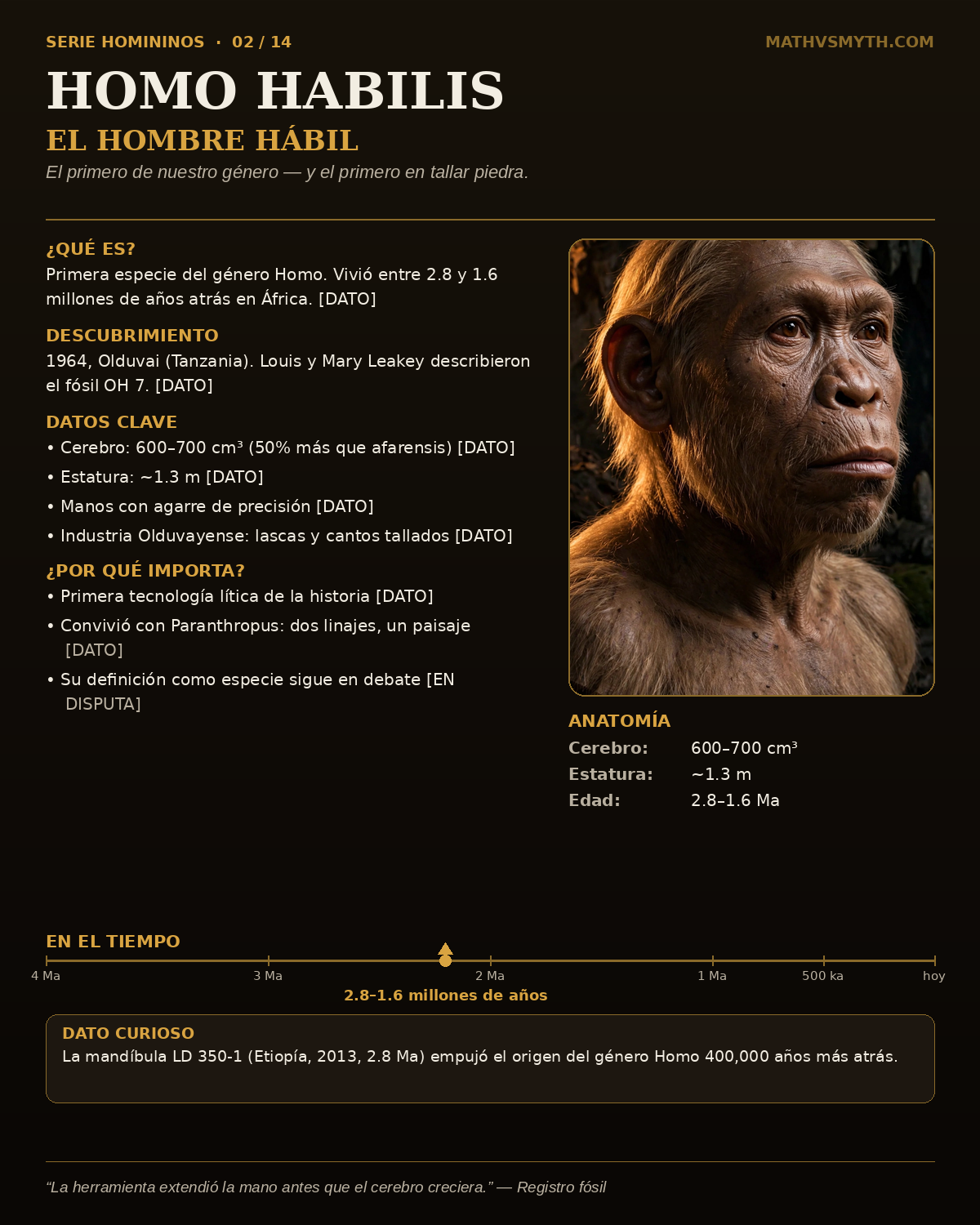
CARD 02 / 14
HOMO HABILIS
The handy man
The first of our genus — and the first to knap stone.
What is it?
First species of the genus Homo. It lived between 2.8 and 1.6 million years ago in Africa. DATA
Discovery
1964, Olduvai (Tanzania). Louis and Mary Leakey described the fossil OH 7. DATA
The fossil — photograph of the actual remain
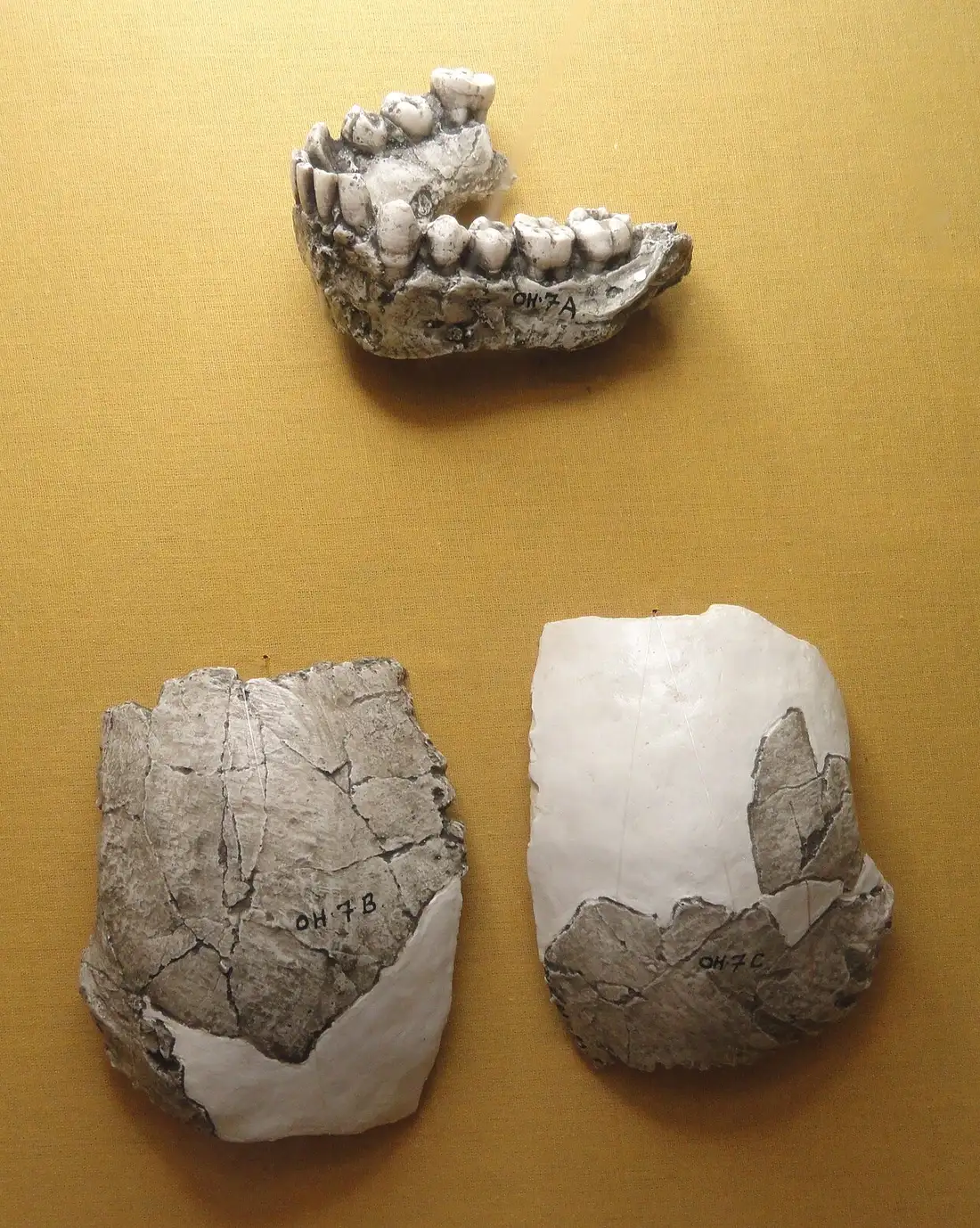
OH 7, the holotype: the mandible with its teeth and the two parietal bones of a juvenile — the pieces that in 1964 were used to name Homo habilis, the first Homo. The photograph shows the exhibition cast at the Springfield Science Museum (USA); the original fossil is kept in Tanzania. Photo: Daderot · CC0 (public domain), via Wikimedia Commons · photo from 2012.
Where it surfaced
Olduvai Gorge (Tanzania), at the edge of the Serengeti plain. In 1960, Jonathan Leakey — son of Louis and Mary — found the mandible and hand bones of a juvenile; the Leakey team described it in 1964 as a new species: the first member of the genus Homo. DATA
Its world
Continent: East Africa. Olduvai was then the shore of an alkaline lake: the sediments and fauna of the site are lake-margin and grassland. DATA The current reconstruction: a mosaic of open savanna with patches of riverine woodland, shared with Paranthropus and with the carnivores that also left bones in the gorge. THEORY
Key facts
Brain: 600–700 cm³ (50% more than afarensis) DATA
Height: ~1.3 m DATA
Hands with a precision grip DATA
Oldowan industry: flakes and knapped cobbles DATA
Why it matters
The first stone technology in history DATA
It lived alongside Paranthropus: two lineages, one landscape DATA
Its definition as a species is still debated DISPUTED
Anatomy
Brain600–700 cm³
Height~1.3 m
Age2.8–1.6 Ma
In time
4 Ma2.8–1.6 million yearstoday
CURIOUS FACT — The LD 350-1 jaw (Ethiopia, 2013, 2.8 Ma) pushed the origin of the genus Homo 400,000 years further back.
The tool extended the hand before the brain grew.— Fossil record
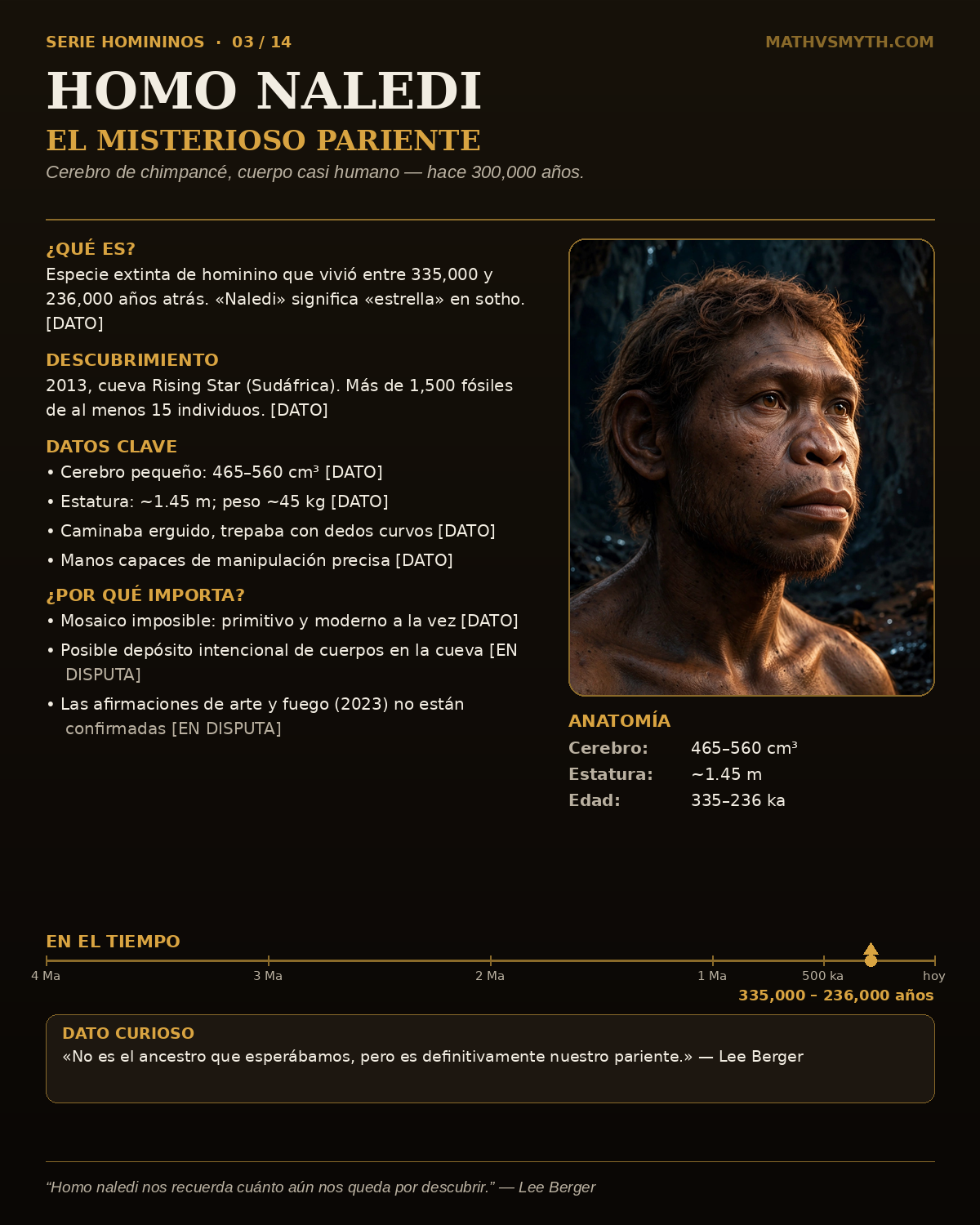
CARD 03 / 14
HOMO NALEDI
The mysterious relative
A chimpanzee's brain, an almost human body — 300,000 years ago.
What is it?
An extinct hominin species that lived between 335,000 and 236,000 years ago. “Naledi” means “star” in Sotho. DATA
Discovery
2013, Rising Star cave (South Africa). More than 1,500 fossils from at least 15 individuals. DATA
The fossil — photograph of the actual remain
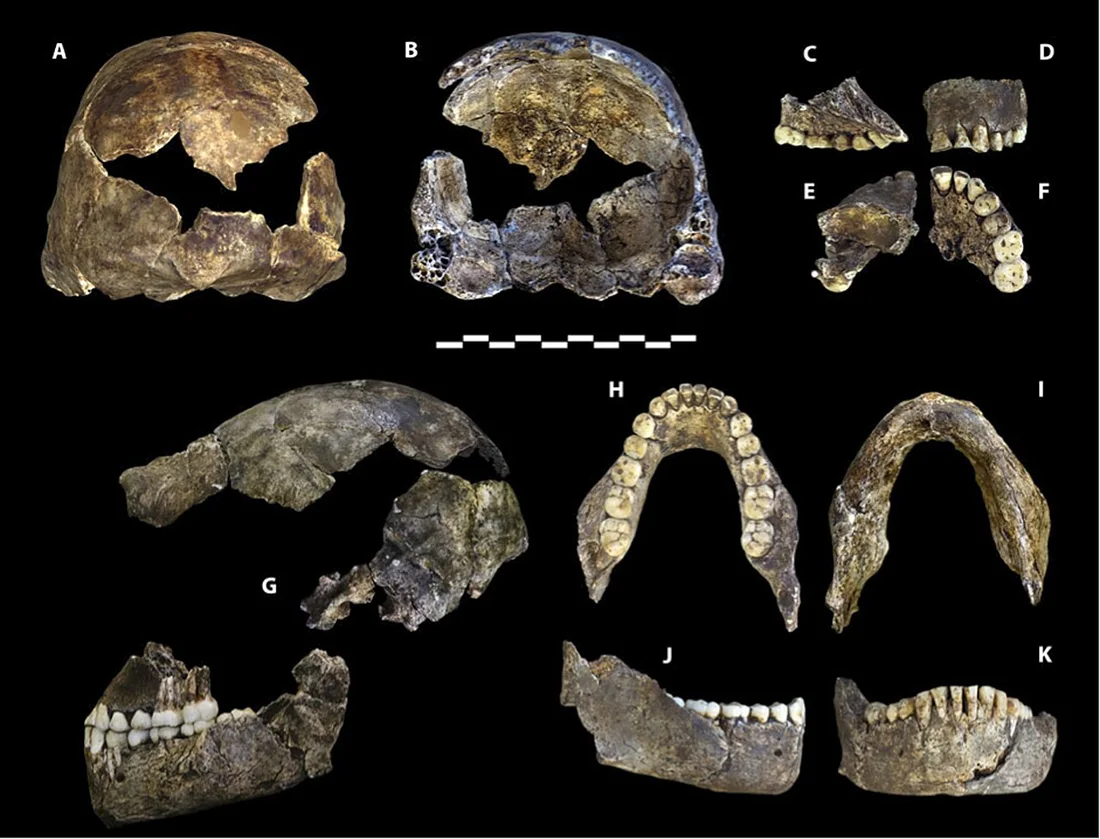
DH1, the holotype: the cranium and mandible of the first defined individual from the Dinaledi Chamber, in the views from the discovery team's original publication. These are original fossils — more than 1,500 pieces from at least 15 individuals came out of that chamber. Photo: Lee Roger Berger research team · CC BY-SA 4.0, via Wikimedia Commons · photo from 2015.
Where it surfaced
Rising Star Cave, in the Cradle of Humankind (South Africa). In 2013, cavers Rick Hunter and Steven Tucker reached a chamber that is almost inaccessible — today it is entered through an 18 cm chute — and found it carpeted with bones: the Dinaledi Chamber. Lee Berger's team excavated more than 1,500 fossils there. DATA
Its world
Continent: southern Africa. One rare and central fact: inside the Dinaledi Chamber there are almost no bones of other animals — no predators or water currents got in; nearly everything there is naledi. DATA The current reconstruction of the surface: grassland and wooded savanna over the dolomite hills of the Cradle of Humankind — a sunlit world very different from the total darkness where its bones lay. THEORY
Key facts
Small brain: 465–560 cm³ DATA
Height: ~1.45 m; weight ~45 kg DATA
It walked upright and climbed with curved fingers DATA
Hands capable of precise manipulation DATA
Why it matters
An impossible mosaic: primitive and modern at once DATA
Possible intentional deposition of bodies in the cave DISPUTED
The 2023 claims of art and fire are not confirmed DISPUTED
Anatomy
Brain465–560 cm³
Height~1.45 m
Age335–236 ka
In time
4 Ma335,000 – 236,000 yearstoday
CURIOUS FACT — “It is not the ancestor we expected, but it is definitely our relative.” — Lee Berger
Homo naledi reminds us how much we still have to discover.— Lee Berger
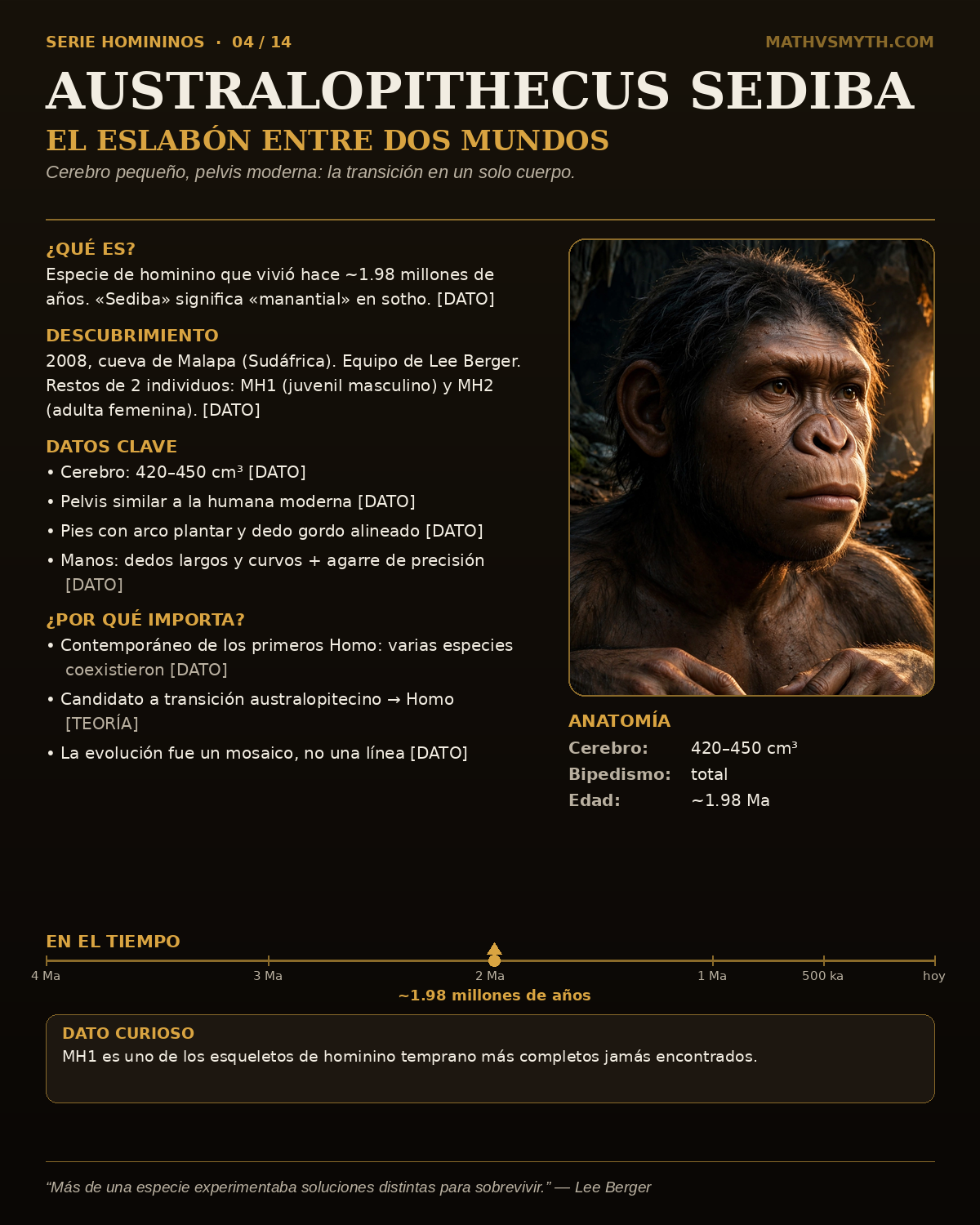
CARD 04 / 14
AUSTRALOPITHECUS SEDIBA
The link between two worlds
Small brain, modern pelvis: the transition in a single body.
What is it?
A hominin species that lived ~1.98 million years ago. “Sediba” means “spring” in Sotho. DATA
Discovery
2008, Malapa cave (South Africa). Lee Berger's team. Remains of 2 individuals: MH1 (juvenile male) and MH2 (adult female). DATA
The fossil — photograph of the actual remain
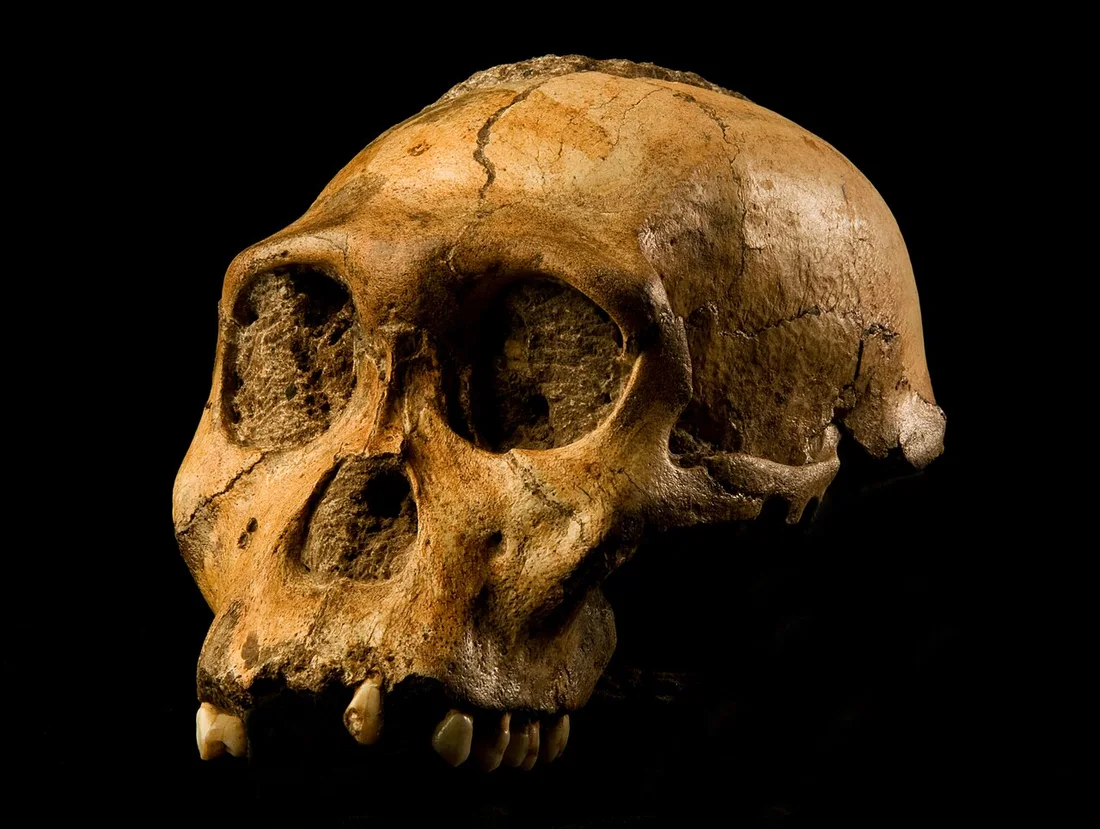
The cranium of MH1, “Karabo”: the Malapa juvenile whose partial skeleton is the holotype of the species. This is the original fossil, photographed by the team that studies it at the University of the Witwatersrand. Photo: Brett Eloff, courtesy of Lee Berger and Wits University · CC BY-SA 4.0, via Wikimedia Commons · photo from 2013.
Where it surfaced
Malapa Cave, Cradle of Humankind (South Africa). In August 2008, Matthew Berger — the nine-year-old son of palaeontologist Lee Berger — picked up a rock with a clavicle sticking out of it during a prospecting outing; two partial articulated skeletons came out of that cave: MH1 and MH2. DATA
Its world
Continent: southern Africa. Malapa was a dolomite cave where animals fell in and died: antelopes, a sabre-toothed cat and other mammals were preserved alongside the sediba individuals. DATA The current reconstruction: a mosaic of grassland and gallery forest, wetter than today, in the same cave system that two million years later would also tell the story of naledi. THEORY
Key facts
Brain: 420–450 cm³ DATA
Pelvis similar to the modern human one DATA
Feet with a plantar arch and an aligned big toe DATA
Hands: long, curved fingers + precision grip DATA
Why it matters
Contemporary with the first Homo: several species coexisted DATA
Candidate for the australopithecine → Homo transition THEORY
Evolution was a mosaic, not a line DATA
Anatomy
Brain420–450 cm³
Bipedalismfull
Age~1.98 Ma
In time
4 Ma~1.98 million yearstoday
CURIOUS FACT — MH1 is one of the most complete early hominin skeletons ever found.
More than one species was experimenting with different solutions to survive.— Lee Berger
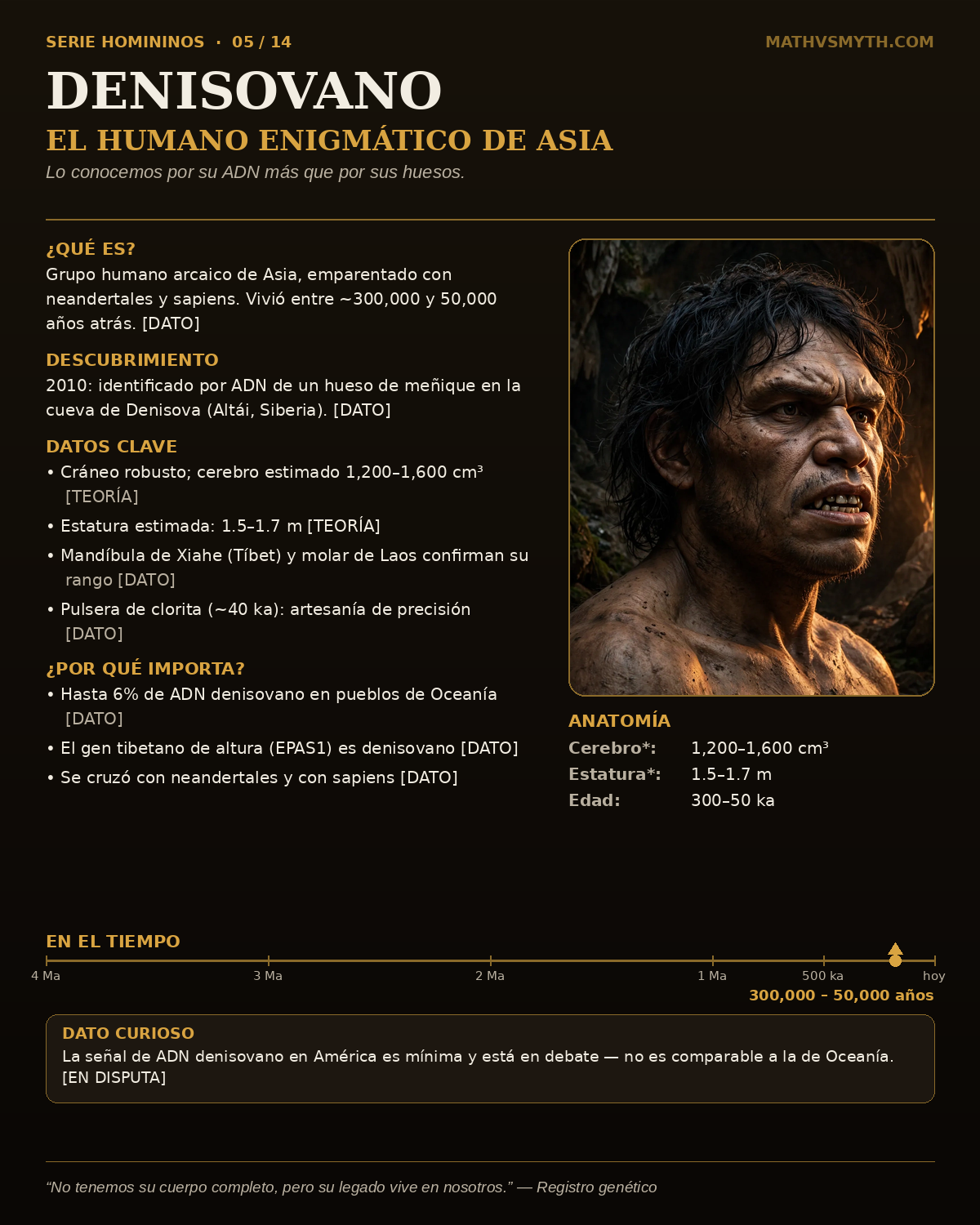
CARD 05 / 14
THE DENISOVANS
The enigmatic human of Asia
We know them by their DNA more than by their bones.
What is it?
An archaic human group of Asia, kin to Neanderthals and sapiens. It lived between ~300,000 and 50,000 years ago. DATA
Discovery
2010: identified by DNA from a little-finger bone in Denisova Cave (Altai, Siberia). DATA
The fossil — photograph of the actual remain
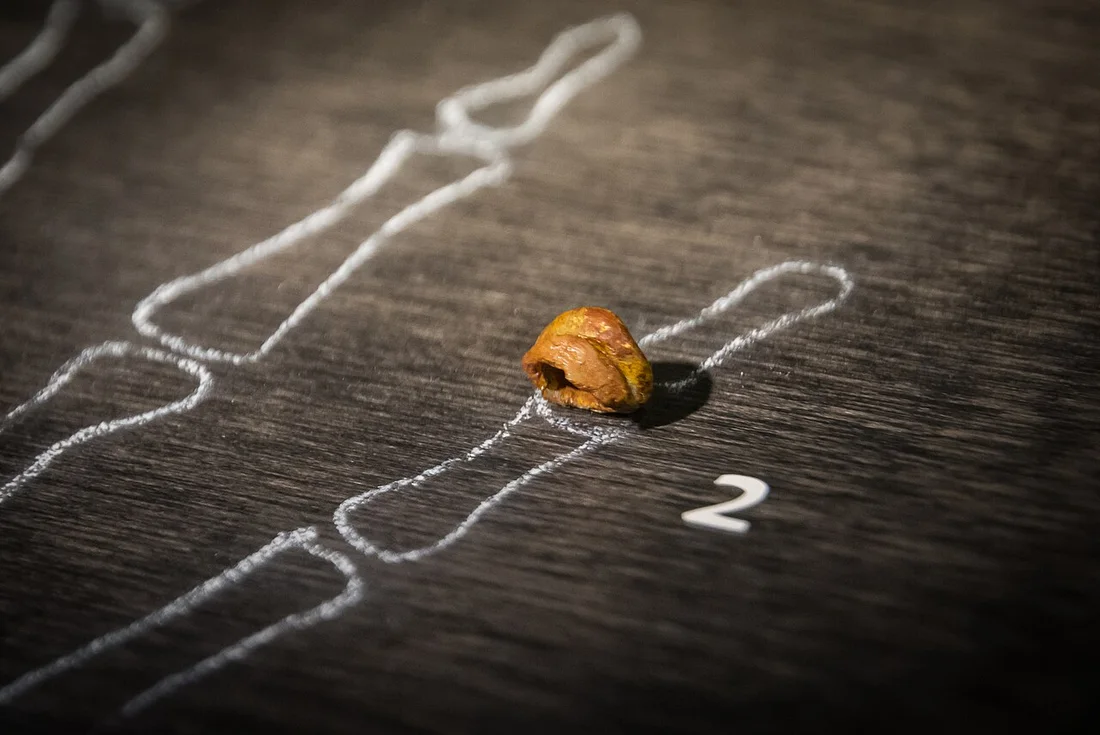
The finger bone (Denisova 3): a fragment of little-finger phalanx only a few millimetres long — from its DNA came, in 2010, an entire human lineage. The photograph shows the replica exhibited at the Museum of Natural Sciences in Brussels; the original fragment is kept by the institute that studies it. Photo: Thilo Parg · CC BY-SA 3.0, via Wikimedia Commons · photo from 2015.
Where it surfaced
Denisova Cave, Altai Mountains (Siberia, Russia): a shelter above the Anui River occupied in turns for hundreds of thousands of years. In 2008, the excavators found the phalanx fragment; in 2010, Svante Pääbo's team (Max Planck Institute, Leipzig) read its DNA and announced that it was neither Neanderthal nor sapiens: it was something else. DATA
Its world
Continent: Asia, from Siberia to Tibet and Laos. The cave opens over a river valley between steppe and mountain forest; inside, tools and bones of Denisovans, Neanderthals and sapiens alternate in layers. DATA The current reconstruction: a corridor of cold steppe and habitable valleys through which this lineage occupied half of Asia while leaving almost no bones — its map was drawn by DNA, not by the fossil record. THEORY
Key facts
Robust cranium; estimated brain 1,200–1,600 cm³ THEORY
Estimated height: 1.5–1.7 m THEORY
The Xiahe mandible (Tibet) and a molar from Laos confirm their range DATA
Chlorite bracelet (~40 ka): precision craftsmanship DATA
Why it matters
Up to 6% Denisovan DNA in peoples of Oceania DATA
The Tibetan altitude gene (EPAS1) is Denisovan DATA
They interbred with Neanderthals and with sapiens DATA
Anatomy
Brain*1,200–1,600 cm³
Height*1.5–1.7 m
Age300–50 ka
In time
4 Ma300,000 – 50,000 yearstoday
CURIOUS FACT — The Denisovan DNA signal in the Americas is minimal and debated — it is not comparable to Oceania's. DISPUTED
We do not have their complete body, but their legacy lives in us.— Genetic record
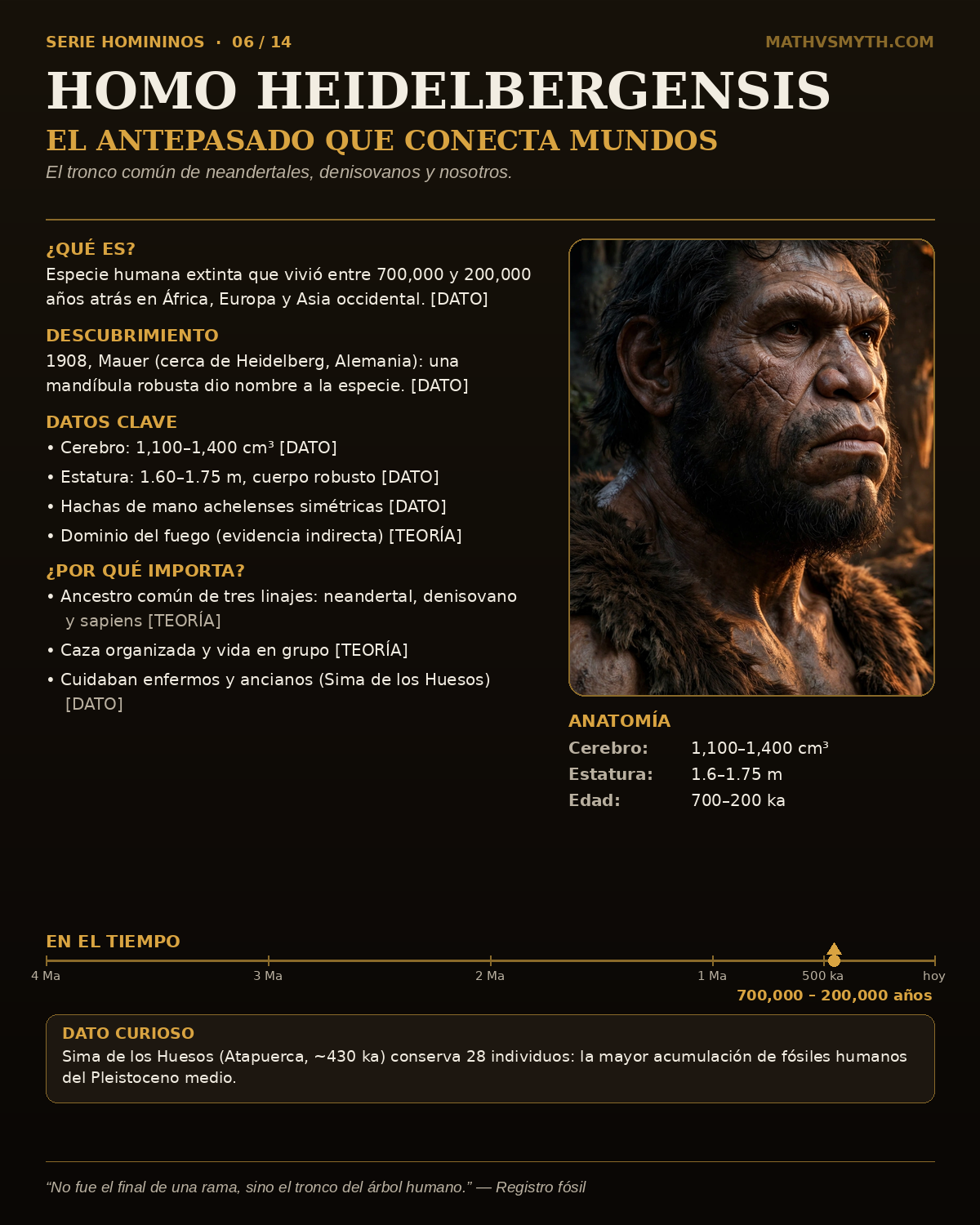
CARD 06 / 14
HOMO HEIDELBERGENSIS
The ancestor who connects worlds
The common trunk of Neanderthals, Denisovans and us.
What is it?
An extinct human species that lived between 700,000 and 200,000 years ago in Africa, Europe and western Asia. DATA
Discovery
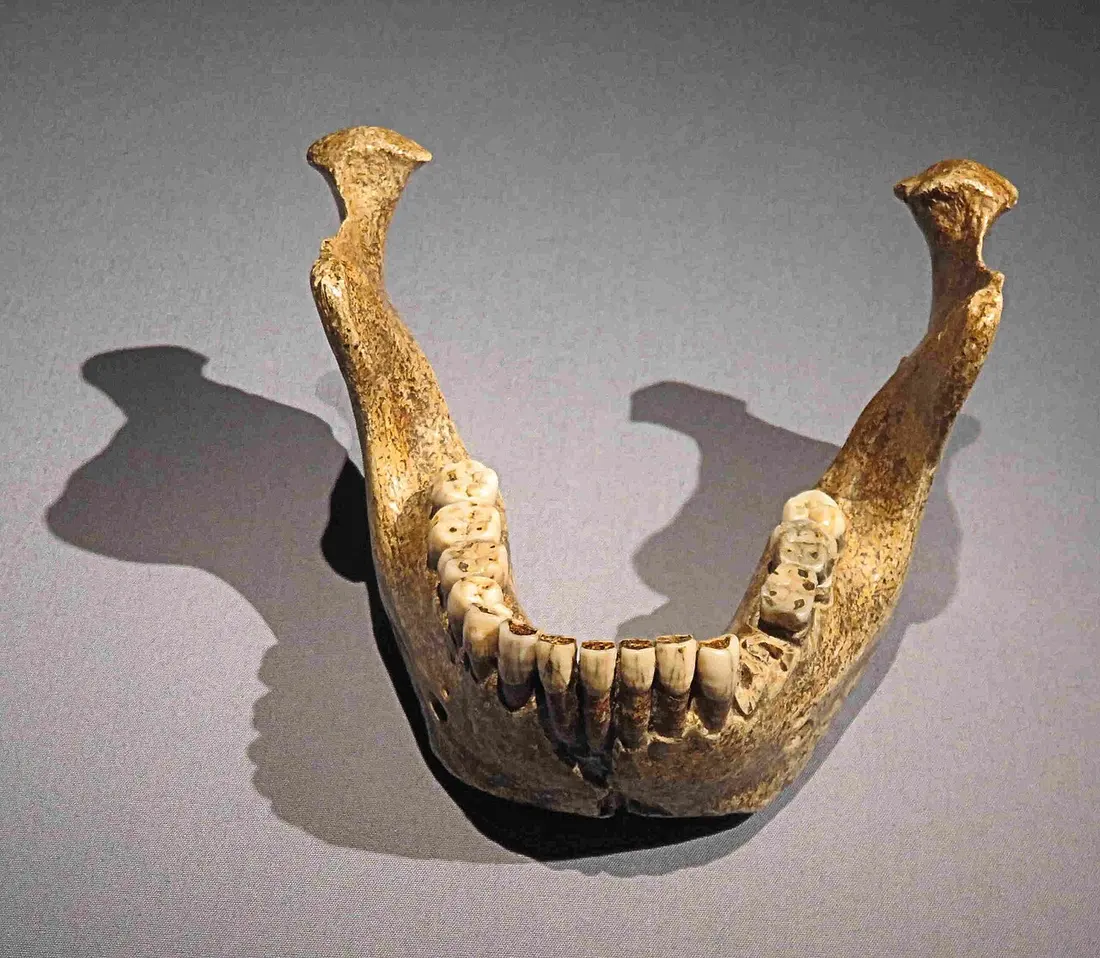
1908, Mauer (near Heidelberg, Germany): a robust mandible gave the species its name. DATA
The fossil — photograph of the actual remain
The Mauer mandible (Mauer 1): the holotype of the species — a massive jaw with no chin, and teeth already similar to ours. This is the original fossil, kept at the University of Heidelberg. Photo: Gerbil · CC BY 3.0, via Wikimedia Commons · photo from 2015.
Where it surfaced
Mauer, near Heidelberg (Germany), in a sand quarry by the Neckar River. On 21 October 1907, a quarry worker, Daniel Hartmann, dug it out with his shovel and set it aside; palaeontologist Otto Schoetensack described it in 1908 and used it to name Homo heidelbergensis. DATA
Its world
Continents: Africa, Europe and western Asia. The Mauer sand preserves warm-river fauna — hippopotamuses and rhinoceroses lived by the Neckar during an interglacial. DATA The current reconstruction: temperate riverine forests and clearings where groups of hunters with Acheulean hand axes followed the great herds. THEORY
Key facts
Brain: 1,100–1,400 cm³ DATA
Height: 1.60–1.75 m, robust body DATA
Symmetrical Acheulean hand axes DATA
Mastery of fire (indirect evidence) THEORY
Why it matters
Common ancestor of three lineages: Neanderthal, Denisovan and sapiens THEORY
Organised hunting and group life THEORY
They cared for the sick and the old (Sima de los Huesos) DATA
Anatomy
Brain1,100–1,400 cm³
Height1.6–1.75 m
Age700–200 ka
In time
4 Ma700,000 – 200,000 yearstoday
CURIOUS FACT — Sima de los Huesos (Atapuerca, ~430 ka) preserves 28 individuals: the largest accumulation of human fossils of the Middle Pleistocene.
It was not the end of a branch, but the trunk of the human tree.— Fossil record
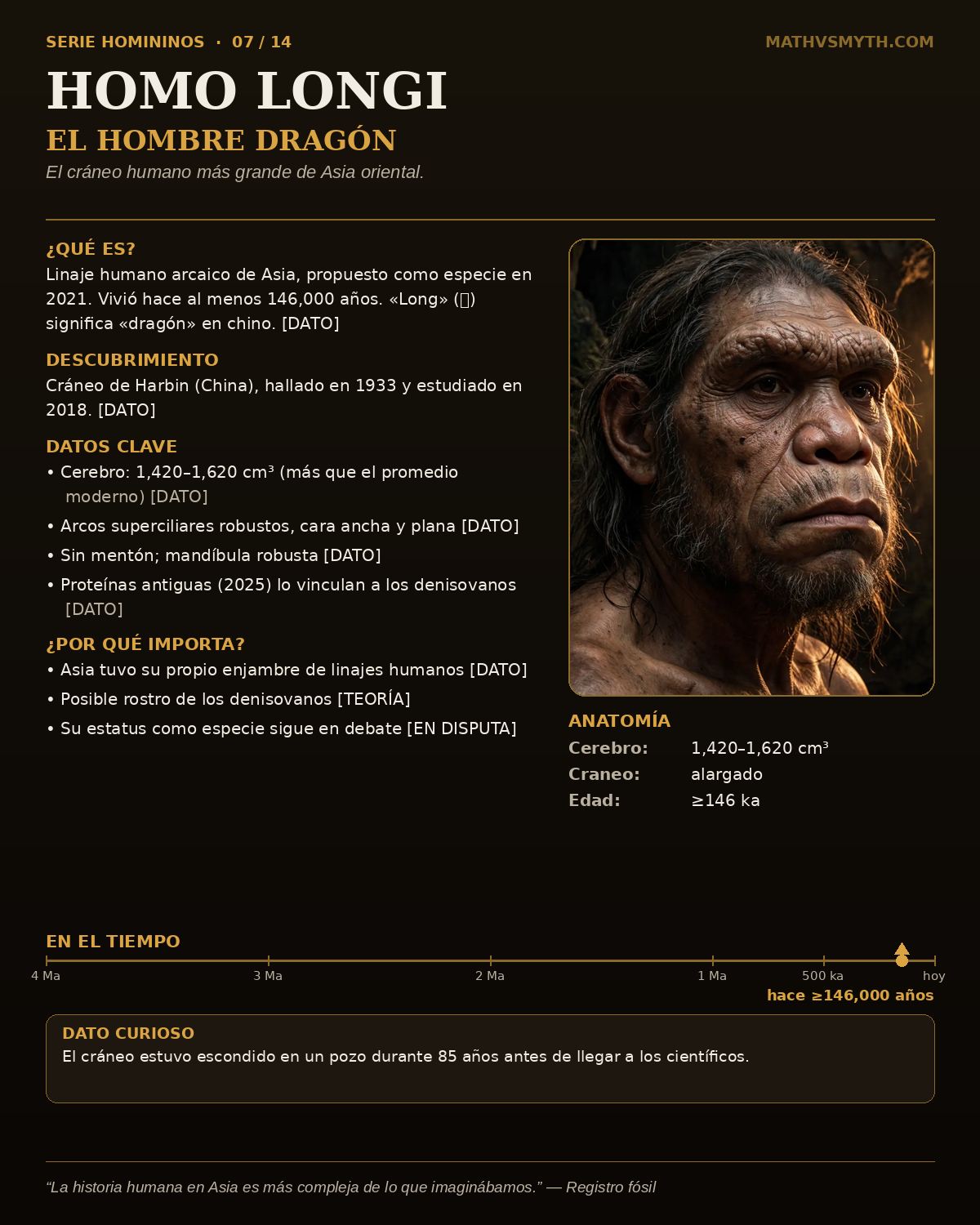
CARD 07 / 14
HOMO LONGI
The dragon man
The largest human cranium of East Asia.
What is it?
An archaic human lineage of Asia, proposed as a species in 2021. It lived at least 146,000 years ago. “Long” (龙) means “dragon” in Chinese. DATA
Discovery
Harbin cranium (China), found in 1933 and studied in 2018. DATA
The fossil — photograph of the actual remain
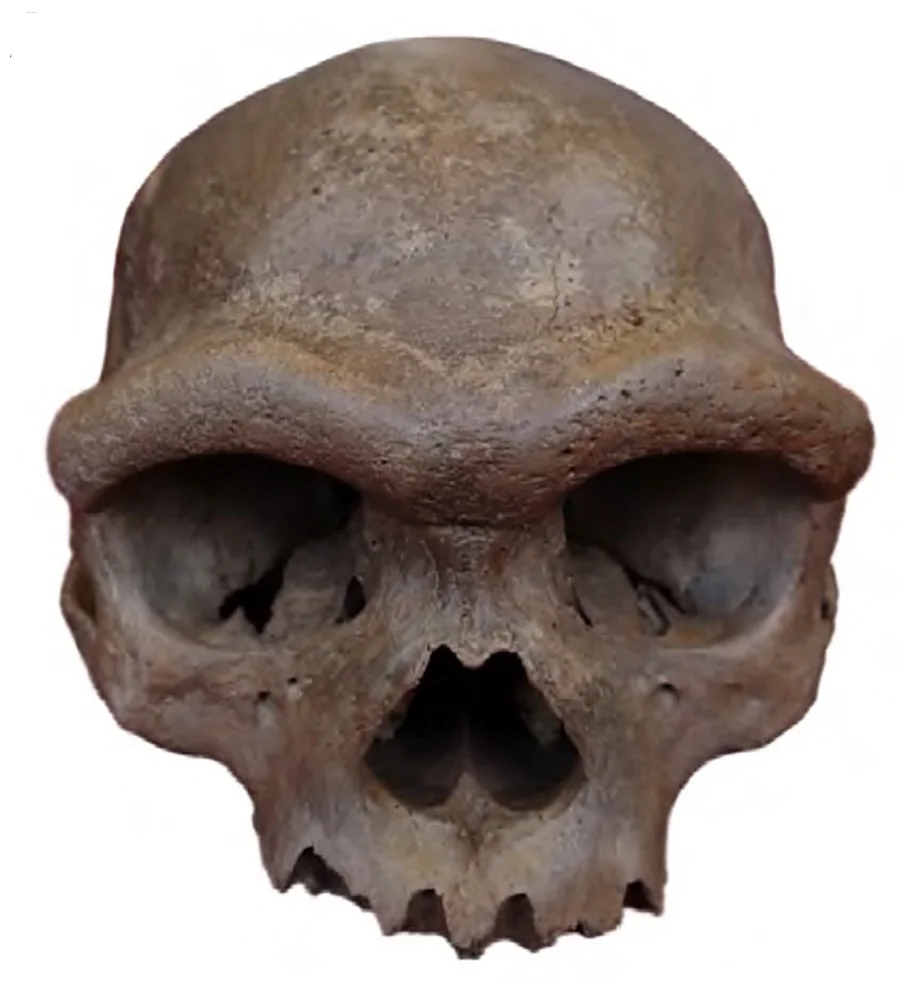
The Harbin cranium, holotype of Homo longi: one of the largest archaic human crania of East Asia, with its continuous brow ridge. This is the original fossil, in the photograph from the 2025 study that linked it by proteins to the Denisovans. Photo: Fu et al. (2025) · CC BY 4.0, via Wikimedia Commons · photo from 2025.
Where it surfaced
Harbin (Heilongjiang, China). In 1933, a labourer building a bridge over the Songhua River pulled out the cranium and, instead of handing it over, hid it in an abandoned well, where it stayed for 85 years; in 2018 it finally reached scientists, and in 2021 it received its name: Homo longi, the dragon man. DATA
Its world
Continent: East Asia, the cold end. The fauna of its time and region is that of the mammoth steppe — mammoths and woolly rhinoceroses. DATA The current reconstruction: cold, open plains beside great rivers, where a robust body and a large brain endured very long winters. THEORY
Key facts
Brain: 1,420–1,620 cm³ (more than the modern average) DATA
Robust brow ridges, broad and flat face DATA
No chin; robust mandible DATA
Ancient proteins (2025) link it to the Denisovans DATA
Why it matters
Asia had its own swarm of human lineages DATA
Possible face of the Denisovans THEORY
Its status as a species is still debated DISPUTED
Anatomy
Brain1,420–1,620 cm³
Skullelongated
Age≥146 ka
In time
4 Ma≥146,000 years agotoday
CURIOUS FACT — The cranium was hidden in a well for 85 years before reaching scientists.
The human story in Asia is more complex than we imagined.— Fossil record
CARD 08 / 14
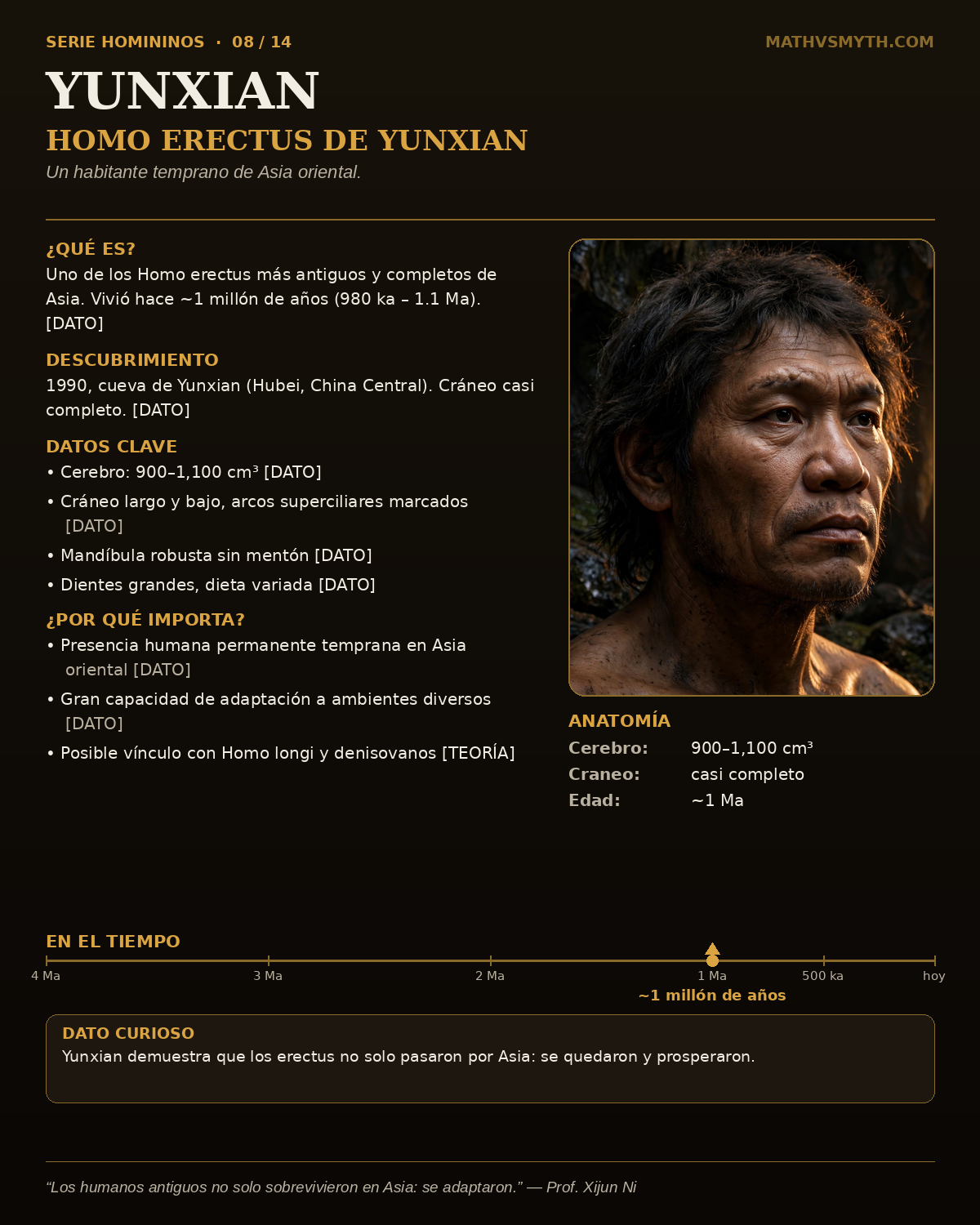
YUNXIAN
Homo erectus from Yunxian
An early inhabitant of East Asia.
What is it?
One of the oldest and most complete Homo erectus of Asia. It lived ~1 million years ago (980 ka – 1.1 Ma). DATA
Discovery
1990, Yunxian cave (Hubei, Central China). A nearly complete cranium. DATA
The fossil — photograph of the actual remain
Image wanted — a donation to knowledge: if you hold a freely licensed photograph of this fossil, this slot is waiting for it.
Where it surfaced
Yunxian (Hubei, central China), at the Xuetangliangzi site, on the terraces of the Han River. In 1989 and 1990 two nearly complete crania appeared (EV 9001 and EV 9002), deformed by the weight of the sediments; they are among the oldest erectus of East Asia. DATA
Its world
Continent: East Asia, temperate-subtropical zone. The fauna accompanying the crania at the site is warm forest and riverbank, very different from the cold steppe of northern China. DATA The current reconstruction: wooded river valleys where Asian erectus were no longer visitors: it was their permanent home. THEORY
Key facts
Brain: 900–1,100 cm³ DATA
Long, low cranium, marked brow ridges DATA
Robust mandible without chin DATA
Large teeth, varied diet DATA
Why it matters
Early permanent human presence in East Asia DATA
Great capacity to adapt to diverse environments DATA
Possible link with Homo longi and the Denisovans THEORY
Anatomy
Brain900–1,100 cm³
Skullnearly complete
Age~1 Ma
In time
4 Ma~1 million yearstoday
CURIOUS FACT — Yunxian shows that the erectus did not just pass through Asia: they stayed and prospered.
Ancient humans did not only survive in Asia: they adapted.— Prof. Xijun Ni
CARD 09 / 14
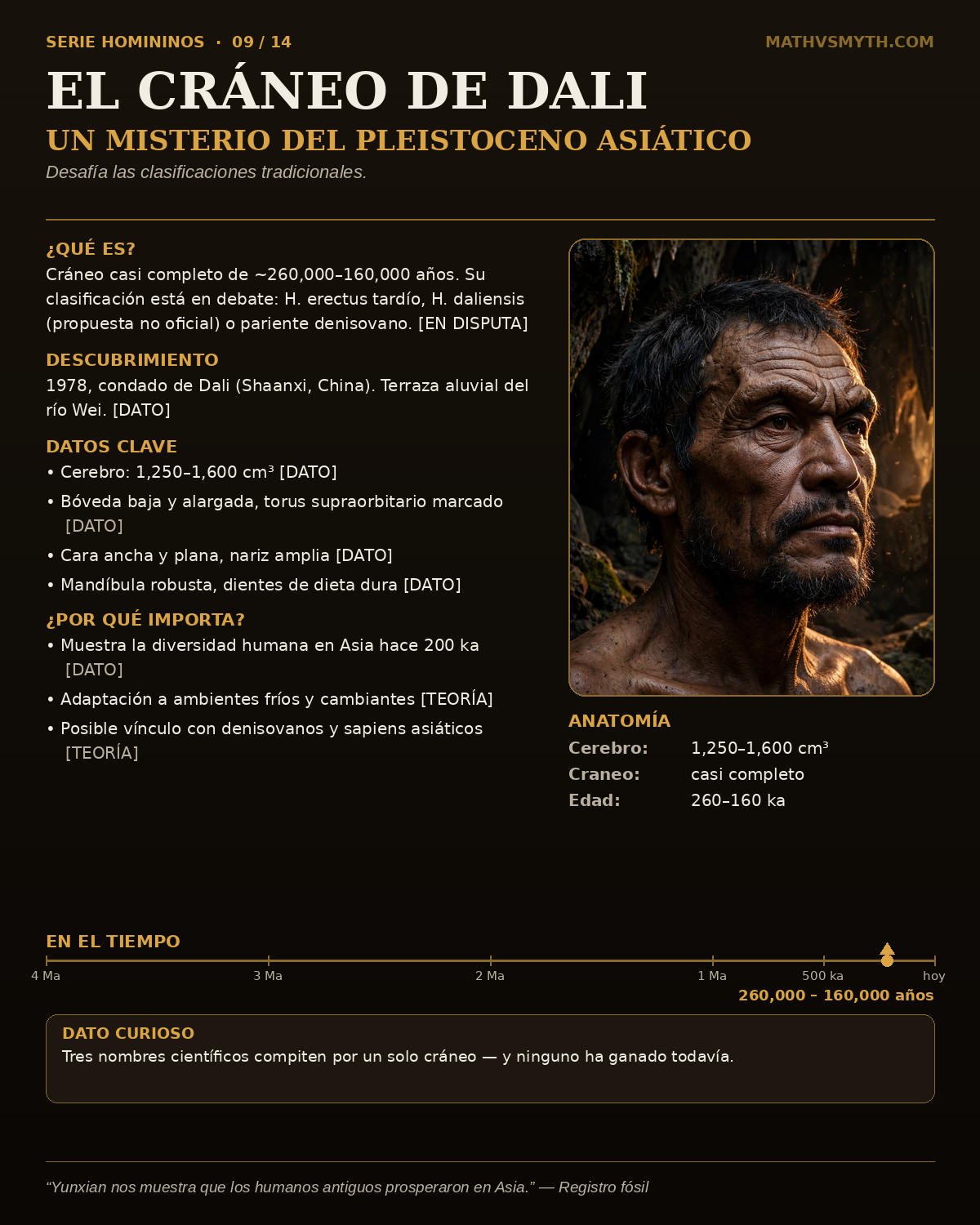
THE DALI SKULL
A mystery of the Asian Pleistocene
It defies the traditional classifications.
What is it?
A nearly complete cranium of ~260,000–160,000 years. Its classification is debated: late H. erectus, H. daliensis (unofficial proposal) or a Denisovan relative. DISPUTED
Discovery
1978, Dali County (Shaanxi, China). Alluvial terrace of the Wei River. DATA
The fossil — photograph of the actual remain
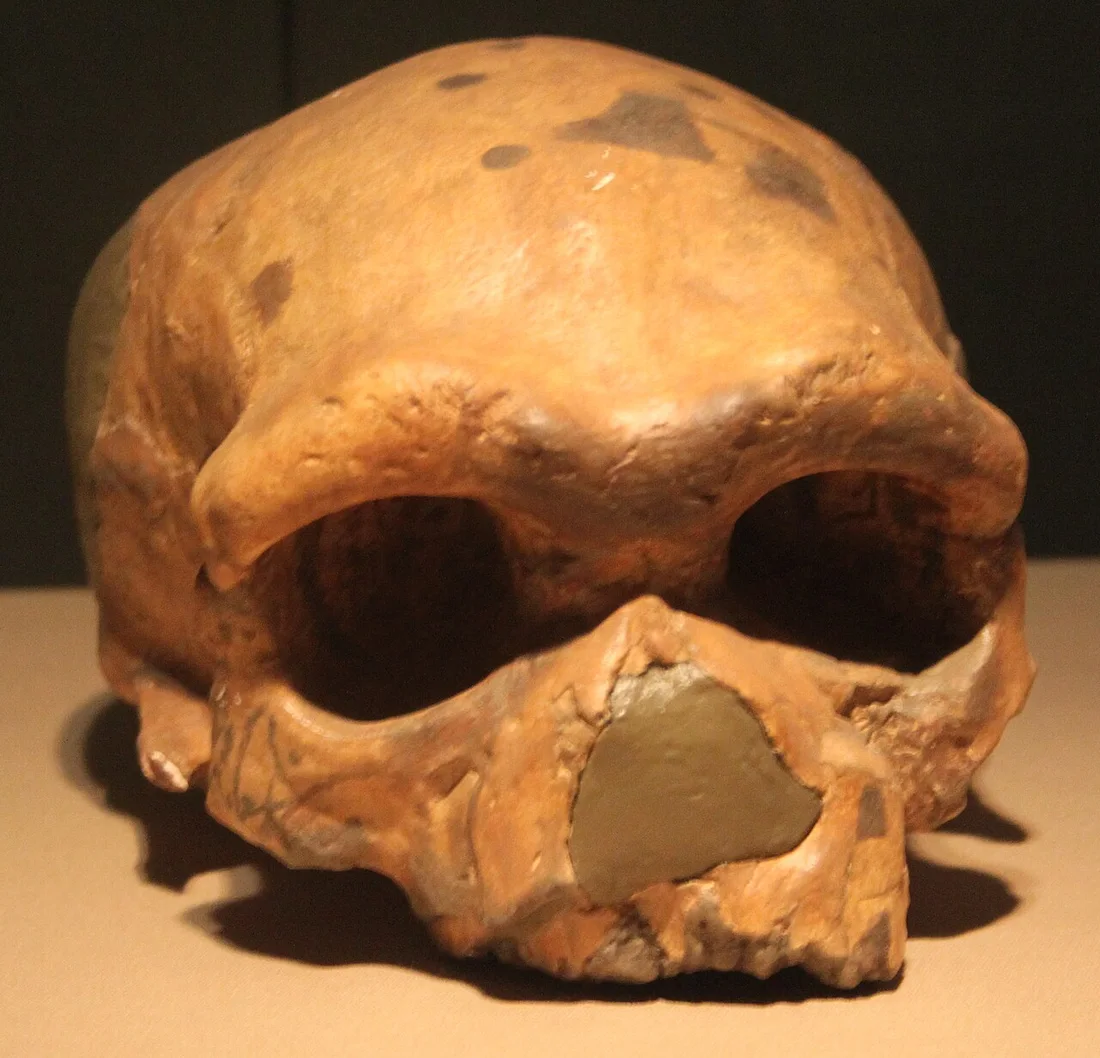
The Dali cranium: low, elongated vault, marked brow ridge and a broad, flat face. The photograph shows the replica exhibited at the Shaanxi History Museum (Xi'an); the original fossil is kept by the institute that curates it in China. Photo: Gary Todd · CC0 (public domain), via Wikimedia Commons · 2021.
Where it surfaced
Dali County (Shaanxi, China), by Jiefang village, on a river terrace. In 1978, geologist Liu Shuntang collected the cranium from the sediments; ever since, three scientific names have disputed it, and its classification is still open. DATA
Its world
Continent: East Asia. Dali lies at the edge of the loess plateau, between the Wei River plain and the Qinling Mountains; the fauna of its time mixes steppe and temperate-forest species. DATA The current reconstruction: a colder, drier climate than today, of shifting steppe-forest, to which this lineage was adapted. THEORY
Key facts
Brain: 1,250–1,600 cm³ DATA
Low, elongated vault, marked brow ridge DATA
Broad, flat face, wide nose DATA
Robust mandible, teeth for a hard diet DATA
Why it matters
It shows human diversity in Asia 200 ka ago DATA
Adaptation to cold, changing environments THEORY
Possible link with Denisovans and Asian sapiens THEORY
Anatomy
Brain1,250–1,600 cm³
Skullnearly complete
Age260–160 ka
In time
4 Ma260,000 – 160,000 yearstoday
CURIOUS FACT — Three scientific names compete for a single cranium — and none has won yet.
Yunxian shows us that ancient humans prospered in Asia.— Fossil record
CARD 10 / 14
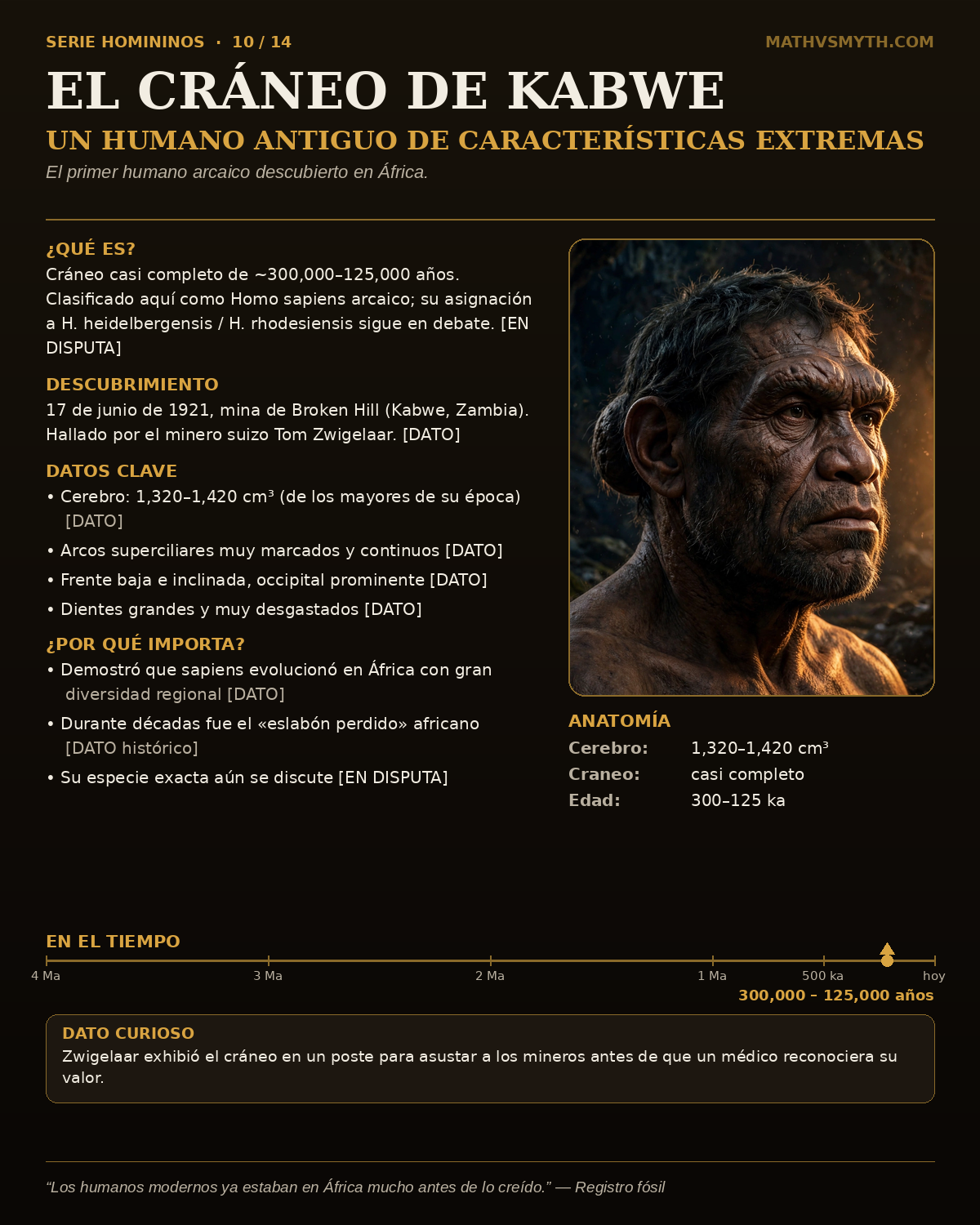
THE KABWE SKULL
An ancient human of extreme features
The first archaic human discovered in Africa.
What is it?
A nearly complete cranium of ~300,000–125,000 years. Classified here as archaic Homo sapiens; its assignment to H. heidelbergensis / H. rhodesiensis is still debated. DISPUTED
Discovery
17 June 1921, Broken Hill mine (Kabwe, Zambia). Found by the Swiss miner Tom Zwigelaar. DATA
The fossil — photograph of the actual remain
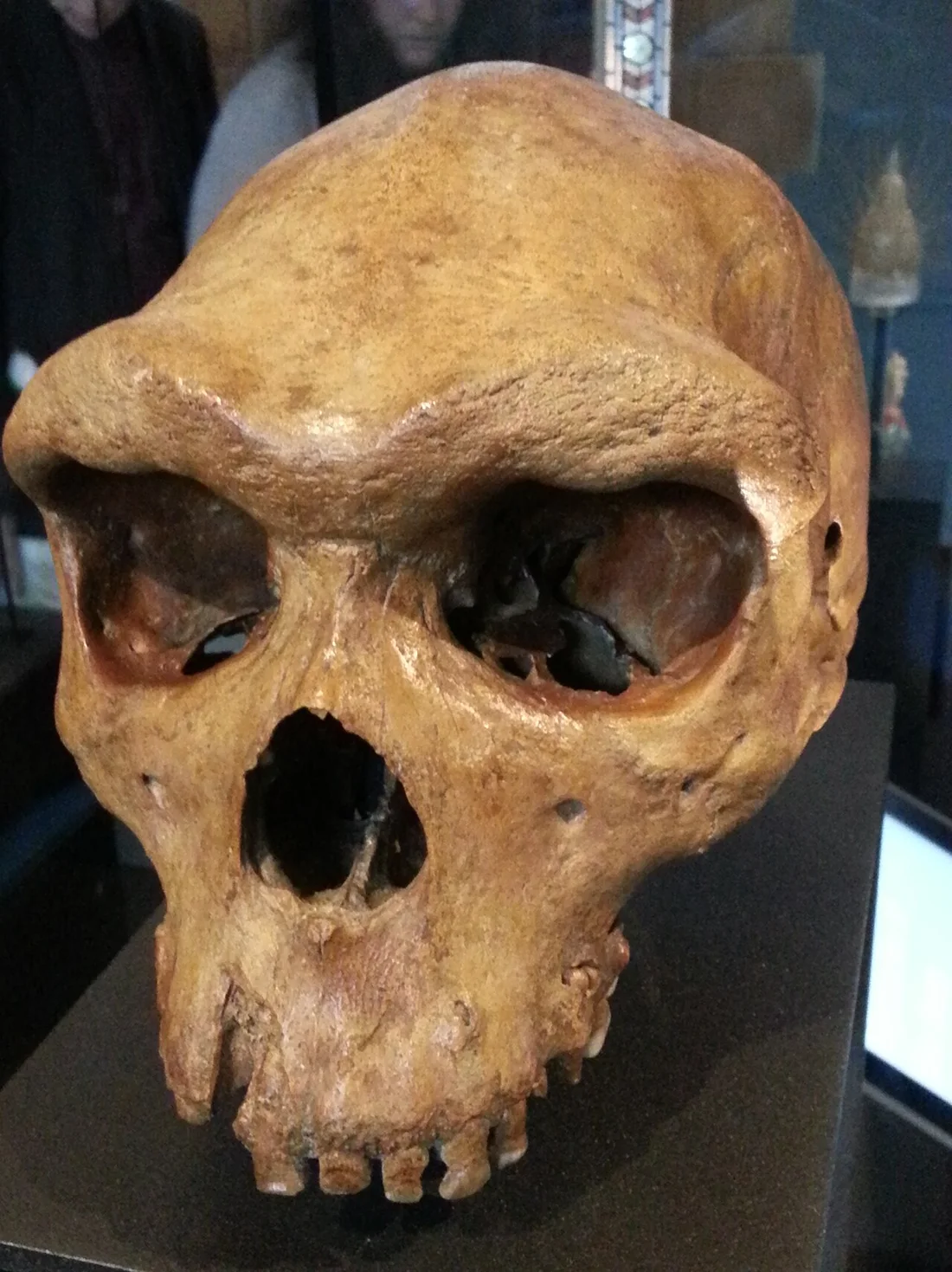
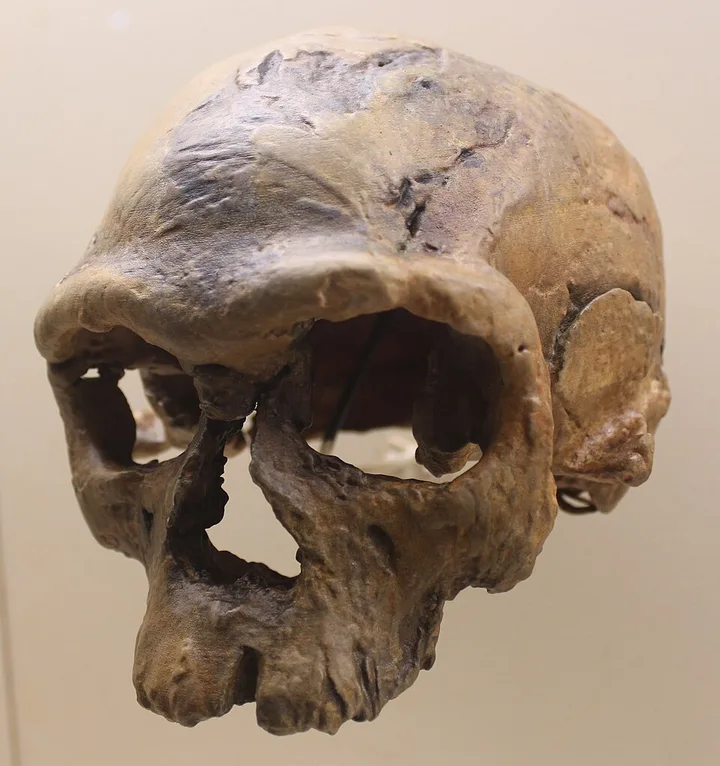
Kabwe 1, the “Broken Hill man”: the nearly complete cranium with the most marked brow ridges of its era. This is the original fossil, exhibited at the Natural History Museum in London. Photo: Jonathan Cardy · CC BY-SA 3.0, via Wikimedia Commons · photo from 2013.
Where it surfaced
Broken Hill mine, today's Kabwe (Zambia): a bone-filled cave inside the lead and zinc mine. On 17 June 1921, Swiss miner Tom Zwigelaar came upon the cranium; a doctor recognised its value, and the fossil travelled to London, where it is kept today. DATA
Its world
Continent: south-central Africa. The mine cave also preserved bones of the savanna fauna that surrounded it. DATA The current reconstruction: wooded savanna (miombo) with strongly marked seasons, where a human with an already large brain hunted and scavenged among great herbivores. THEORY
Key facts
Brain: 1,320–1,420 cm³ (among the largest of its era) DATA
Very marked, continuous brow ridges DATA
Low, sloping forehead, prominent occipital DATA
Large, heavily worn teeth DATA
Why it matters
It showed that sapiens evolved in Africa with great regional diversity DATA
For decades it was the African “missing link” — a historical label DATA
Its exact species is still discussed DISPUTED
Anatomy
Brain1,320–1,420 cm³
Skullnearly complete
Age300–125 ka
In time
4 Ma300,000 – 125,000 yearstoday
CURIOUS FACT — Zwigelaar displayed the cranium on a post to frighten the miners before a doctor recognised its value.
Modern humans were already in Africa far earlier than believed.— Fossil record
CARD 11 / 14
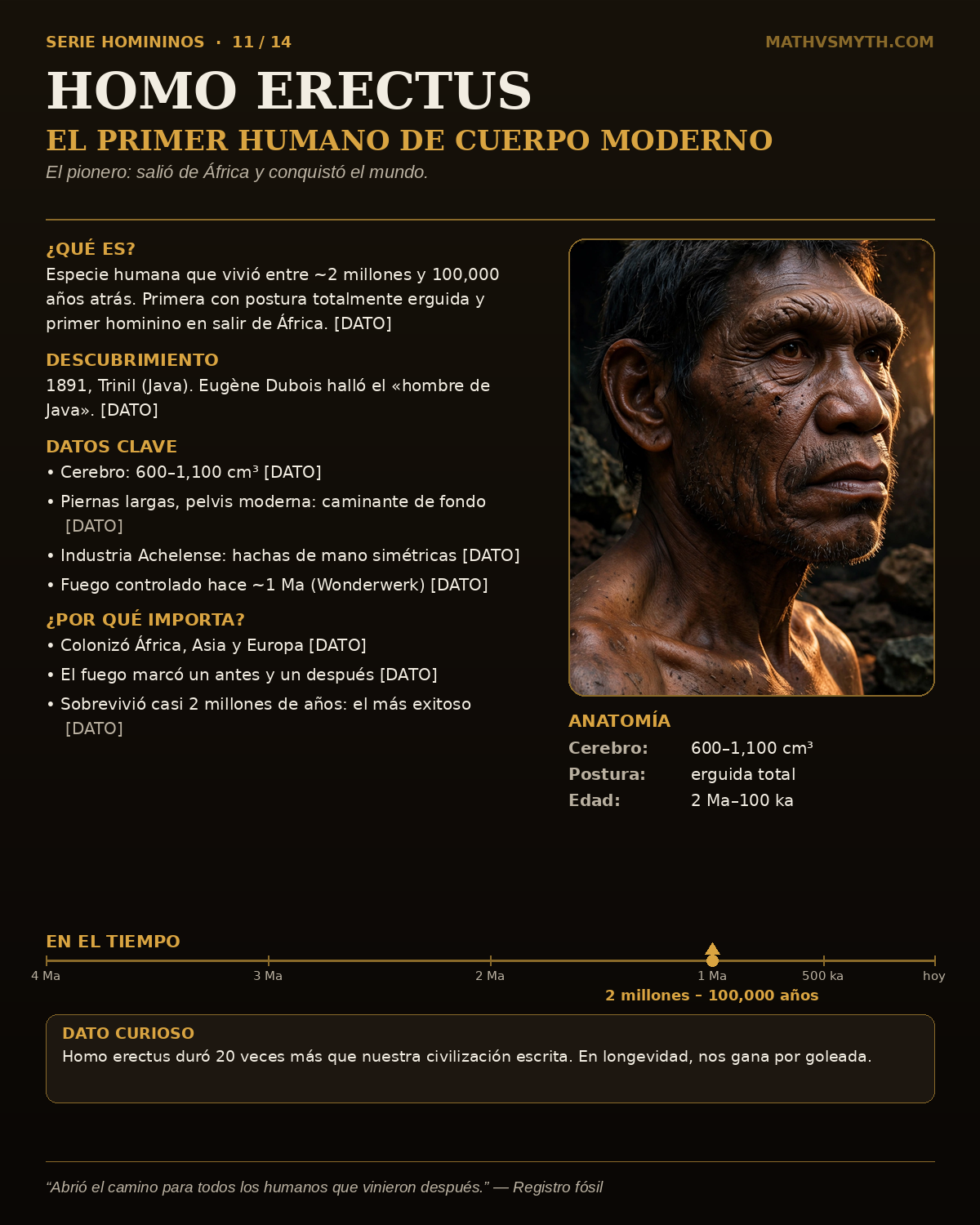
HOMO ERECTUS
The first human with a modern body
The pioneer: it left Africa and conquered the world.
What is it?
A human species that lived between ~2 million and 100,000 years ago. The first with a fully upright posture and the first hominin to leave Africa. DATA
Discovery
1891, Trinil (Java). Eugène Dubois found the “Java man”. DATA
The fossil — photograph of the actual remain
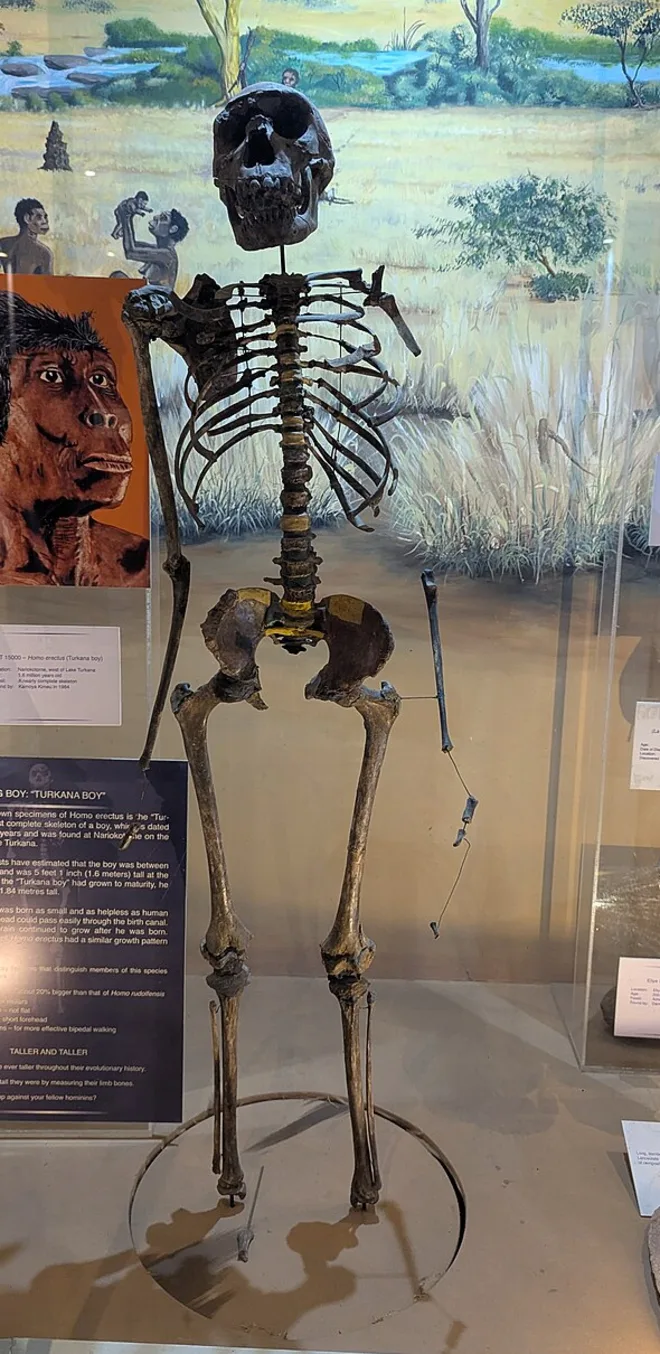
The Turkana Boy (KNM-WT 15000): the most complete Homo erectus skeleton in existence — a youth of ~1.6 million years ago, already with a modern body and a walker's legs. It is exhibited at the National Museum of Kenya (Nairobi), the institution that curates the fossil. Photo: ProtoplasmaKid · CC BY-SA 4.0, via Wikimedia Commons · photo from 2025.
Where it surfaced
Nariokotome, western shore of Lake Turkana (Kenya). In 1984, Kamoya Kimeu — the fossil finder of Richard Leakey and Alan Walker's team — spotted a cranial fragment on the surface; the excavation recovered almost the whole skeleton. The find that gave the species its name had happened nearly a century earlier, an ocean away: Trinil, on the island of Java (1891). DATA
Its world
Continents: Africa, Asia and Europe — the first to occupy three. DATA The Turkana Boy was buried in the sediments of the plain the lake flooded: he died beside the water. DATA The current reconstruction: ever more open, hot savannas, where a tall, narrow body with long legs serves to walk far under the sun and shed heat. THEORY
Key facts
Brain: 600–1,100 cm³ DATA
Long legs, modern pelvis: a long-distance walker DATA
Acheulean industry: symmetrical hand axes DATA
Controlled fire ~1 Ma ago (Wonderwerk) DATA
Why it matters
It colonised Africa, Asia and Europe DATA
Fire marked a before and an after DATA
It survived almost 2 million years: the most successful DATA
Anatomy
Brain600–1,100 cm³
Posturefully upright
Age2 Ma–100 ka
In time
4 Ma2 million – 100,000 yearstoday
CURIOUS FACT — Homo erectus lasted 20 times longer than our written civilisation. In longevity, it beats us by a landslide.
It opened the way for all the humans who came after.— Fossil record
CARD 12 / 14
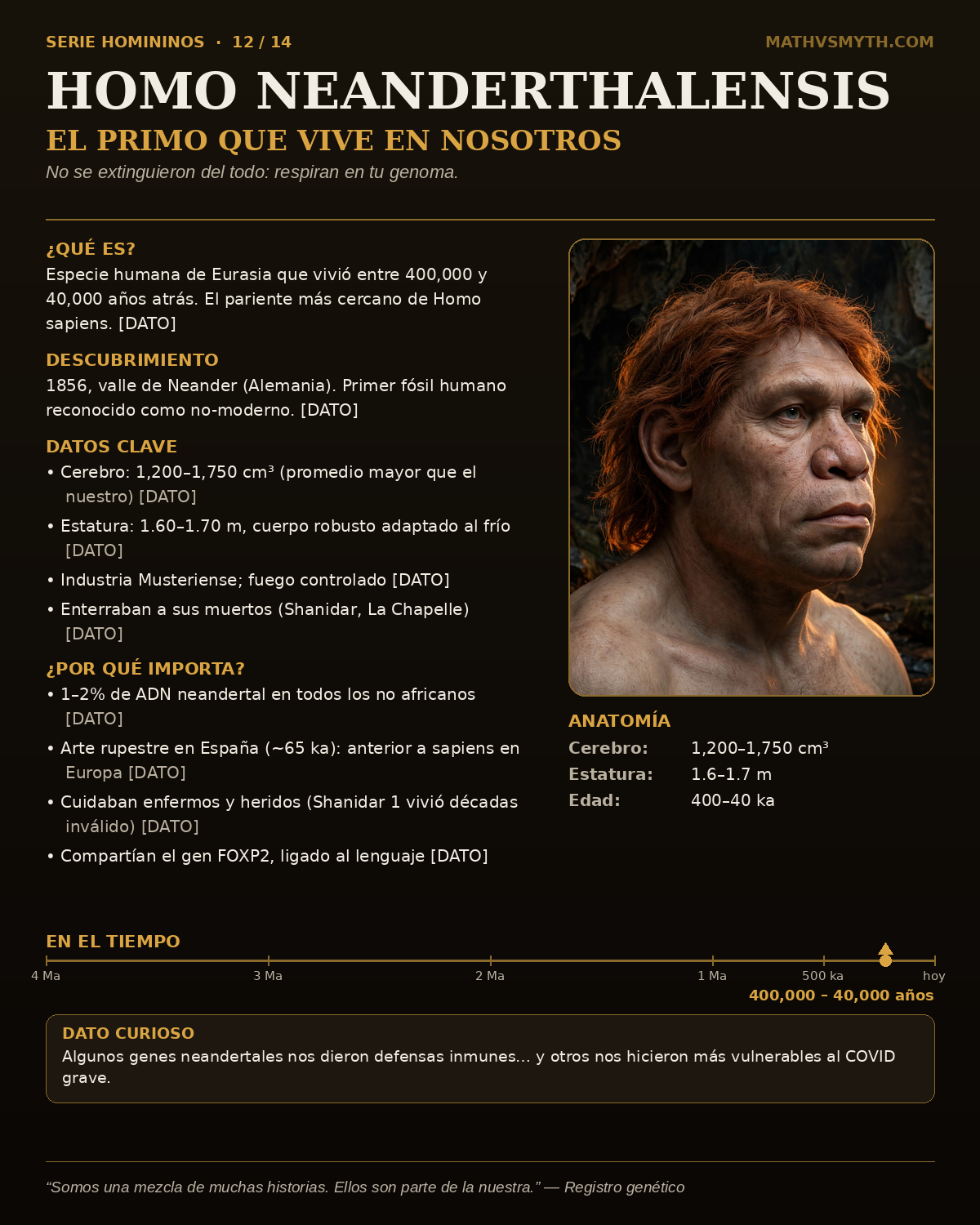
HOMO NEANDERTHALENSIS
The cousin who lives on in us
They did not go entirely extinct: they breathe in your genome.
What is it?
A human species of Eurasia that lived between 400,000 and 40,000 years ago. The closest relative of Homo sapiens. DATA
Discovery
1856, Neander Valley (Germany). The first human fossil recognised as non-modern. DATA
The fossil — photograph of the actual remain
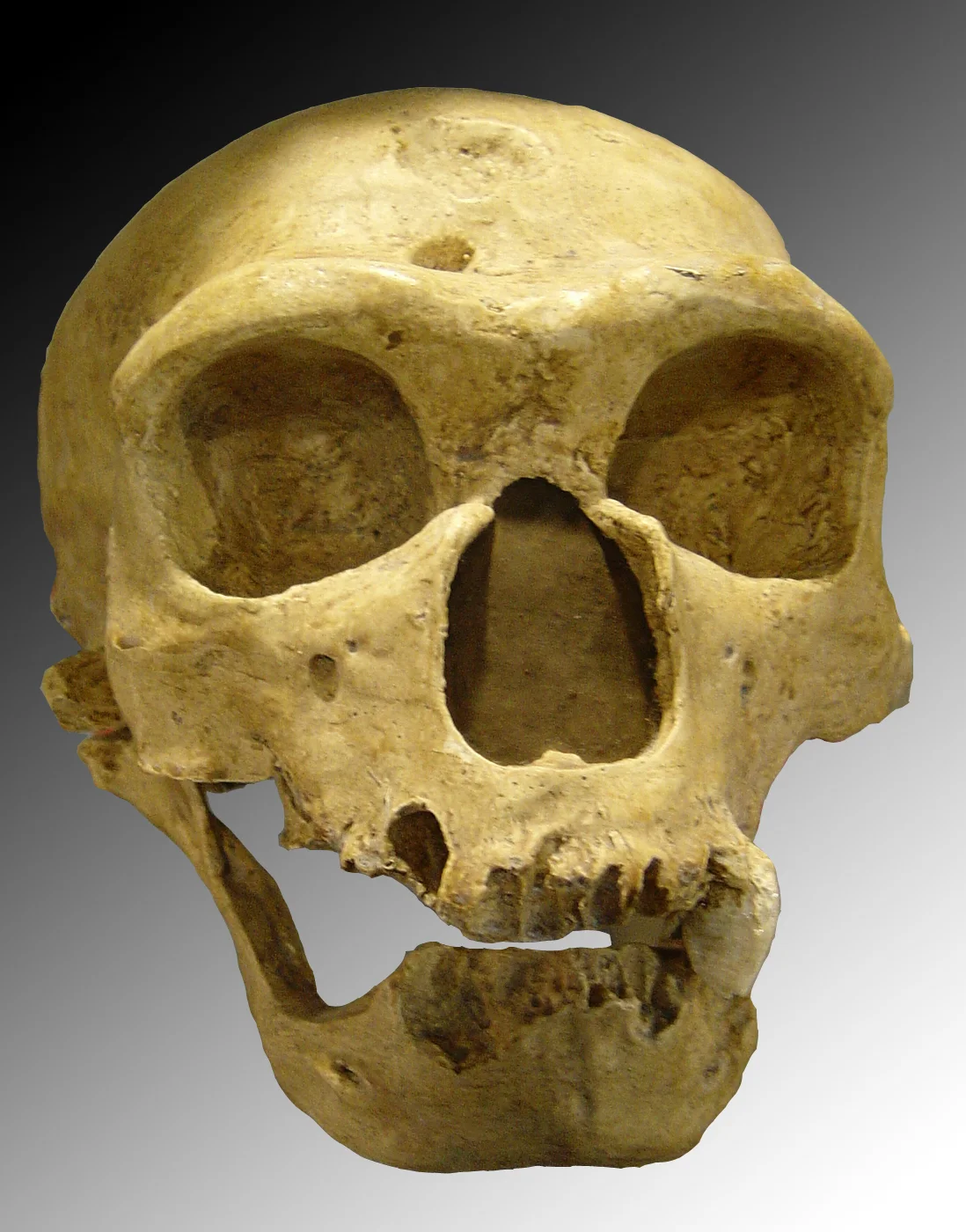
The La Chapelle-aux-Saints cranium: the “old man of La Chapelle”, the buried Neanderthal excavated in 1908 who fixed the species' image for a century. This is the original fossil, kept at the Musée de l'Homme (Paris). Photo: Luna04 · CC BY 2.5, via Wikimedia Commons · photo from 2005.
Where it surfaced
Neander Valley, near Düsseldorf (Germany). In August 1856, workers in a limestone quarry pulled a skullcap and bones from the Feldhofer Cave that were nearly discarded; schoolteacher Johann Carl Fuhlrott recognised them as an ancient human, and in 1864 the species received its name: Homo neanderthalensis. DATA
Its world
Continent: Eurasia, from Iberia to Siberia. Its fauna is that of the mammoth steppe: reindeer, bison and woolly rhinoceroses appear in the same sites. DATA The current reconstruction: a glacial world of cold steppes and wooded southern refuges, where low, broad bodies conserved heat — and where the injured were cared for over years. THEORY
Key facts
Brain: 1,200–1,750 cm³ (average larger than ours) DATA
Height: 1.60–1.70 m, robust cold-adapted body DATA
Mousterian industry; controlled fire DATA
They buried their dead (Shanidar, La Chapelle) DATA
Why it matters
1–2% Neanderthal DNA in all non-Africans DATA
Cave art in Spain (~65 ka): before sapiens in Europe DATA
They cared for the sick and injured (Shanidar 1 lived decades disabled) DATA
They shared the FOXP2 gene, linked to language DATA
Anatomy
Brain1,200–1,750 cm³
Height1.6–1.7 m
Age400–40 ka
In time
4 Ma400,000 – 40,000 yearstoday
CURIOUS FACT — Some Neanderthal genes gave us immune defences… and others made us more vulnerable to severe COVID.
We are a mixture of many stories. They are part of ours.— Genetic record
CARD 13 / 14
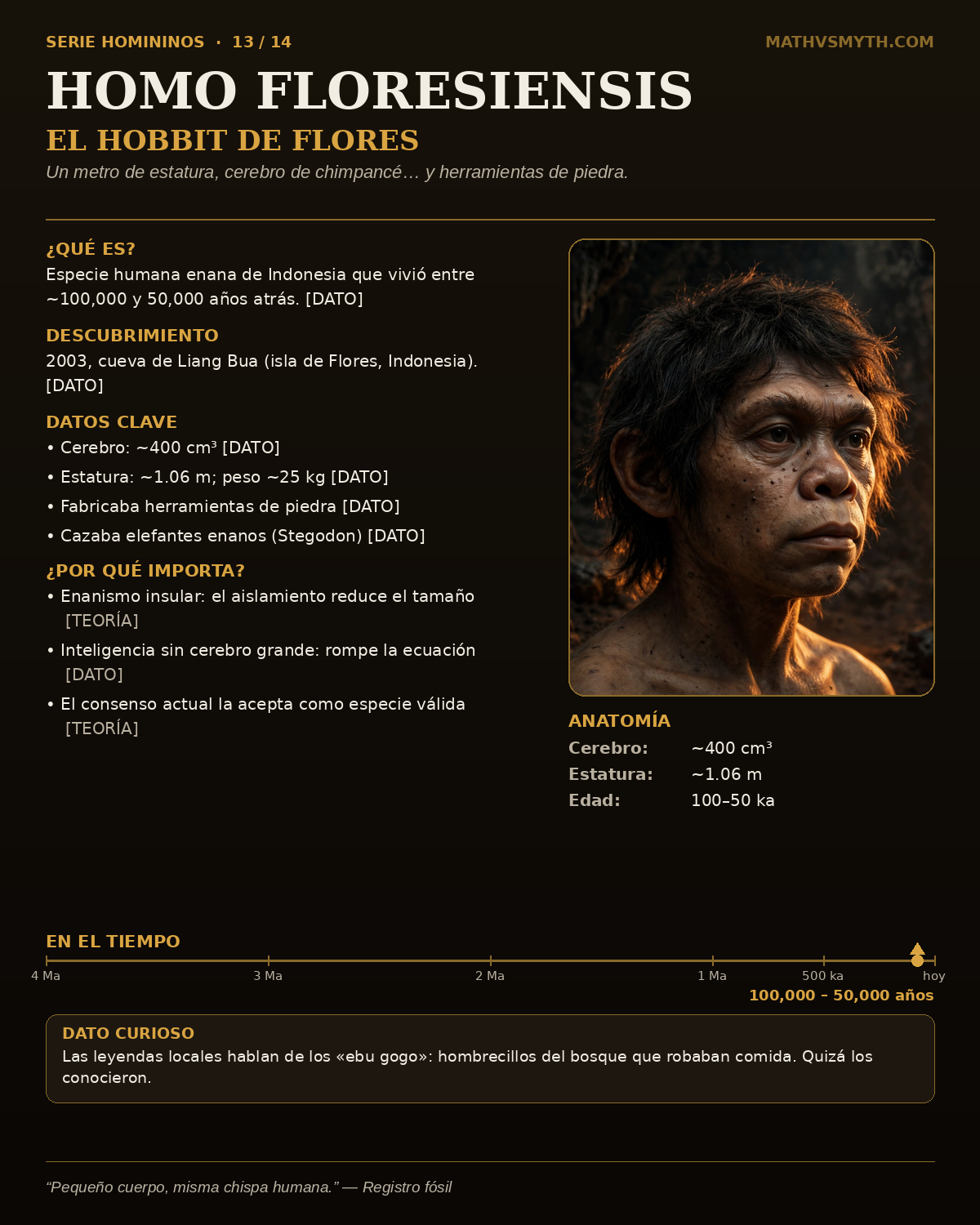
HOMO FLORESIENSIS
The hobbit of Flores
One metre tall, a chimpanzee's brain… and stone tools.
What is it?
A dwarf human species of Indonesia that lived between ~100,000 and 50,000 years ago. DATA
Discovery
2003, Liang Bua cave (island of Flores, Indonesia). DATA
The fossil — photograph of the actual remain
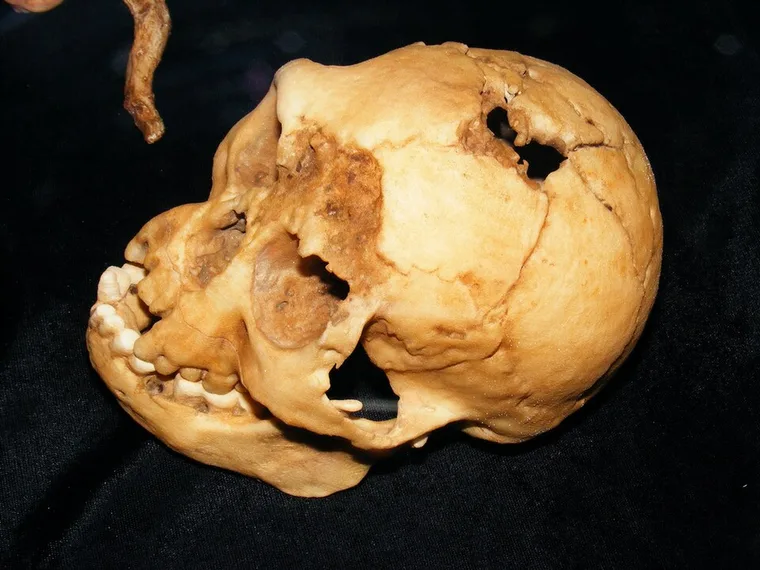
The LB1 cranium: the individual that defined the species — an adult female of ~1.06 m whose whole cranium fits in one hand, with a brain of ~400 cm³. The original fossil is kept in Indonesia; the photograph shows it as exhibited. Photo: Ray · CC BY-SA 2.0, via Wikimedia Commons · photo from 2009.
Where it surfaced
Liang Bua Cave, a limestone cavern in the interior of the island of Flores (Indonesia). In 2003, the joint Indonesian-Australian excavation of Mike Morwood and Peter Brown — with archaeologist Thomas Sutikna in the trench — unearthed, some 6 m down, the partial skeleton LB1: at first they thought it was a child, until the teeth said she was an adult. DATA
Its world
Continent: an island of Asia, isolated even when the sea was low — reaching it meant crossing water. Alongside its remains appear dwarf elephants (Stegodon), Komodo dragons, giant rats and stone tools. DATA The current reconstruction: a volcanic tropical island with no large continental carnivores, where isolation shrinks the big and enlarges the small — insular dwarfism. THEORY
Key facts
Brain: ~400 cm³ DATA
Height: ~1.06 m; weight ~25 kg DATA
It made stone tools DATA
It hunted dwarf elephants (Stegodon) DATA
Why it matters
Insular dwarfism: isolation reduces size THEORY
Intelligence without a big brain: it breaks the equation DATA
The current consensus accepts it as a valid species THEORY
Anatomy
Brain~400 cm³
Height~1.06 m
Age100–50 ka
In time
4 Ma100,000 – 50,000 yearstoday
CURIOUS FACT — Local legends speak of the “ebu gogo”: little forest people who stole food. Perhaps they knew them.
Small body, the same human spark.— Fossil record
CARD 14 / 14
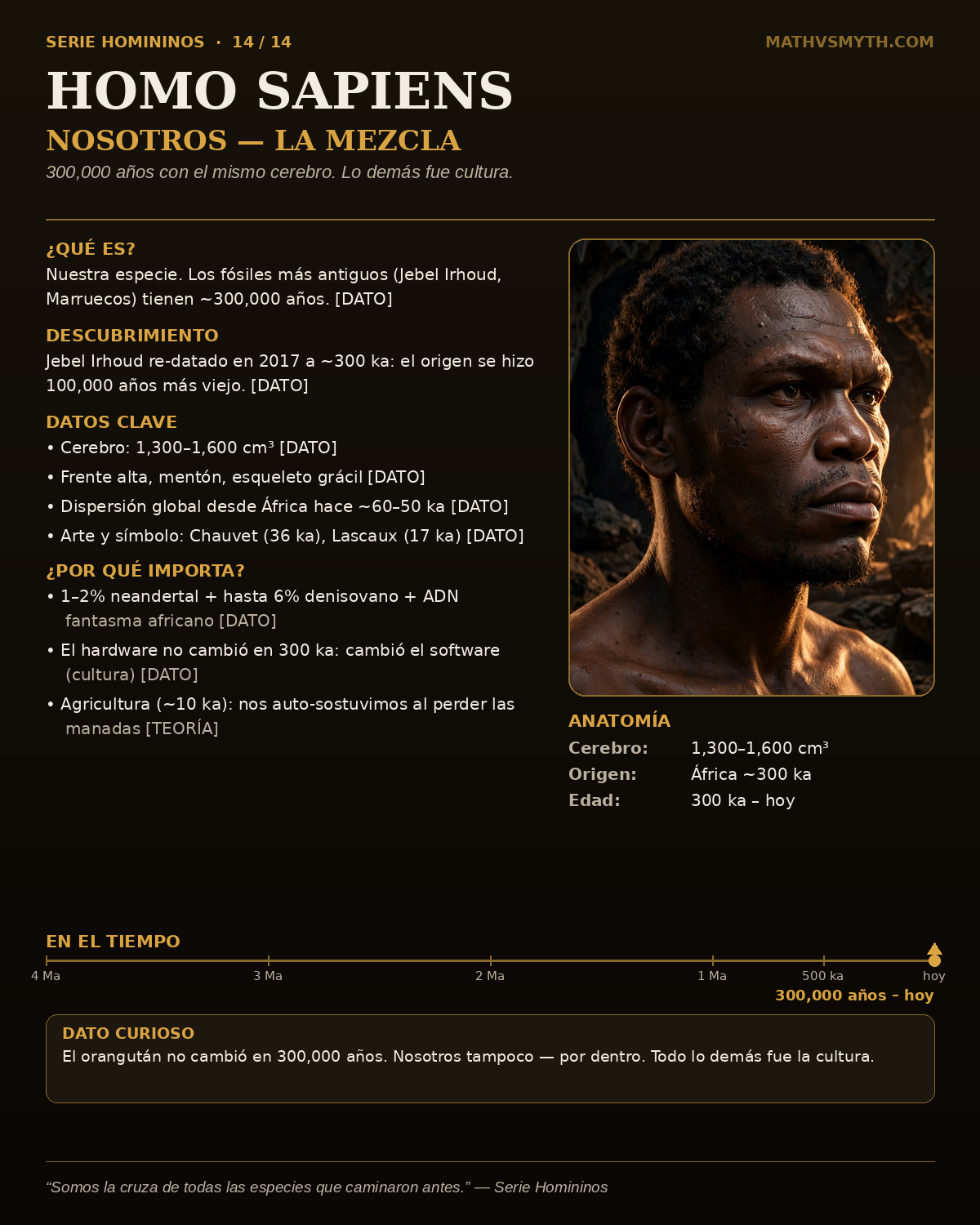
HOMO SAPIENS
Us — the mixture
300,000 years with the same brain. The rest was culture.
What is it?
Our species. The oldest fossils (Jebel Irhoud, Morocco) are ~300,000 years old. DATA
Discovery
Jebel Irhoud re-dated in 2017 to ~300 ka: our origin became 100,000 years older. DATA
The fossil — photograph of the actual remain
Jebel Irhoud 1: the nearly complete cranium of one of the earliest known Homo sapiens — an already modern face, a braincase still elongated, without today's roundness. The photograph shows the cast exhibited at the Smithsonian's National Museum of Natural History; the original fossil is kept in Morocco. Photo: Jonathan Chen · CC BY-SA 4.0, via Wikimedia Commons · photo from 2024.
Where it surfaced
Jebel Irhoud, near Safi (Morocco), in a barite mine. In 1961 miners extracted a nearly complete cranium (Irhoud 1) that spent decades classified as an African Neanderthal. In 2017, Jean-Jacques Hublin's team re-excavated the site, found more fossils and tools beside burned gazelle bones, and the re-dating took the assemblage to ~300,000 years. DATA
Its world
Continent: Africa — the whole of it, not a single corner. The Jebel Irhoud fauna (gazelles, wildebeest, zebras) is savanna, in what is today an arid plain. DATA The current reconstruction: ~300 ka ago a humid phase turned the Sahara green and connected the north with the rest of the continent; fossils of the same age exist in the east (Omo, Ethiopia) and the south (Florisbad, South Africa). Our origin was pan-African. THEORY
Key facts
Brain: 1,300–1,600 cm³ DATA
High forehead, chin, gracile skeleton DATA
Global dispersal from Africa ~60–50 ka ago DATA
Art and symbol: Chauvet (36 ka), Lascaux (17 ka) DATA
Why it matters
1–2% Neanderthal + up to 6% Denisovan + African ghost DNA DATA
The hardware did not change in 300 ka: the software did (culture) DATA
Agriculture (~10 ka): we sustained ourselves after losing the herds THEORY
Anatomy
Brain1,300–1,600 cm³
OriginAfrica ~300 ka
Age300 ka – today
In time
4 Ma300,000 years – todaytoday
CURIOUS FACT — The orangutan has not changed in 300,000 years. Neither have we — on the inside. Everything else was culture.
We are the crossing of all the species that walked before.— Hominins Series
Leave a datum, or come in to collaborate
Without joining the beta
You can also leave a datum without joining the beta. You leave it right here, on this page, with your name or with just an alias — no email. It can be a datum, a correction, or a better or newer fossil photograph: the Yunxian Man slot is still waiting for its own, and every image that comes in enters with the name of whoever brings it and with its date. And what you leave can be sealed right here, on the page, with its date: what was left, and when, stays fixed. The alias is your key: with it you can say, whenever you want to collaborate, that it was you.
Ask for your place in the beta
Joining is something else: it is for collaborating on an ongoing basis. MathvsMyth is in beta, and the beta is temporary; there are no profiles yet. Whoever wants to collaborate on an ongoing basis asks for their place in the beta and says what they bring — as a person, a laboratory, a university or a school. When profiles open, whoever came in will already have their name — or their alias — and their date inside.
 Mathvsmyth