The edge of the known: LUCA
LUCA has never been observed. It is not a fossil: it is an inference — the never-proven datum that holds up the whole tree. We include it and represent it just as science classifies it: theoretical to this day.
What we can verify Data
Everything alive shares almost the same genetic code, the same base amino acids, the same energy currency (ATP) and the same machinery (ribosomes, DNA→RNA→protein). That universal coincidence can only be explained if everything descends from a single common ancestor: LUCA (Last Universal Common Ancestor).
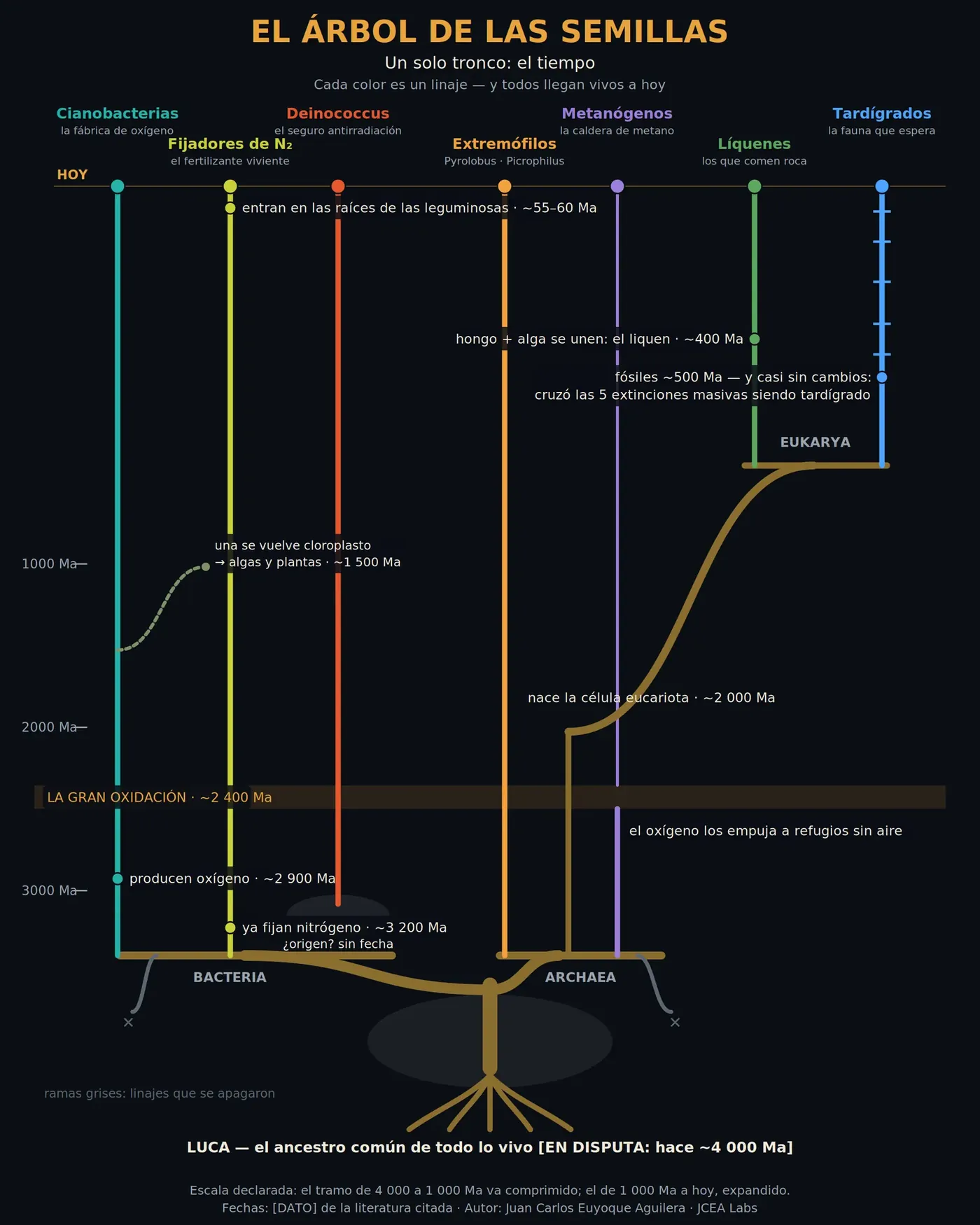
By comparing genomes, traits are reconstructed for it: it was a cell with a DNA genome; the study by Weiss et al. 2016 (Nature Microbiology) traced ~355 gene families back to it and depicts it as anaerobic, dependent on H2, fixing CO2 via the Wood-Ljungdahl pathway.
What is still under investigation In dispute Theory
Its date: molecular clock estimates place it at around ~4,200 Ma (range 4,090–4,330 Ma) — Moody et al. 2024, Nature Ecology & Evolution — already surprisingly complex, with a genome of at least 2.5 Mb and even an early immune system; the exact date is debated.
Its home: the favourite theory is the hydrothermal vents Theory.
The finest question: whether it was one being or a population that exchanged genes — with horizontal transfer, «LUCA» may have been a community, not an individual In dispute.
Its face: unknown; any drawing of LUCA is imagination and must say so.
In our tree, LUCA is placed in fog on purpose: the fog is not a decoration, it is the exact form of what we know — the order of the branches, yes; the face, no.
This card remains open. Perhaps in ten years someone will find it, refute it or a new name will arise for it: that day, this page will be corrected with a date and with the name of whoever brought it. What can be proven, and what is still under investigation: that is MathvsMyth.
What is known, and what remains open
Everything above is what is known on Earth: seven lineages with a date, a face and living descendants, and an inferred ancestor at the base. That is the firm ground of this page.
This piece walks on three floors: what we know — the dated terrestrial record —; what we propose it was — the theoretical reconstructions of the past: the traits of LUCA, the young worlds —; and what we might possibly find in our neighbourhood — Mars and Venus today, with the question still open.
Third floor — what we might possibly find in our neighbourhood
[THEORIZED · UNDER INVESTIGATION]
This is not ours: they are questions theorized by the scientific community, and each one carries its citation. The two works of this house go separately, below.
Mars
Martian life is not proven — neither present nor past. What there is: the seasonal methane, measured and disputed (its origin, geological or biological?, remains unsettled); the subsurface as a possible refuge where radiation does not reach; and the samples that the Perseverance rover has sealed in tubes, awaiting being brought to Earth.
State: under active investigation.
Citations: the seasonal methane was measured by the TLS instrument (tunable laser spectrometer) of the SAM laboratory aboard the Curiosity rover — Webster et al., 2018, Science —; the dispute arises from the upper limits of the ExoMars/TGO orbiter (ESA), which does not detect it — Korablev et al., 2019, Nature. The samples in tubes: Mars 2020 / Perseverance mission (NASA).
Venus
Nor is there proven life. What there is: the phosphine signal of 2020, which remains unsettled — neither confirmed nor fully refuted [IN DISPUTE]: later campaigns have again found candidate signals at low abundance, without independent confirmation; the cloud layer at 50–60 km as the least hostile theorized niche; and three missions in preparation that will measure the planet in the next decade: DAVINCI (NASA, target launch December 2030, with a descent probe), VERITAS (NASA, target November 2032) and EnVision (ESA, 2032).
State: under active investigation.
Citations: the phosphine signal — Greaves et al., 2020, Nature Astronomy —; the later dispute: Snellen et al., 2020, Astronomy & Astrophysics (reanalysis of the ALMA data) and Villanueva et al., 2021, Nature Astronomy, with later candidate signals from the JCMT-Venus programme, without consensus. The cloud niche and the missions: official fact sheets of the agencies — NASA (DAVINCI and VERITAS) and ESA (EnVision).
What is ours
In this same house, two sealed works work on those questions with their numbers and their method: Mars Core Reboot (the reboot of the core of Mars) and La Custodia de Venus (its thermal regulation). They are theorized studies of this house, not data: they go marked as such and are corrected with a date, like everything here.
What can be proven, and what is still under investigation. That is MathvsMyth.
This page remains open to the collaboration of whoever has a datum. Whoever contributes a datum, a correction or a measurement enters with their name and their date, as the house works.
Collaborate with an updated image
This page does not only await the missing image: it also receives the better or newer image of any of its beings, from whoever it comes — a person, a laboratory, a university, a school. Every image that enters, enters with the name of whoever brings it and with its date: that is the guarantee of the house. Joining this page is joining a mutual and social knowledge: what is corrected or improved here remains with its author and its day, for everyone.
Leave a datum, or join in collaborating
Without entering the beta
You can also leave a datum without entering the beta. You leave it right here, on this page, with your name or only with an alias — without email. And what you leave can be sealed right here, on the page, with its date: it remains fixed what was left and when. The alias is your key: with it you will be able to say, when you want to collaborate, that it was you.
Request your place in the beta
Entering is something else: it is for collaborating continuously. MathvsMyth is in beta, and the beta is temporary; there are no profiles yet. Whoever wants to collaborate continuously requests their place in the beta and says what they bring — as a person, laboratory, university or school. When the profiles open, whoever entered will already have their name — or their alias — and their date inside.
Request my place in the beta
 Mathvsmyth