 Mathvsmyth
Solar System Moons Series
Moon
Our closest neighbor: the only world humanity has walked on.
Author: Juan Carlos Euyoque Aguilera · October 7, 2026 · CC BY 4.0
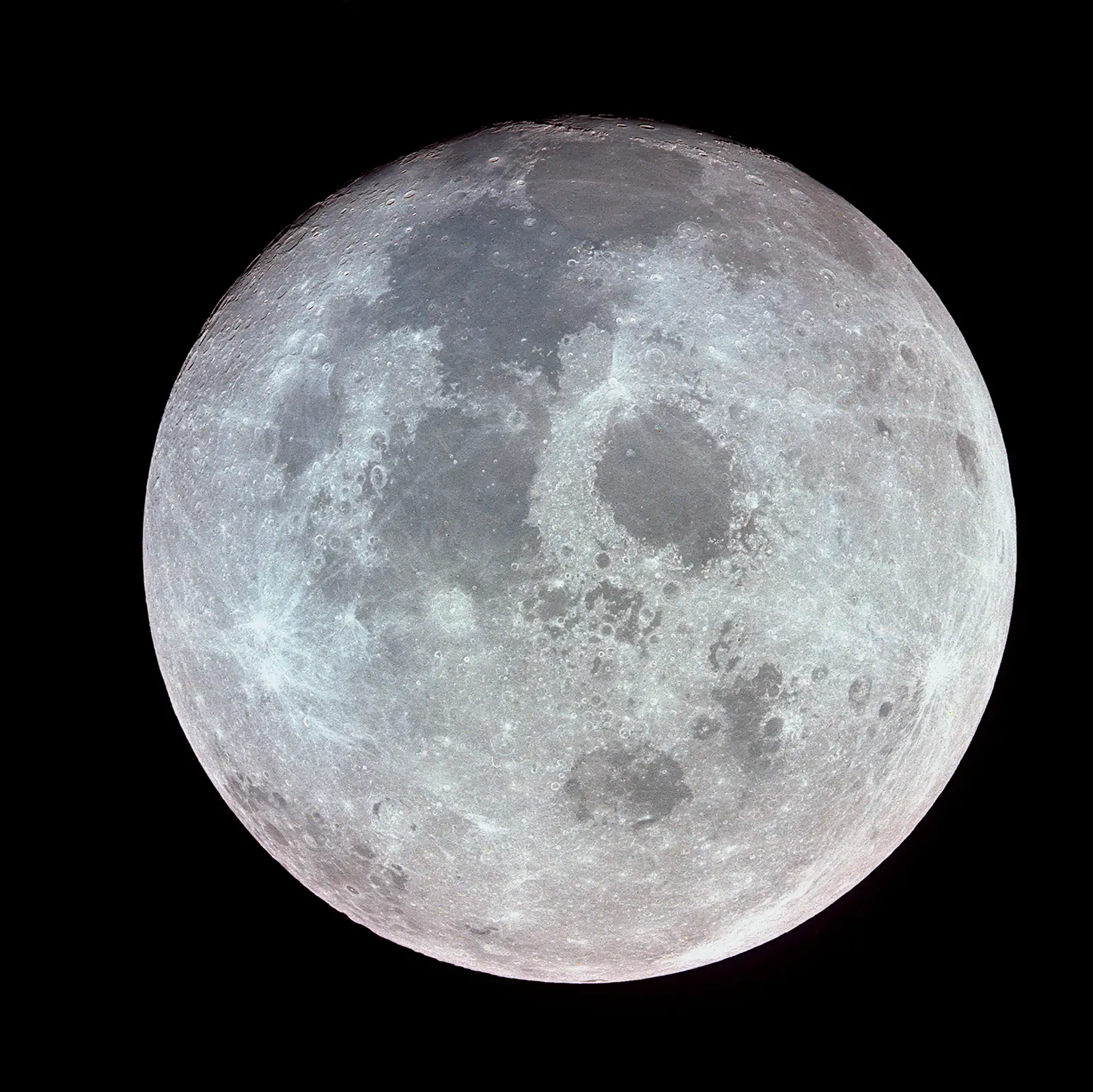
The Moon orbits Earth at 384,400 km and is the fifth-largest satellite in the solar system, 3,474.8 km across. Twelve astronauts walked its surface between 1969 and 1972, and its rocks —brought back by the Apollo missions— calibrated the age of the entire inner solar system.
With no atmosphere to shield it, its surface preserves an intact record of 4 billion years of impacts. And it is moving away: laser ranging shows it receding 3.8 cm every year.
Measured data [DATO]
| Data | Value | Status | Source |
|---|---|---|---|
| Diameter | 3,474.8 km | [DATO] observado | NASA Moon Fact Sheet |
| Mass | 7.346×10²² kg | [DATO] observado | NASA Moon Fact Sheet |
| Mean density | 3,344 kg/m³ | [DATO] observado | NASA Moon Fact Sheet |
| Surface gravity | 1.62 m/s² | [DATO] observado | NASA Moon Fact Sheet |
| Orbital period | 27.3217 days | [DATO] observado | NASA Moon Fact Sheet |
| Rotation period | 655.720 hrs (27.32 days, synchronous) | [DATO] observado | NASA Moon Fact Sheet |
| Distance from Earth | 384,400 km (semimajor axis) | [DATO] observado | NASA Moon Fact Sheet |
| Temperature | mean −20 °C (equatorial range: 95–390 K) | [DATO] observado | NASA Moon Fact Sheet |
| Atmosphere | Tenuous exosphere: 3×10⁻¹⁵ bar (night) | [DATO] observado | NASA Moon Fact Sheet |
| Notable feature | Receding 3.8 cm/yr (laser ranging) | [DATO] observado | NASA Moon Fact Sheet |
Truths [DATO]
- [DATO] The Moon does rotate: it spins once every 27.32 days, exactly its orbital period — which is why we always see the same face (synchronous rotation).
- [DATO] Twelve people walked on the Moon (Apollo 11, 12, 14, 15, 16 and 17, 1969–1972); their 382 kg of samples are still being dated today.
- [DATO] The leading hypothesis for its origin is the giant impact: a Mars-sized body struck the early Earth ~4.5 billion years ago.
- [DATO] There is water ice in permanently shadowed polar craters, confirmed by several missions (LCROSS, LRO, Chandrayaan-1).
Labeled myths [MITO]
[MITO] The Moon does not rotate.
False: it rotates every 27.32 days (655.720 hours, measured). Its rotation is synchronized with its orbit, which is why we always see the same face.
Fuente: NASA Moon Fact Sheet
[MITO] The dark side of the Moon never gets sunlight.
False: the far side gets as much sunlight as the near side over the lunar month; 'dark' meant 'unknown' before the Luna 3 probe photographed it in 1959.
Fuente: NASA Science
Open questions [PREGUNTA]
- [PREGUNTA] How much water ice is really at the lunar poles, and is it extractable?
- [PREGUNTA] Does the giant impact tell the whole origin story, or are pieces missing?
- [PREGUNTA] How old exactly are the youngest lunar maria?