 Mathvsmyth
Solar System Moons Series
Io
The most volcanic world in the solar system: a sulfur hell kneaded by Jupiter.
Author: Juan Carlos Euyoque Aguilera · October 7, 2026 · CC BY 4.0
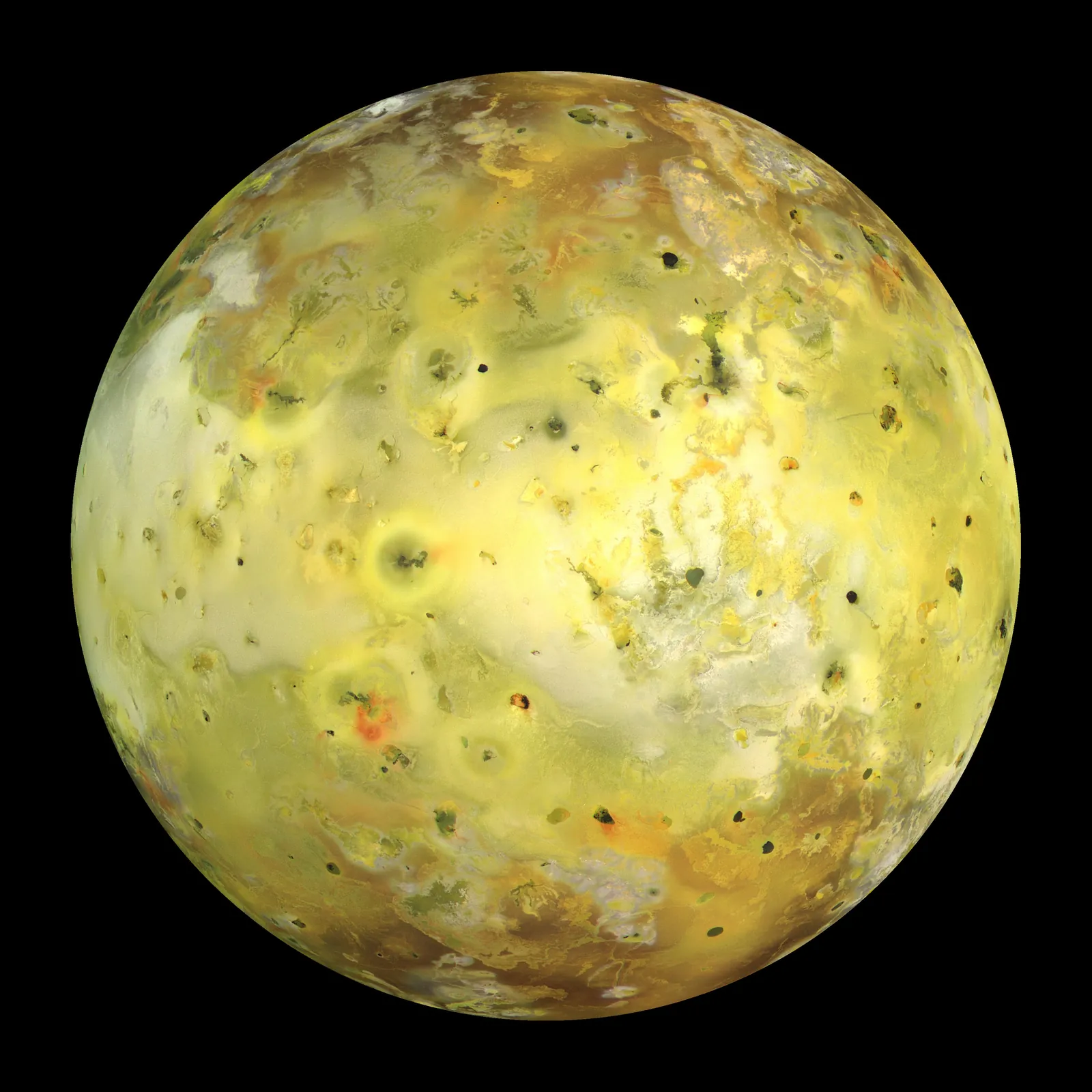
Io, the innermost Galilean moon, orbits Jupiter at 421,700 km. The giant's gravity squeezes and stretches it on every 1.769-day orbit, and that internal friction —tidal heating— made it the most volcanically active body in the solar system: over 400 active volcanoes.
Its yellow surface is sulfur and sulfur dioxide thrown up by plumes rising hundreds of kilometers. Voyager 1 saw them in 1979; Galileo measured them up close; Juno keeps watch today.
Measured data [DATO]
| Data | Value | Status | Source |
|---|---|---|---|
| Diameter | 3,643.2 km | [DATO] observado | NASA Planetary Fact Sheets |
| Mass | 8.932×10²² kg | [DATO] observado | NASA Planetary Fact Sheets |
| Mean density | 3,530 kg/m³ | [DATO] observado | NASA Planetary Fact Sheets |
| Surface gravity | 1.796 m/s² | [DATO] observado | NASA Planetary Fact Sheets |
| Orbital period | 1.769 days | [DATO] observado | NASA Planetary Fact Sheets |
| Rotation period | synchronous (1.769 days) | [DATO] observado | NASA Planetary Fact Sheets |
| Distance from Jupiter | 421,700 km | [DATO] observado | NASA Planetary Fact Sheets |
| Temperature | ~130 K mean (volcanic hotspots: thousands of K) | [DATO] observado | NASA Science |
| Atmosphere | Tenuous: sulfur dioxide (SO₂) | [DATO] observado | NASA Science |
| Notable feature | Most volcanically active body in the solar system | [DATO] observado | NASA/JPL |
Truths [DATO]
- [DATO] Io is the most volcanically active body in the solar system: its volcanoes blast plumes up to ~300 km high (Pele), seen by Voyager 1 in 1979.
- [DATO] The heat does not come from plate tectonics —Io has none— but from tidal heating: Jupiter deforms its interior on every orbit.
- [DATO] Its yellow-green color is sulfur and sulfur dioxide: the surface is endlessly repaved with fresh volcanic material.
- [DATO] Material escaping Io feeds Jupiter's plasma torus, a cloud of charged particles around the planet.
Labeled myths [MITO]
[MITO] Io is the hottest place in the solar system.
False: it is the most volcanically active, but its mean temperature is a frigid ~130 K (−143 °C); the extreme heat is confined to volcanic hotspots.
Fuente: NASA Science
[MITO] Io's volcanoes work like Earth's.
False: Earth moves tectonic plates; Io has no plates — its volcanism is powered by the tidal friction Jupiter exerts on its interior.
Fuente: NASA/JPL
Open questions [PREGUNTA]
- [PREGUNTA] Is there a global magma ocean beneath Io's crust?
- [PREGUNTA] How is its crust recycled without plate tectonics?
- [PREGUNTA] How much material does Io lose to space each year?