 Mathvsmyth
Solar System Moons Series
Europa
An ocean under the ice: the most promising place to search for life in the solar system.
Author: Juan Carlos Euyoque Aguilera · October 7, 2026 · CC BY 4.0
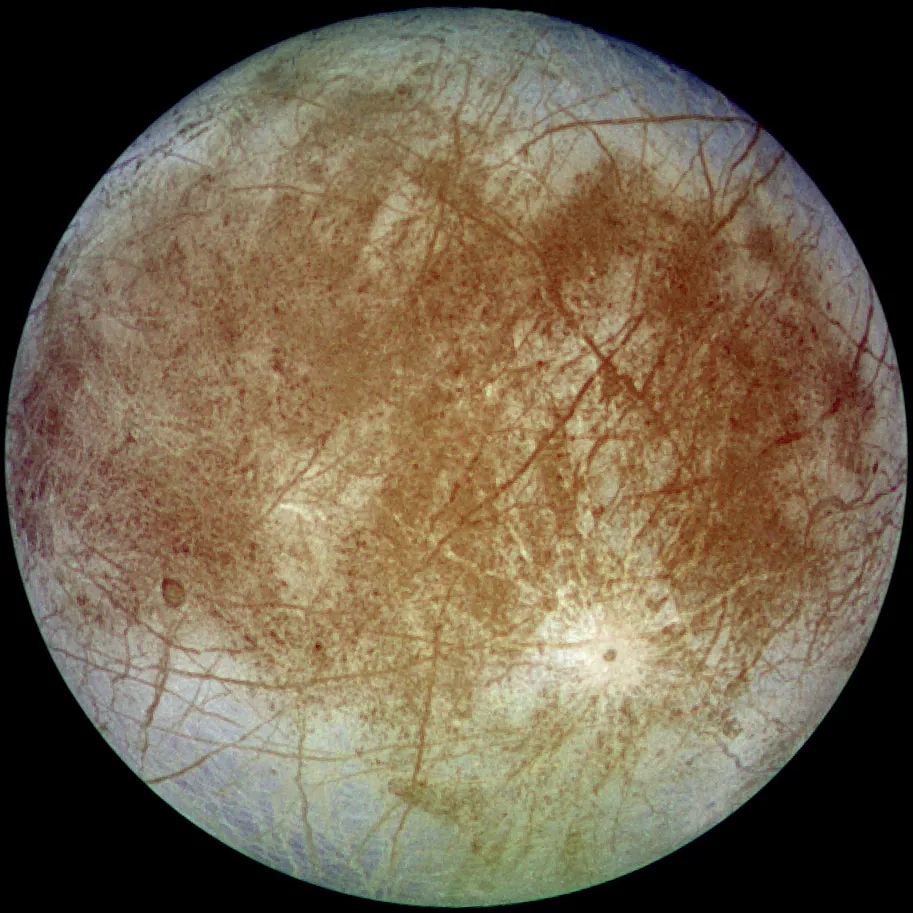
Europa orbits Jupiter at 671,000 km, wrapped in a water-ice crust crossed by reddish lines. Beneath it —magnetic measurements from Galileo indicate— there may be a global ocean of liquid water holding perhaps twice the water of all Earth's oceans.
Tidal heating keeps that ocean liquid despite the cold outside (~100 K at the surface). NASA's Europa Clipper mission, already en route, will study whether that ocean could be habitable.
Measured data [DATO]
| Data | Value | Status | Source |
|---|---|---|---|
| Diameter | 3,121.6 km | [DATO] observado | NASA Planetary Fact Sheets |
| Mass | 4.80×10²² kg | [DATO] observado | NASA Planetary Fact Sheets |
| Mean density | 3,010 kg/m³ | [DATO] observado | NASA Planetary Fact Sheets |
| Surface gravity | 1.315 m/s² | [DATO] observado | NASA Planetary Fact Sheets |
| Orbital period | 3.551 days | [DATO] observado | NASA Planetary Fact Sheets |
| Rotation period | synchronous (3.551 days) | [DATO] observado | NASA Planetary Fact Sheets |
| Distance from Jupiter | 671,000 km | [DATO] observado | NASA Planetary Fact Sheets |
| Temperature | ~100 K at the surface | [DATO] observado | NASA Science |
| Atmosphere | Tenuous: molecular oxygen | [DATO] observado | NASA Science |
| Notable feature | Evidence of a subsurface global ocean (Galileo magnetometer) | [DATO] observado | NASA Science |
Truths [DATO]
- [DATO] Galileo's magnetometer detected an induced magnetic field at Europa: the strongest explanation is a global salty-water ocean under the ice, responding to Jupiter's field.
- [DATO] The reddish 'lineae' are ice fractures stained by salts: the crust cracks and renews itself — ice tectonics.
- [DATO] The Hubble telescope observed possible water-vapor plumes venting from Europa's south pole.
- [DATO] Europa endures intense radiation from Jupiter: its surface is one of the most radioactive environments in the solar system — the ocean, under kilometers of ice, would be shielded.
Labeled myths [MITO]
[MITO] Life has already been found on Europa.
False: there is strong evidence of an ocean, but no life has been detected. Europa Clipper will investigate habitability (the ingredients), not life directly.
Fuente: NASA Science
[MITO] Europa's ice is thin and easy to drill through.
False: the crust's estimated thickness is ~15–25 km from models — estimated, not measured — and drilling it is beyond any current technology.
Fuente: NASA Science
Open questions [PREGUNTA]
- [PREGUNTA] How thick really is the ice crust?
- [PREGUNTA] Are there active plumes today that a probe could sample?
- [PREGUNTA] Does the ocean have the chemistry life needs?