 Mathvsmyth
Solar System Moons Series
Ganymede
The largest moon in the solar system —bigger than Mercury— and the only one with its own magnetic field.
Author: Juan Carlos Euyoque Aguilera · October 7, 2026 · CC BY 4.0
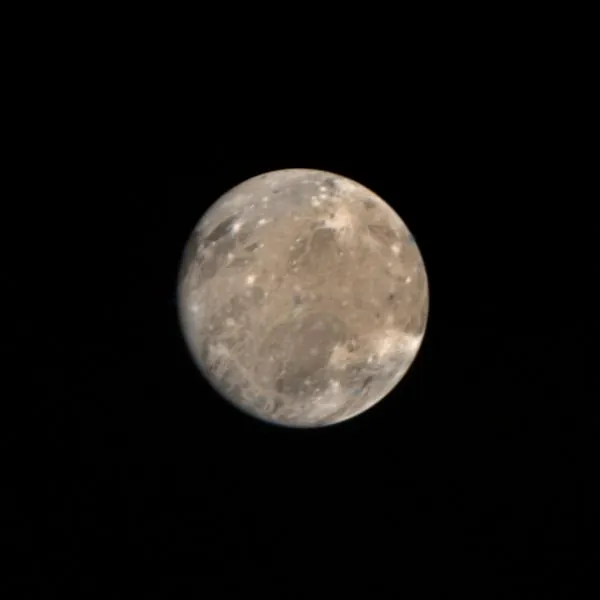
Ganymede orbits Jupiter at 1,070,000 km and, at 5,262.4 km across, is larger than the planet Mercury. It is a differentiated world: iron core, rocky mantle, and a thick shell of ice and water.
Galileo discovered in 1996 that it generates its own magnetic field —the only moon that does— and Hubble found hints of a salty ocean under the ice by watching its auroras. ESA's JUICE mission will study it up close in the coming decade.
Measured data [DATO]
| Data | Value | Status | Source |
|---|---|---|---|
| Diameter | 5,262.4 km (the largest moon) | [DATO] observado | NASA Planetary Fact Sheets |
| Mass | 1.4819×10²³ kg | [DATO] observado | NASA Planetary Fact Sheets |
| Mean density | 1,940 kg/m³ | [DATO] observado | NASA Planetary Fact Sheets |
| Surface gravity | 1.428 m/s² | [DATO] observado | NASA Planetary Fact Sheets |
| Orbital period | 7.155 days | [DATO] observado | NASA Planetary Fact Sheets |
| Rotation period | synchronous (7.155 days) | [DATO] observado | NASA Planetary Fact Sheets |
| Distance from Jupiter | 1,070,000 km | [DATO] observado | NASA Planetary Fact Sheets |
| Temperature | ~110 K | [DATO] observado | NASA Science |
| Atmosphere | Tenuous: oxygen | [DATO] observado | NASA Science |
| Notable feature | Only moon with its own magnetic field (Galileo, 1996) | [DATO] observado | NASA Science |
Truths [DATO]
- [DATO] Ganymede is the largest moon in the solar system (5,262.4 km): bigger than Mercury (4,879 km) and Pluto.
- [DATO] It is the only moon with its own magnetosphere, generated by a convecting iron core — like Earth, in miniature.
- [DATO] Its auroras, observed by Hubble, wobble less than expected: the explanation is a salty ocean under the ice damping the motion.
- [DATO] Its surface mixes ancient dark terrain and younger bright grooves: two geological ages in one world.
Labeled myths [MITO]
[MITO] Ganymede should be a planet because it is bigger than Mercury.
False: the planet definition (IAU, 2006) requires orbiting the Sun; Ganymede orbits Jupiter, so it is a moon by definition, regardless of size.
Fuente: NASA Science
[MITO] Ganymede is just an inert ball of ice.
False: it has an iron core, its own magnetic field, a likely inner ocean and a storied geology — it is one of the most complex worlds in the solar system.
Fuente: NASA Science
Open questions [PREGUNTA]
- [PREGUNTA] How many alternating layers of ice and ocean lie inside?
- [PREGUNTA] How does it generate and sustain its magnetic field?
- [PREGUNTA] What will JUICE report when it arrives in the coming decade?