 Mathvsmyth
Solar System Moons Series
Callisto
The oldest world in sight: four billion years of unerased craters.
Author: Juan Carlos Euyoque Aguilera · October 7, 2026 · CC BY 4.0
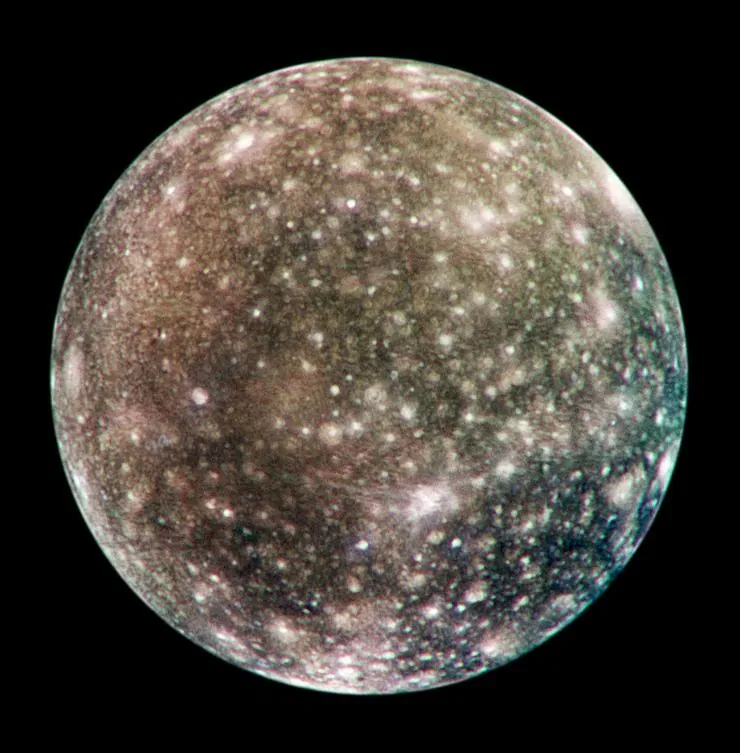
Callisto, the outermost Galilean, orbits Jupiter at 1,883,000 km. Far from the tidal heating that stirs its sisters, its surface froze in time: it is the most heavily cratered in the solar system, with an estimated age of ~4 billion years.
That stillness makes it a time capsule: every crater is an impact that geology would have erased on other worlds. And beneath the ice, it too may hide an ocean.
Measured data [DATO]
| Data | Value | Status | Source |
|---|---|---|---|
| Diameter | 4,820.6 km | [DATO] observado | NASA Planetary Fact Sheets |
| Mass | 1.0759×10²³ kg | [DATO] observado | NASA Planetary Fact Sheets |
| Mean density | 1,830 kg/m³ | [DATO] observado | NASA Planetary Fact Sheets |
| Surface gravity | 1.235 m/s² | [DATO] observado | NASA Planetary Fact Sheets |
| Orbital period | 16.689 days | [DATO] observado | NASA Planetary Fact Sheets |
| Rotation period | synchronous (16.689 days) | [DATO] observado | NASA Planetary Fact Sheets |
| Distance from Jupiter | 1,883,000 km | [DATO] observado | NASA Planetary Fact Sheets |
| Temperature | ~134 K | [DATO] observado | NASA Science |
| Atmosphere | Tenuous: carbon dioxide | [DATO] observado | NASA Science |
| Notable feature | Surface ~4 billion years old (crater counting) | [MODELO] estimado | NASA Science |
Truths [DATO]
- [DATO] Callisto has the oldest surface in the solar system: ~4 billion years by crater counting, an intact record of the primordial bombardment.
- [DATO] Unlike its sisters, Callisto is not fully differentiated: the ice and rock inside never completely separated.
- [DATO] Galileo detected a tenuous carbon-dioxide atmosphere and an induced magnetic field hinting at an inner salty ocean.
- [DATO] Valhalla, its largest impact structure, spans rings nearly 4,000 km across: one of the biggest scars in the solar system.
Labeled myths [MITO]
[MITO] Callisto is a dead moon of no scientific interest.
False: its surface is the oldest archive of the outer solar system, and its possible inner ocean keeps it on the worlds-to-study list.
Fuente: NASA Science
[MITO] Callisto has no atmosphere.
False: Galileo detected a tenuous carbon-dioxide atmosphere; tenuous is not the same as nonexistent.
Fuente: NASA Science
Open questions [PREGUNTA]
- [PREGUNTA] Does Callisto have a subsurface ocean? Magnetic induction hints at it, unconfirmed.
- [PREGUNTA] Why did its interior never fully differentiate?
- [PREGUNTA] What does its crater record tell us about the early bombardment?