 Mathvsmyth
Solar System Moons Series
Titan
The moon with atmosphere and rain: a world where methane plays the role of water.
Author: Juan Carlos Euyoque Aguilera · October 7, 2026 · CC BY 4.0
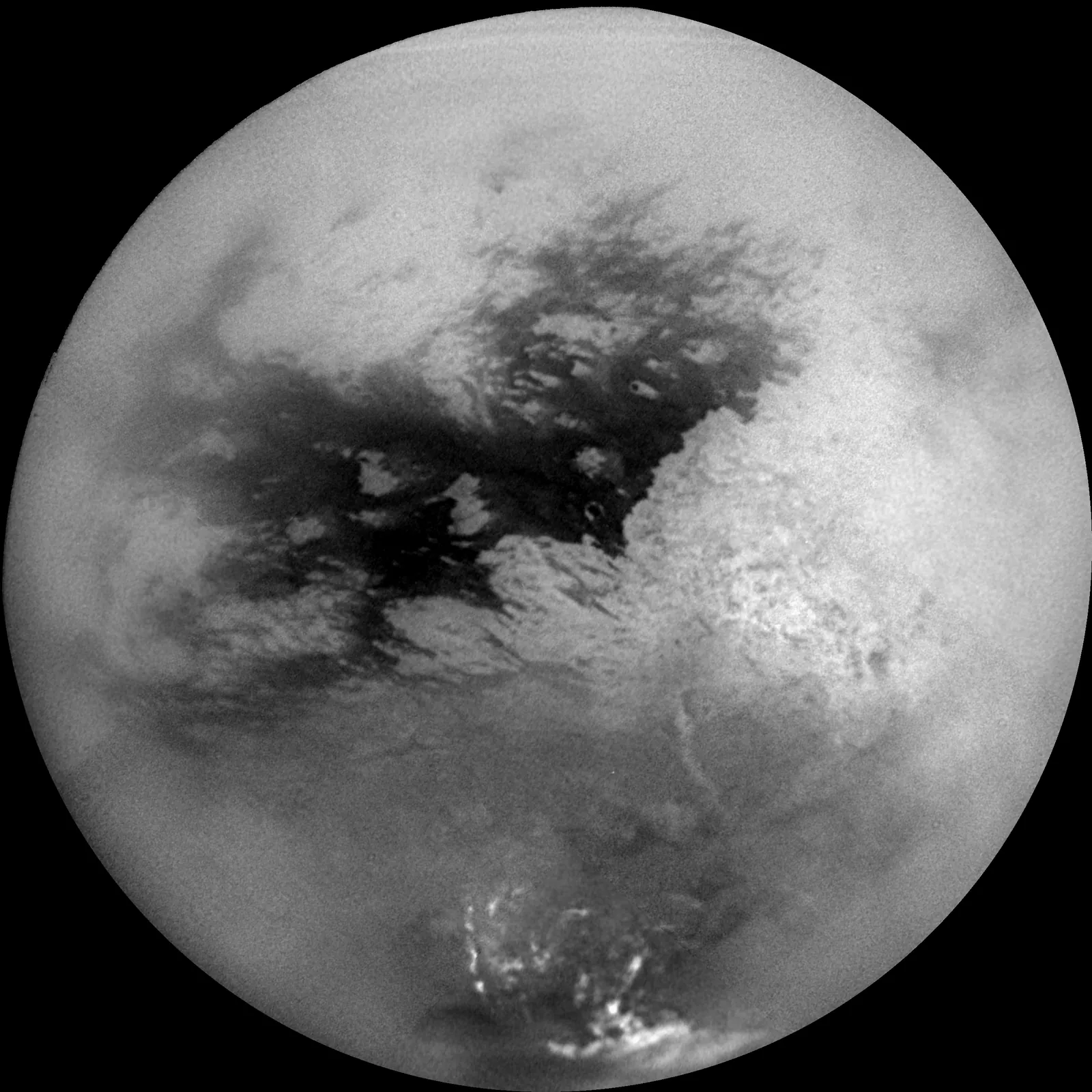
Titan orbits Saturn at 1,221,870 km and is the second-largest moon in the solar system, 5,150 km across. It is the only moon with a substantial atmosphere: 1.5 bars of nitrogen and methane — more surface pressure than Earth's.
At 94 K water is rock and methane rains: Cassini found lakes, seas and rivers of liquid methane and ethane — a complete hydrological cycle with different chemistry. NASA's Dragonfly mission will fly there in the coming decade.
Measured data [DATO]
| Data | Value | Status | Source |
|---|---|---|---|
| Diameter | 5,150 km | [DATO] observado | NASA Planetary Fact Sheets |
| Mass | 1.3452×10²³ kg | [DATO] observado | NASA Planetary Fact Sheets |
| Mean density | 1,880 kg/m³ | [DATO] observado | NASA Planetary Fact Sheets |
| Surface gravity | 1.352 m/s² | [DATO] observado | NASA Planetary Fact Sheets |
| Orbital period | 15.945 days | [DATO] observado | NASA Planetary Fact Sheets |
| Rotation period | synchronous (15.945 days) | [DATO] observado | NASA Planetary Fact Sheets |
| Distance from Saturn | 1,221,870 km | [DATO] observado | NASA Planetary Fact Sheets |
| Temperature | 94 K (−179 °C, measured by Huygens) | [DATO] observado | NASA Science |
| Atmosphere | 1.5 bar: nitrogen (95%) + methane | [DATO] observado | NASA Science |
| Notable feature | Liquid methane/ethane lakes and seas (Cassini radar) | [DATO] observado | NASA Science |
Truths [DATO]
- [DATO] Titan is the only moon with a thick atmosphere: 1.5 bars at the surface, with clouds, rain, and a methane cycle analogous to Earth's water cycle.
- [DATO] Cassini mapped by radar hundreds of lakes and three large seas —Kraken, Ligeia and Punga— of liquid methane and ethane in the northern hemisphere.
- [DATO] The Huygens probe landed on Titan in 2005 and photographed a dry riverbed with water-ice 'rocks': images taken from farther than any other surface.
- [DATO] Beneath the ice crust there would be a global ocean of liquid water, separated from the outside by high-pressure ice.
Labeled myths [MITO]
[MITO] Titan's lakes are water.
False: they are liquid methane and ethane; at 94 K water is as hard as rock and forms the bedrock. Liquid water, if it exists, lies in a subsurface ocean.
Fuente: NASA Science
[MITO] There is life on Titan because it resembles the early Earth.
False: it is a prebiotic-chemistry laboratory, but no life has been detected; its chemistry runs on liquid methane, not water.
Fuente: NASA Science
Open questions [PREGUNTA]
- [PREGUNTA] What replenishes the atmosphere's methane? Sunlight destroys it within millions of years.
- [PREGUNTA] Is there active prebiotic chemistry in the lakes or on the surface?
- [PREGUNTA] What is the inner ocean like, and what separates it from the surface?