 Mathvsmyth
Solar System Moons Series
Enceladus
The moon spraying an ocean into space: water geysers feeding Saturn's rings.
Author: Juan Carlos Euyoque Aguilera · October 7, 2026 · CC BY 4.0
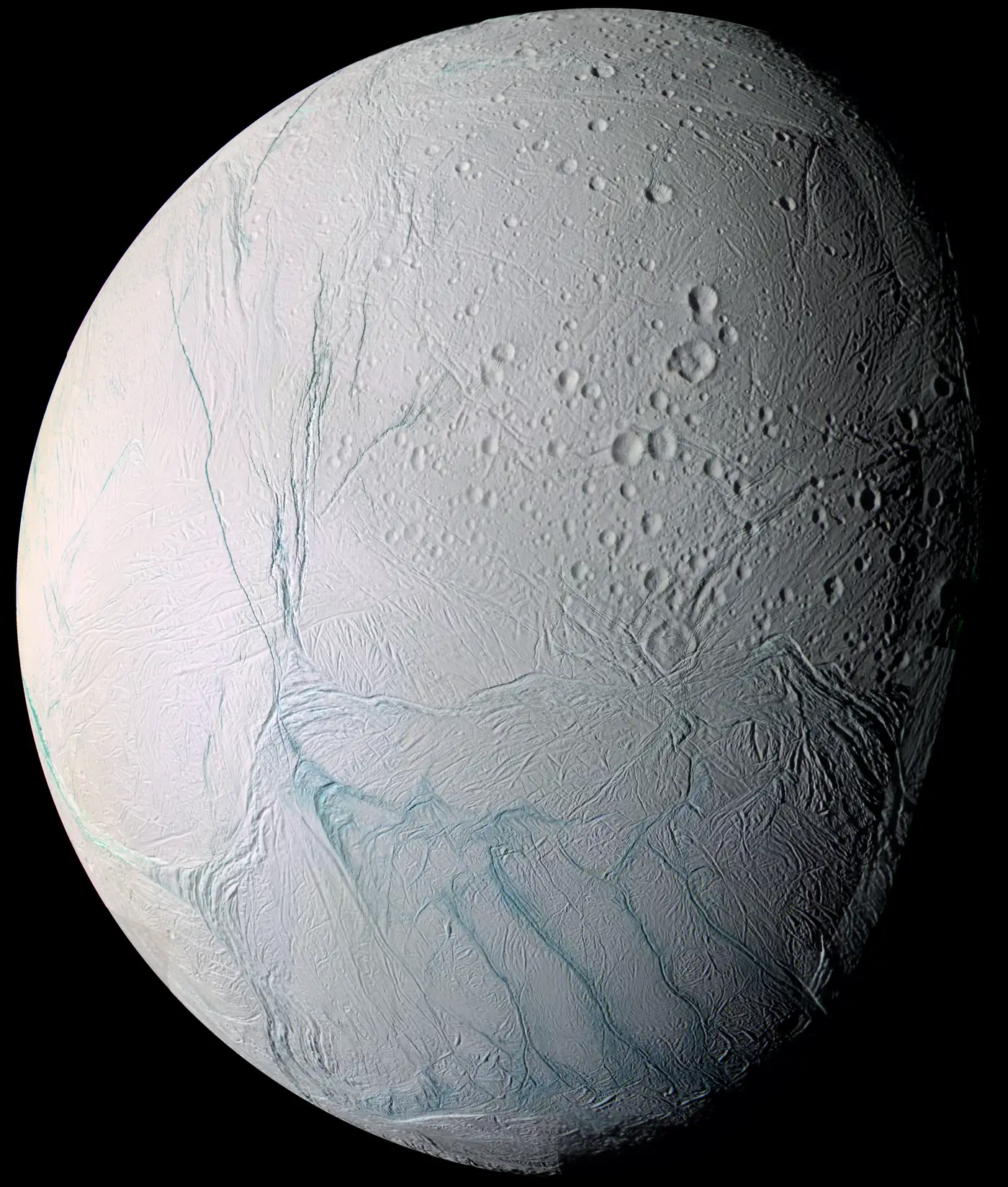
Enceladus, just 504 km across, orbits Saturn at 237,948 km. So small its gravity is 0.113 m/s² — yet it is one of the most active worlds: plumes of water vapor and ice erupt from its south pole, discovered by Cassini in 2005.
Those plumes feed Saturn's E ring and, from Cassini's gravity and libration measurements, come from a global ocean under the ice. Enceladus is now one of the best candidates in the search for life.
Measured data [DATO]
| Data | Value | Status | Source |
|---|---|---|---|
| Diameter | 504 km | [DATO] observado | NASA Planetary Fact Sheets |
| Mass | 1.08×10²⁰ kg | [DATO] observado | NASA Planetary Fact Sheets |
| Mean density | 1,610 kg/m³ | [DATO] observado | NASA Planetary Fact Sheets |
| Surface gravity | 0.113 m/s² | [DATO] observado | NASA Planetary Fact Sheets |
| Orbital period | 1.370 days | [DATO] observado | NASA Planetary Fact Sheets |
| Rotation period | synchronous (1.370 days) | [DATO] observado | NASA Planetary Fact Sheets |
| Distance from Saturn | 237,948 km | [DATO] observado | NASA Planetary Fact Sheets |
| Temperature | ~75 K (the Tiger Stripes, warmer) | [DATO] observado | NASA Science |
| Atmosphere | Tenuous: water vapor from the plumes | [DATO] observado | NASA Science |
| Notable feature | Global ocean under the ice; plumes feed the E ring (Cassini) | [DATO] observado | NASA Science |
Truths [DATO]
- [DATO] Cassini flew through Enceladus's plumes and analyzed their composition: water, salts, ammonia and organic molecules — ocean water, not just surface ice.
- [DATO] The libration (wobble) measured by Cassini only fits if the ice crust floats on a global ocean, not on rock.
- [DATO] The south pole's 'Tiger Stripes' are ~130 km fractures venting the plumes; tidal heating keeps them active.
- [DATO] In 2023 the JWST confirmed a huge water-vapor column from Enceladus stretching thousands of kilometers: the E ring, seen live.
Labeled myths [MITO]
[MITO] Enceladus's geysers are boiling water.
False: they are cryovolcanic plumes —vapor and ice crystals erupting into vacuum from fractures, driven by tidal heating; 'boiling' assumes an atmospheric pressure that does not exist there.
Fuente: NASA Science
[MITO] Enceladus is too small to have an ocean.
False: Cassini's libration and gravity measurements confirm a global ocean under the ice; size does not rule — tidal heating does.
Fuente: NASA Science
Open questions [PREGUNTA]
- [PREGUNTA] Are there active hydrothermal vents on its ocean floor?
- [PREGUNTA] Is Enceladus's ocean habitable?
- [PREGUNTA] How long will the plume activity last?