 Mathvsmyth
Solar System Moons Series
Triton
The backwards moon: retrograde orbit, nitrogen geysers, and the most extreme cold measured.
Author: Juan Carlos Euyoque Aguilera · October 7, 2026 · CC BY 4.0
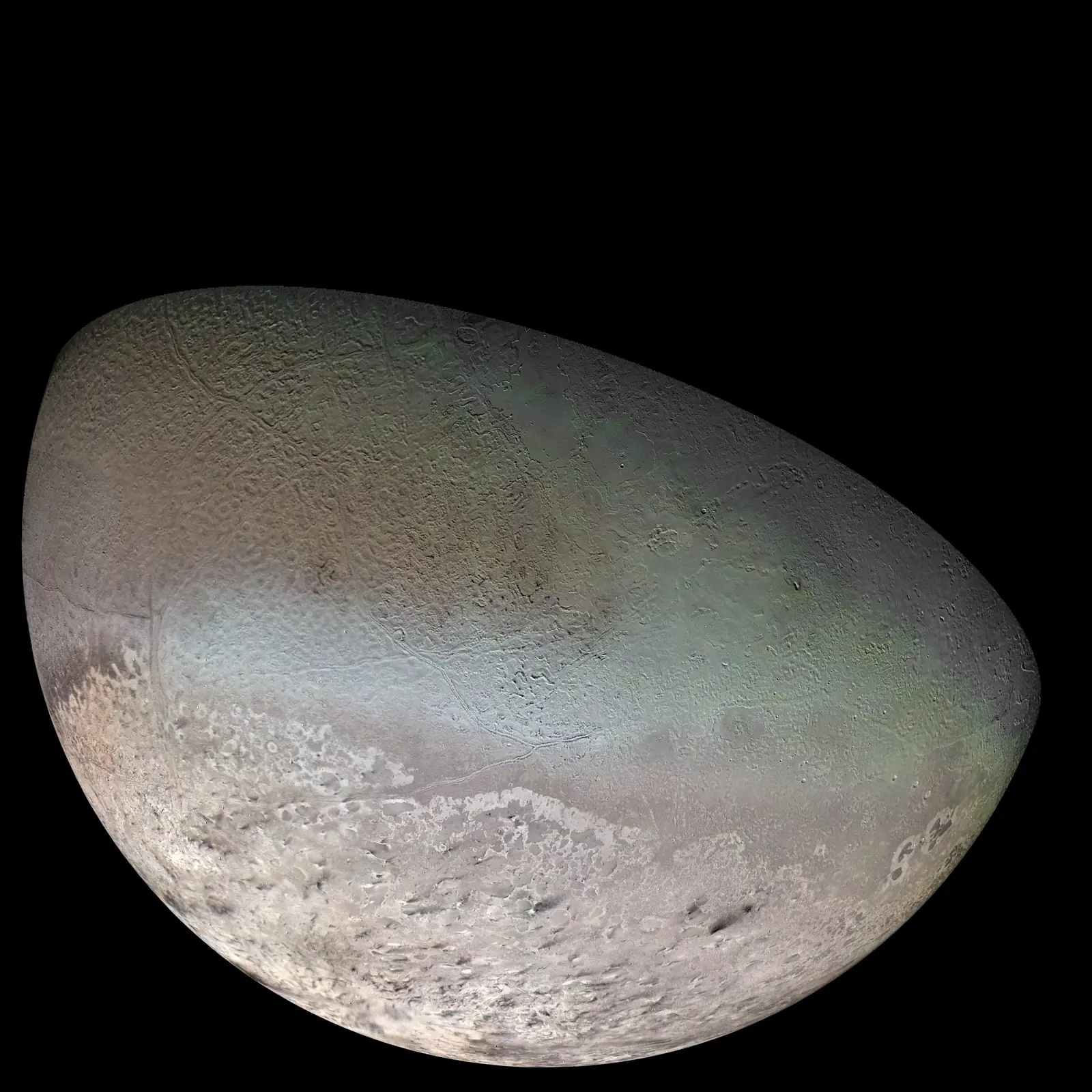
Triton orbits Neptune at 354,760 km, but backwards: it is the only large moon in the solar system with a retrograde orbit, opposite to the planet's rotation. The favored explanation is that it was not born there: it would be a Kuiper Belt object captured by Neptune.
Voyager 2 visited it in 1989 —the only visit— and found active nitrogen geysers and a 38 K surface, among the coldest ever measured. Half of its world remains unmapped.
Measured data [DATO]
| Data | Value | Status | Source |
|---|---|---|---|
| Diameter | 2,706.8 km | [DATO] observado | NASA Planetary Fact Sheets |
| Mass | 2.14×10²² kg | [DATO] observado | NASA Planetary Fact Sheets |
| Mean density | 2,060 kg/m³ | [DATO] observado | NASA Planetary Fact Sheets |
| Surface gravity | 0.779 m/s² | [DATO] observado | NASA Planetary Fact Sheets |
| Orbital period | 5.877 days (retrograde) | [DATO] observado | NASA Planetary Fact Sheets |
| Rotation period | synchronous retrograde | [DATO] observado | NASA Planetary Fact Sheets |
| Distance from Neptune | 354,760 km | [DATO] observado | NASA Planetary Fact Sheets |
| Temperature | 38 K (among the coldest measured) | [DATO] observado | NASA Science |
| Atmosphere | Tenuous: nitrogen + methane | [DATO] observado | NASA Science |
| Notable feature | Only large retrograde moon; nitrogen geysers (Voyager 2) | [DATO] observado | NASA Science |
Truths [DATO]
- [DATO] Triton is the only large moon with a retrograde orbit: it circles Neptune opposite to the planet's rotation — a classic capture signature.
- [DATO] Voyager 2 photographed nitrogen plumes ~8 km high in 1989: active cryovolcanic geysers, driven by sunlight warming nitrogen ice beneath the surface.
- [DATO] At 38 K, its surface is among the coldest measured in the solar system; nitrogen, methane and carbon monoxide lie frozen.
- [DATO] Its composition and size resemble Pluto more than the neighboring moons: supporting the captured-Kuiper-Belt-object hypothesis.
Labeled myths [MITO]
[MITO] Triton was always Neptune's moon.
Unconfirmed: the leading hypothesis is capture of a Kuiper Belt object (retrograde orbit + Pluto-like composition), but the exact capture mechanism remains open.
Fuente: NASA Science
[MITO] Triton is a dead, frozen world with no activity.
False: Voyager 2 found active geysers and young terrain; extreme cold does not mean geological stillness.
Fuente: NASA Science
Open questions [PREGUNTA]
- [PREGUNTA] How exactly did Neptune capture Triton?
- [PREGUNTA] Is cryovolcanism still active today?
- [PREGUNTA] What lies in the hemisphere Voyager 2 could not see?