 Mathvsmyth
Solar System Series
Jupiter
The giant of the solar system: eternal storms and a shield that may not be one
Author: Juan Carlos Euyoque Aguilera · October 7, 2026 · CC BY 4.0
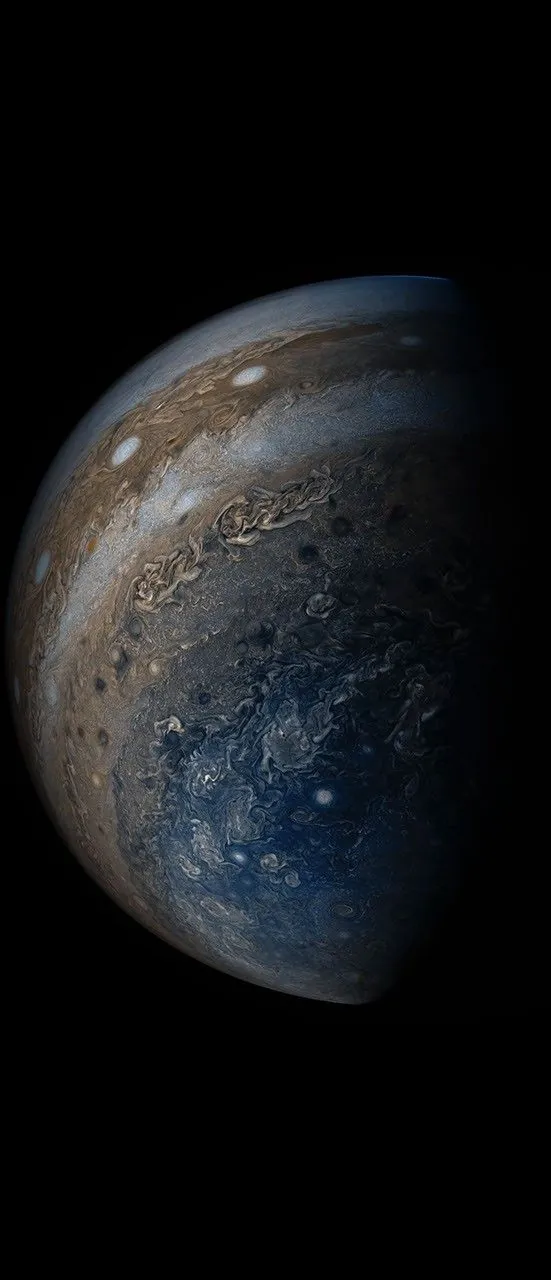
Jupiter is the undisputed king of the solar system: the largest planet, the most massive, and the one with the shortest day. Its cloud bands, its Great Red Spot, and its 95 moons form a miniature planetary system that the Juno spacecraft is still exploring today.
But Jupiter is also the planet of great modern myths: that it protects us like a cosmic shield, that it almost became a star. Here we separate what has been measured from what has been imagined, with NASA data and questions that remain open.
Measured data [DATO]
| Data | Value | State | Source |
|---|---|---|---|
| Diameter | 142,984 km | [DATO] observed | NASA Planetary Fact Sheet (NSSDCA) |
| Mass | 1,898 × 10²⁴ kg | [DATO] observed | NASA Planetary Fact Sheet (NSSDCA) |
| Mean density | 1,326 kg/m³ | [DATO] observed | NASA Planetary Fact Sheet (NSSDCA) |
| Surface gravity | 23.1 m/s² (at the 1-bar level) | [DATO] observed | NASA Planetary Fact Sheet (NSSDCA) |
| Escape velocity | 59.5 km/s | [DATO] observed | NASA Planetary Fact Sheet (NSSDCA) |
| Mean distance from the Sun | 778.5 × 10⁶ km (5.2 AU) | [DATO] observed | NASA Planetary Fact Sheet (NSSDCA) |
| Orbital period | 4,331 days (11.9 years) | [DATO] observed | NASA Planetary Fact Sheet (NSSDCA) |
| Rotation period | 9.9 hours | [DATO] observed | NASA Planetary Fact Sheet (NSSDCA) |
| Mean temperature | -110 °C (at the 1-bar level) | [DATO] observed | NASA Planetary Fact Sheet (NSSDCA) |
| Atmosphere / composition | Hydrogen (~89.8%) and helium (~10.2%); traces of methane, ammonia, water vapor, and other compounds | [DATO] observed | NASA NSSDC — Jupiter Fact Sheet |
| Notable feature | The Great Red Spot: an anticyclonic storm wider than Earth, observed for over 300 years; Juno measured it extending about 500 km below the cloud tops | [DATO] observed | NASA Science — Jupiter Facts (misión Juno) |
| Rings | Yes — a faint dust ring system discovered by Voyager 1 in 1979; small dark particles, visible only when backlit | [DATO] observed | NASA Science — Jupiter Facts |
| Known moons | 101 (IAU Minor Planet Center / Scott Sheppard and David Tholen (via Space.com), March 2026) 95 in February 2023 -> 101 in March 2026 (4 new moons: MPEC 2026-F09 to F12). | [DATO] observed | IAU Minor Planet Center / Scott Sheppard and David Tholen (via Space.com) |
Truths [DATO]
- [DATO] It is the largest and most massive planet in the solar system: more than 1,000 Earths could fit inside it, and it holds more than twice the combined mass of all the other planets.
- [DATO] It has the shortest day in the solar system: it spins on its axis in 9.9 hours, driving jet streams that separate its clouds into dark belts and bright zones.
- [DATO] The Great Red Spot is an anticyclonic storm wider than Earth, observed for more than 300 years; Juno data (2021) show it extends about 500 km below the cloud tops.
- [DATO] Its magnetic field is 16 to 54 times as powerful as Earth's, and its magnetosphere stretches beyond Saturn's orbit.
The four Galilean moons [DATO]
| Moon | Diameter | Measured fact | Source |
|---|---|---|---|
| Io | 3,630 km | [DATO] The most volcanically active body in the solar system: tidal heating from Jupiter melts its interior. | NASA Science (The Galilean Satellites, photojournal) |
| Europa | 3,138 km | [DATO] Evidence of a global liquid-water ocean beneath its ice crust; one of the best places to search for life. | OpenStax Astronomy (chapter: the Galilean moons of Jupiter) |
| Ganymede | 5,262 km | [DATO] The largest moon in the solar system (bigger than the planet Mercury) and the only one with an internally generated magnetic field of its own. | OpenStax Astronomy (chapter: the Galilean moons of Jupiter) |
| Callisto | 4,800 km | [DATO] The most cratered and oldest surface in the solar system; almost no internal geological activity. | OpenStax Astronomy (chapter: the Galilean moons of Jupiter) |
Marked myths [MITO]
[MITO] Jupiter is our shield: its gravity protects us from asteroids and comets that would otherwise strike Earth.
Simulations in the published literature (Horner & Jones, 2008–2010; Grazier, JPL, in Astrobiology 2016) show Jupiter does not clearly reduce the impact flux toward Earth and, together with Saturn, can fling outer-system objects into Earth-crossing orbits. The 'shield' is a challenged hypothesis, not a measured fact.
[MITO] Jupiter is a failed star: it almost ignited like the Sun.
To fuse deuterium (the IAU brown-dwarf limit) it would need about 13 times its mass; to fuse hydrogen like a real star, 75 to 80 times its mass. Jupiter does not even approach the first threshold: it is a planet, not a half-star.
Fuente: Documentales y divulgación popular; corrección en Astronomy Magazine
Open questions [PREGUNTA]
- [PREGUNTA] Juno found a 'fuzzy' core — large and partially dissolved into the metallic hydrogen — instead of the compact solid core that was expected: how did it form?
- [PREGUNTA] Its atmospheric jet streams reach about 3,200 km deep: what drives them so far down?
- [PREGUNTA] What has kept the Great Red Spot alive for centuries, and how long will it last?