 Mathvsmyth
Solar System Series
Mars
The red desert that once had rivers.
Author: Juan Carlos Euyoque Aguilera · October 7, 2026 · CC BY 4.0
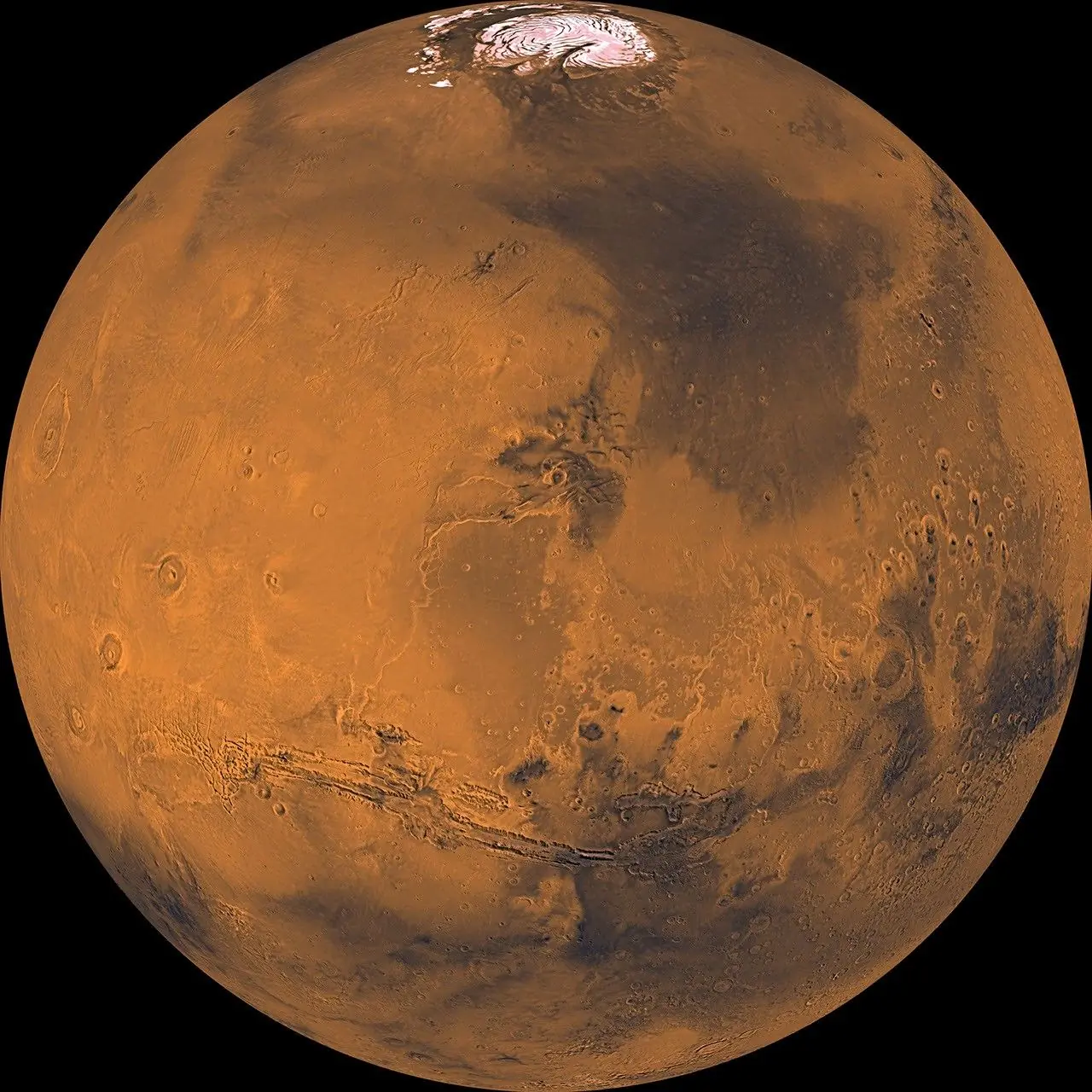
Mars is the most Earth-like planet in its daily rhythm: a 24.6-hour day, seasons from its 25° tilt, polar caps. But its air is 100 times thinner and almost all CO₂.
It is the most robot-visited planet, and the only one with a sealed theory from this house about its lost atmosphere: the owner's position is below, in his voice, without rewrites.
Measured data [DATO]
| Data | Value | State | Source |
|---|---|---|---|
| Diameter | 6,792 km | [DATO] observed | NASA Planetary Fact Sheet |
| Mass | 6.42×10²³ kg | [DATO] observed | NASA Mars Fact Sheet |
| Mean density | 3,934 kg/m³ | [DATO] observed | NASA Mars Fact Sheet |
| Surface gravity | 3.7 m/s² | [DATO] observed | NASA Mars Fact Sheet |
| Escape velocity | 5.0 km/s | [DATO] observed | NASA Planetary Fact Sheet |
| Mean distance from the Sun | 227.96 million km (1.524 AU) | [DATO] observed | NASA Mars Fact Sheet |
| Orbital period | 687.0 days | [DATO] observed | NASA Planetary Fact Sheet |
| Rotation period | 24.6 hours | [DATO] observed | NASA Mars Fact Sheet |
| Mean temperature | −65 °C | [DATO] observed | NASA Planetary Fact Sheet |
| Atmosphere | 95.1% CO₂, 2.59% N₂, 1.94% Ar; surface pressure 6.36 mb | [DATO] observed | NASA Mars Fact Sheet |
| Notable feature | Olympus Mons: 21.9 km tall, the tallest volcano in the solar system | [DATO] observed | MOLA / NASA Mars Global Surveyor |
| Known moons | 2 (LiveScience (solar system overview), April 2026) Phobos and Deimos. No changes recorded. | [DATO] observed | LiveScience (solar system overview) |
Truths [DATO]
- [DATO] Its day lasts 24.6 hours, almost like Earth's, and its 25.2° tilt gives it seasons.
- [DATO] It has two small moons, Phobos and Deimos, probably captured asteroids.
- [DATO] Its atmosphere is thin (6.36 mb, less than 1% of Earth's) and 95.1% carbon dioxide.
- [DATO] It hosts Olympus Mons, 21.9 km high: the tallest known volcano in the solar system.
- [DATO] It has no global magnetic field; only remanent magnetism in its crust remains.
Marked myths [MITO]
[MITO] This August, Mars will look as big as the full Moon to the naked eye.
Hoax born from a 2003 email reading 'at 75-power magnification it will look as large as the Moon'; the magnification part was lost in forwarding. Mars can never get close enough: it would have to be about 766,000 km away, twice the distance to the Moon.
Fuente: El bulo resurge cada agosto desde 2003; lo desmienten la NASA y Space.com.
[MITO] The 'face on Mars' photographed by Viking 1 in 1976 is an alien construction.
Pareidolia: a trick of light and shadow on a mesa. Mars Global Surveyor photographed it in 1998 and 2001 at 2 meters per pixel and showed an eroded natural hill.
Fuente: El mito circuló en libros y TV; la corrección es de la NASA/JPL.
Open questions [PREGUNTA]
- [PREGUNTA] Where does the methane that the Curiosity rover detects in seasonal spikes come from: geology or biology?
- [PREGUNTA] Is there liquid water beneath the surface? The MARSIS radar echoes at the south pole remain disputed.
- [PREGUNTA] When did its global dynamo die, and why? Only the fossil magnetism of the crust remains.
The author's voice
His sealed position (Mars Core Reboot v1, 2026-09-25): cutting off Olympus Mons does not stop atmospheric escape — the exosphere sits at ~200 km altitude, not at the 22 km summit; MAVEN measures escape of ~100 g/s and, with no active dynamo, whatever is gained is lost. He will publish the full Case 0 (Mars Core Reboot) himself as the platform's first user; this piece does not rewrite it, it only references it.