 Mathvsmyth
Solar System Series
Earth
The only blue dot we know is alive.
Author: Juan Carlos Euyoque Aguilera · October 7, 2026 · CC BY 4.0
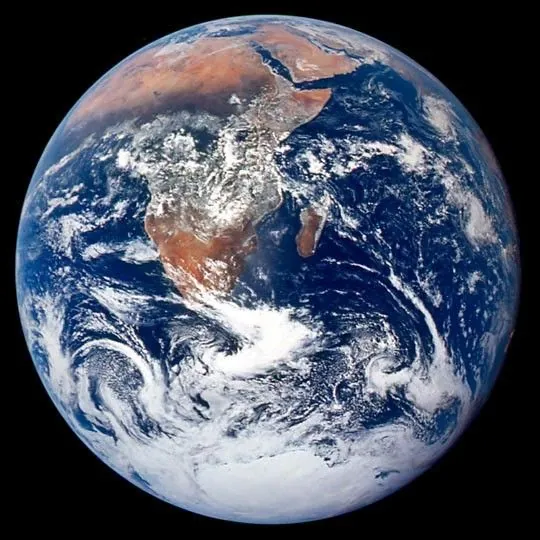
Earth is the only planet with confirmed life, liquid-water oceans on its surface, and active plate tectonics. None of that was guaranteed: it is the result of 4.5 billion years of fortunate accidents.
It is also our only laboratory: everything we know about planets was first measured here — from the true shape of the geoid to the magnetic field that protects us.
Measured data [DATO]
| Data | Value | State | Source |
|---|---|---|---|
| Diameter | 12,756 km | [DATO] observed | NASA Planetary Fact Sheet |
| Mass | 5.97×10²⁴ kg | [DATO] observed | NASA Earth Fact Sheet |
| Mean density | 5,513 kg/m³ | [DATO] observed | NASA Earth Fact Sheet |
| Surface gravity | 9.8 m/s² | [DATO] observed | NASA Earth Fact Sheet |
| Escape velocity | 11.2 km/s | [DATO] observed | NASA Earth Fact Sheet |
| Mean distance from the Sun | 149.6 million km (1.000 AU) | [DATO] observed | NASA Earth Fact Sheet |
| Orbital period | 365.2 days | [DATO] observed | NASA Planetary Fact Sheet |
| Rotation period | 23.9 hours | [DATO] observed | NASA Earth Fact Sheet |
| Mean temperature | 15 °C (288 K) | [DATO] observed | NASA Earth Fact Sheet |
| Atmosphere | 78.08% N₂, 20.95% O₂; surface pressure 1014 mb | [DATO] observed | NASA Earth Fact Sheet |
| Notable feature | The only planet with confirmed life; 71% of its surface is covered by water (USGS) | [DATO] observed | USGS Water Science School |
| Known moons | 1 (LiveScience (solar system overview), April 2026) The Moon. Temporary 'quasi-moons' and 'mini-moons' do not count. | [DATO] observed | LiveScience (solar system overview) |
Truths [DATO]
- [DATO] 71% of its surface is covered by water, and the oceans hold 96.5% of all the planet's water (USGS).
- [DATO] It is not a perfect sphere: an oblate spheroid (geoid), with the equator about 21 km wider than the poles because of rotation.
- [DATO] It has a global magnetic field generated in its liquid-iron core, deflecting the solar wind.
- [DATO] It is the only planet with confirmed active plate tectonics: its crust is recycled.
Marked myths [MITO]
[MITO] The Great Wall of China is the only human construction visible from the Moon.
From the Moon no human-made object is visible at all (Alan Bean, Apollo 12); it cannot even be picked out with the naked eye from low orbit. The myth was born in a 1932 Ripley's Believe It or Not cartoon.
Fuente: Lo desmienten la NASA y los astronautas del Apollo; lo documenta Sky at Night Magazine.
[MITO] Earth is a perfect sphere.
Rotation bulges it at the equator: equatorial radius 6,378.137 km versus 6,356.752 km at the poles (NASA). And even the spheroid is not exact: the true shape, the geoid, has gravity-made bumps and dips.
Fuente: Idea común en libros escolares; la corrigen la NASA y la geodesia.
Open questions [PREGUNTA]
- [PREGUNTA] When and how did plate tectonics start? There is no consensus.
- [PREGUNTA] Where did Earth's water come from: asteroids, comets, or Earth's own mantle?
- [PREGUNTA] The magnetic field is weakening over the South Atlantic: is a pole reversal coming?