 Mathvsmyth
Solar System Series
Venus
The solar system's most beautiful hell.
Author: Juan Carlos Euyoque Aguilera · October 7, 2026 · CC BY 4.0
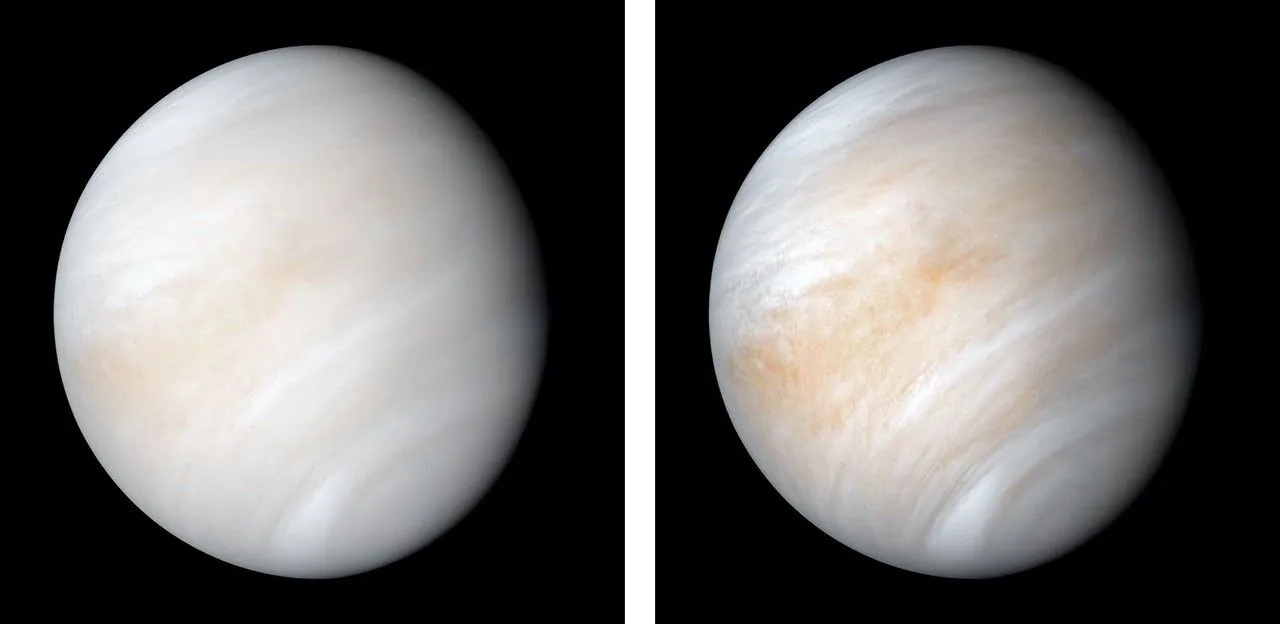
Venus shines as the most beautiful 'star' of the dawn, but beneath its sulfuric-acid clouds lies a 464 °C furnace, with the pressure of being 900 meters underwater.
Almost Earth's size and our most famous neighbor, Venus is a warning of what can happen to a rocky planet when its climate runs out of control.
Measured data [DATO]
| Data | Value | State | Source |
|---|---|---|---|
| Diameter | 12,104 km | [DATO] observed | NASA Planetary Fact Sheet |
| Mass | 4.87×10²⁴ kg | [DATO] observed | NASA Venus Fact Sheet |
| Mean density | 5,243 kg/m³ | [DATO] observed | NASA Venus Fact Sheet |
| Surface gravity | 8.9 m/s² | [DATO] observed | NASA Venus Fact Sheet |
| Escape velocity | 10.4 km/s | [DATO] observed | NASA Planetary Fact Sheet |
| Mean distance from the Sun | 108.2 million km (0.723 AU) | [DATO] observed | NASA Venus Fact Sheet |
| Orbital period | 224.7 days | [DATO] observed | NASA Planetary Fact Sheet |
| Rotation period | −5,832.5 hours (243 days; retrograde) | [DATO] observed | NASA Venus Fact Sheet |
| Mean temperature | 464 °C (737 K) | [DATO] observed | NASA Venus Fact Sheet |
| Atmosphere | 96.5% CO₂, 3.5% N₂; surface pressure 92 bars, sulfuric-acid clouds | [DATO] observed | NASA Venus Fact Sheet |
| Notable feature | Retrograde spin: its day (243 days) lasts longer than its year (224.7 days) | [DATO] observed | NASA Venus Fact Sheet |
| Known moons | 0 (LiveScience (solar system overview), April 2026) No changes recorded. (Zoozve, its 'quasi-moon', orbits the Sun, not Venus.) | [DATO] observed | LiveScience (solar system overview) |
Truths [DATO]
- [DATO] It is the hottest planet in the solar system: 464 °C on average, day and night, from a runaway CO₂ greenhouse effect.
- [DATO] It spins backwards relative to the other planets, and so slowly that its day (243 days) is longer than its year (224.7 days).
- [DATO] Its surface pressure is 92 bars — about 92 times Earth's at sea level — and its clouds are made of sulfuric acid.
- [DATO] It has no global magnetic field and no moons (NASA Planetary Fact Sheet).
Marked myths [MITO]
[MITO] Venus is Earth's twin.
The resemblance ends at size, mass and density. At the surface: 464 °C, 92 bars of pressure, sulfuric-acid clouds. NASA itself qualifies the nickname: 'evil twin.'
Fuente: El apodo circula en medios y libros de texto; la corrección es de la NASA.
[MITO] Venus is the planet closest to Earth.
Venus makes the closest approach, but averaging positions over 10,000 years, Mercury spends more time near Earth (1.04 AU versus 1.14 AU). It is the difference between 'minimum distance' and 'mean distance.'
Fuente: Comentario de 2019 en Physics Today (Stockman, Monroe y Cordner), resumido por Space Daily.
Open questions [PREGUNTA]
- [PREGUNTA] Did Venus have liquid-water oceans, or was it a hell from the start? (A 2024 Cambridge study argues it may never have been habitable.)
- [PREGUNTA] What erased and resurfaced almost the entire planet hundreds of millions of years ago?
- [PREGUNTA] What drives super-rotation — its atmosphere spinning 60 times faster than the planet?