 Mathvsmyth
Solar System Series
Mercury
The planet closest to the Sun — and the least like what we imagine.
Author: Juan Carlos Euyoque Aguilera · October 7, 2026 · CC BY 4.0
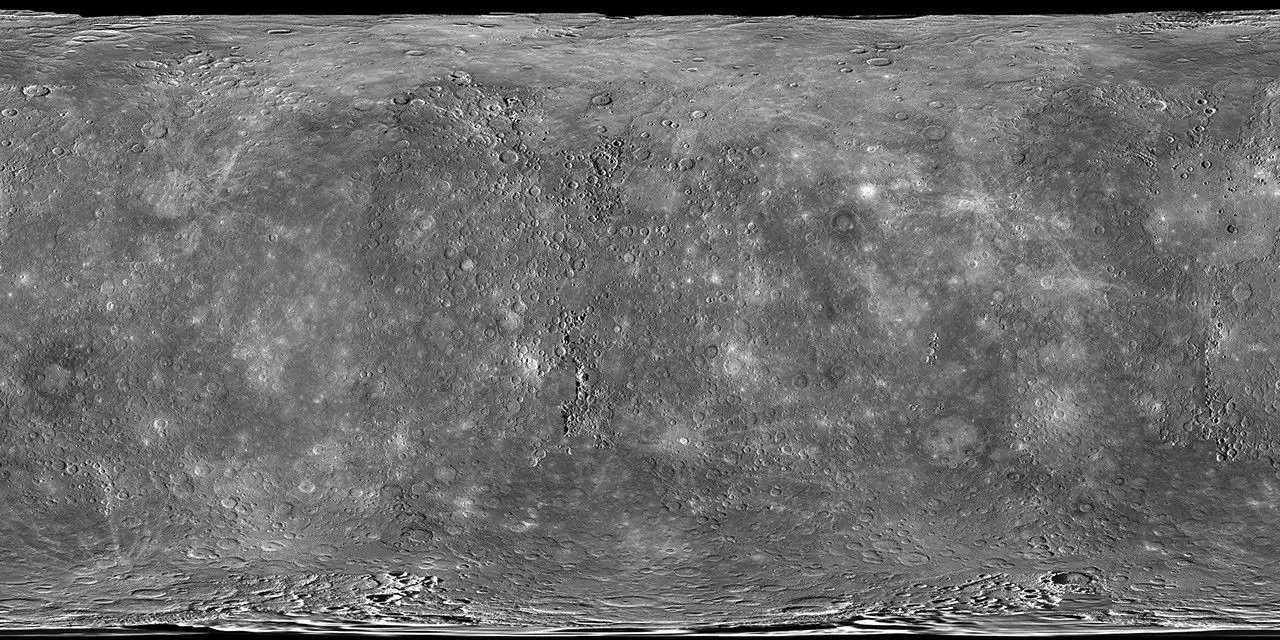
Mercury circles the Sun in 88 days, faster than any other planet, yet its solar day lasts 176 Earth days: two full Mercurian years. It is the planet of extremes: about 430 °C by day and −180 °C by night.
Visited up close only by Mariner 10 and MESSENGER (Europe-Japan's BepiColombo is on its way), Mercury holds surprises: water ice at its poles, a magnetic field it should not have, and a disproportionately large iron core.
Measured data [DATO]
| Data | Value | State | Source |
|---|---|---|---|
| Diameter | 4,879 km | [DATO] observed | NASA Planetary Fact Sheet |
| Mass | 3.30×10²³ kg | [DATO] observed | NASA Mercury Fact Sheet |
| Mean density | 5,429 kg/m³ | [DATO] observed | NASA Mercury Fact Sheet |
| Surface gravity | 3.7 m/s² | [DATO] observed | NASA Mercury Fact Sheet |
| Escape velocity | 4.3 km/s | [DATO] observed | NASA Planetary Fact Sheet |
| Mean distance from the Sun | 57.9 million km (0.387 AU) | [DATO] observed | NASA Mercury Fact Sheet |
| Orbital period | 88.0 days | [DATO] observed | NASA Planetary Fact Sheet |
| Rotation period | 1,407.6 hours (58.6 days) | [DATO] observed | NASA Mercury Fact Sheet |
| Mean temperature | 167 °C (day ~430 °C, night ~−180 °C) | [DATO] observed | NASA Mercury Fact Sheet |
| Atmosphere | Thin exosphere (<5×10⁻¹⁵ bar): sodium, magnesium, oxygen, hydrogen, potassium, calcium | [DATO] observed | NASA Mercury Fact Sheet (MESSENGER) |
| Notable feature | Water ice in permanently shadowed polar craters (MESSENGER, 2012) | [DATO] observed | NASA / MESSENGER |
| Known moons | 0 (LiveScience (solar system overview), April 2026) No changes recorded. | [DATO] observed | LiveScience (solar system overview) |
Truths [DATO]
- [DATO] A solar day on Mercury lasts 176 Earth days: the planet spins three times on its axis for every two orbits around the Sun (3:2 resonance), unique in the solar system.
- [DATO] Next to the Sun yet icy: MESSENGER confirmed in 2012 deposits of water ice in polar craters that never receive direct sunlight.
- [DATO] It is the densest planet after Earth (5,429 kg/m³): its iron core takes up most of its interior.
- [DATO] It has a global magnetic field, measured by MESSENGER — unexpected in a planet that spins so slowly.
Marked myths [MITO]
[MITO] Mercury is the hottest planet in the solar system.
Venus takes the title: 464 °C on average from a runaway greenhouse effect, versus Mercury's 167 °C average — which drops to −180 °C at night because it has almost no atmosphere to hold heat.
[MITO] Mercury is tidally locked to the Sun: one hemisphere lives in eternal day and the other in eternal night.
1965 radar observations showed it spins three times for every two orbits (3:2 resonance). The 1:1 lock was the belief before those measurements.
Fuente: Space.com resume la historia del descubrimiento por radar.
Open questions [PREGUNTA]
- [PREGUNTA] How does Mercury sustain a global magnetic field while spinning so slowly?
- [PREGUNTA] Did its polar ice arrive on comets and asteroids, or form some other way?
- [PREGUNTA] Why is its iron core so large? Did a giant impact strip away its mantle?