 Mathvsmyth
Solar System Series
Pluto
Planet or not, it is in our solar system: the world with an icy heart.
Author: Juan Carlos Euyoque Aguilera · October 7, 2026 · CC BY 4.0
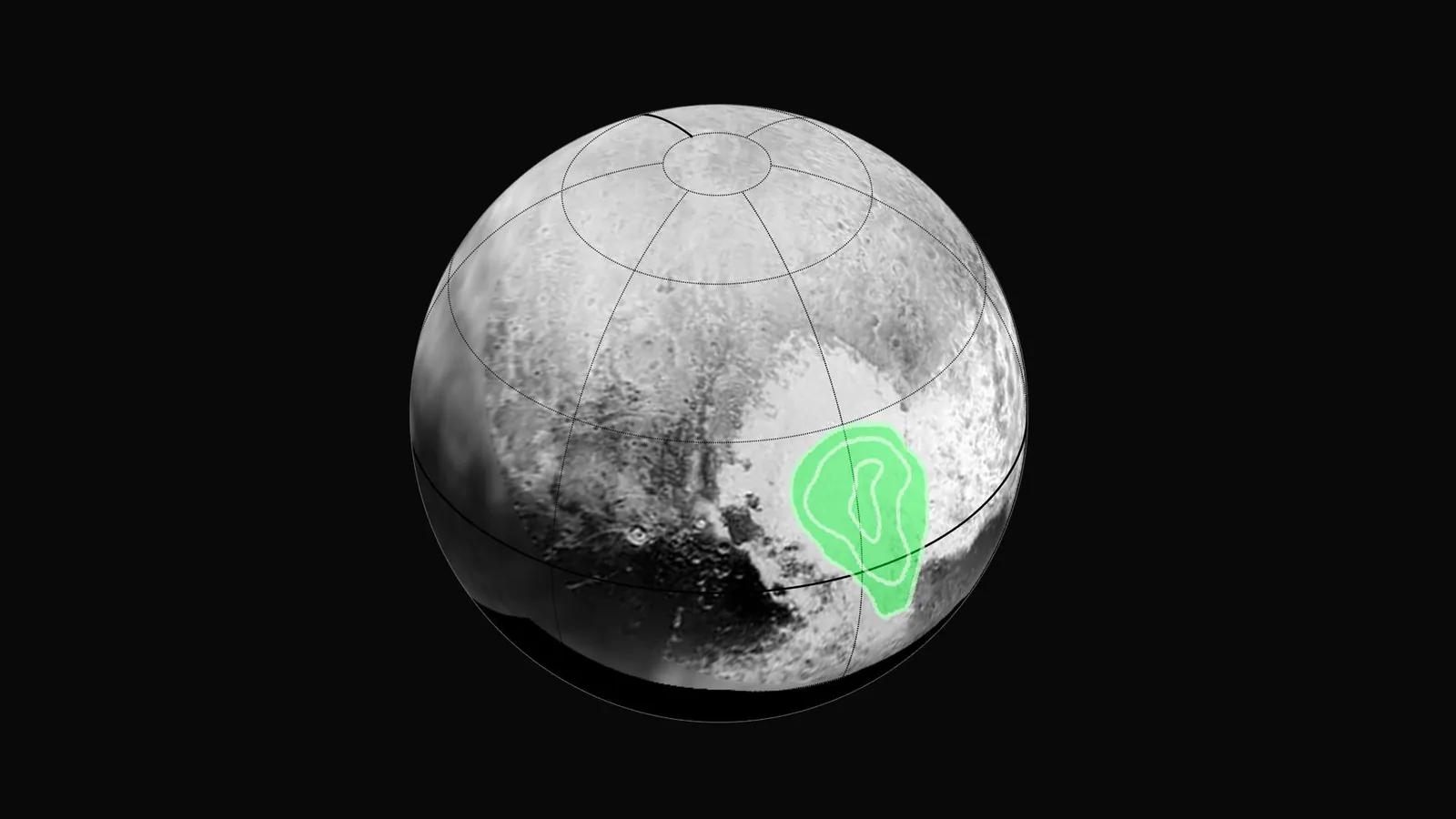
Pluto was the ninth planet for 76 years, until the International Astronomical Union (IAU) reclassified it as a dwarf planet on 24 August 2006. The decision is still debated: this piece presents what the definition says and what its critics answer, without declaring a winner.
On 14 July 2015 NASA's New Horizons spacecraft visited it — the first and only close visit — and found a geologically living world: a convecting nitrogen glacier shaped like a heart, mountains of water ice, and a thin atmosphere with a blue haze.
Measured data [DATO]
| Data | Value | State | Source |
|---|---|---|---|
| New Horizons flyby | Closest approach 14-Jul-2015 at ~12,500 km, at ~49,600 km/h; launched 19-Jan-2006; the first and only spacecraft to visit Pluto up close | [DATO] observed | Science News Explores; Spaceflight Now |
| Diameter | 2,376.6 ± 3.2 km — smaller than the Moon (3,476 km) | [DATO] observed | NASA JPL; Wikipedia (Pluto), a partir de datos de radio-ocultación REX de New Horizons |
| Tombaugh Regio | Bright heart-shaped region ~1,600 km wide; named for Clyde Tombaugh, who discovered Pluto in 1930 | [DATO] observed | NASA (artículo de imagen) |
| Sputnik Planitia | The heart's western lobe: a glacier of convecting nitrogen ice (polygonal cells); nearly crater-free surface less than ~100 million years old | [DATO] observed | NASA (PIA19841) |
| Atmosphere | Thin and nitrogen-dominated (~1 Pa / 10 μbar at the surface); blue haze in layers up to ~160 km high | [DATO] observed | Scientific American (hallazgos de New Horizons) |
| Moons | 5 known: Charon (1978, James Christy), Nix and Hydra (2005, Hubble), Kerberos (2011), Styx (2012) | [DATO] observed | Space.com / NASA |
| Charon | 1,207 km in diameter (~half of Pluto); the system's barycenter lies in the space between the two: a double world | [DATO] observed | Space.com / NASA |
| IAU 2006 definition (what it says) | 24-Aug-2006, Prague, Resolution 5A: a planet = (1) orbits the Sun, (2) massive enough for hydrostatic equilibrium, (3) has cleared its orbital neighborhood. Pluto meets 1 and 2, not 3 → dwarf planet | [DATO] observed | Wikipedia (IAU definition of planet) |
| Counter-argument (opinion) | [OPINION] Stern and other planetary scientists propose a geophysical definition: a planet is any body round by its own gravity that does not fuse elements — it would include 100+ bodies, including the Moon. Criticism of criterion 3: it depends on where a body is, not just on what it is | [MODELO] modeled | Phys.org (definición geofísica de planeta, 2017) |
Truths [DATO]
- [DATO] The only spacecraft to visit it up close is New Horizons (flyby of 14-Jul-2015).
- [DATO] It is 2,377 km in diameter: smaller than the Moon.
- [DATO] Its 'heart' (Tombaugh Regio) hosts a convecting nitrogen glacier: Sputnik Planitia.
- [DATO] It has a thin nitrogen atmosphere with a blue haze.
- [DATO] It has 5 moons; with Charon it forms a double world (the barycenter lies outside Pluto).
- [DATO] Its year lasts 248 Earth years.
Marked myths [MITO]
[MITO] Pluto stopped being a planet because it turned out to be too small.
Size is not a criterion in the IAU's 2006 definition. Pluto meets two of the three criteria (it orbits the Sun and is round by its own gravity); it fails only the third: it has not 'cleared its neighborhood' in the Kuiper Belt.
[MITO] The 2006 vote settled the debate: astronomers agree.
It was a controversial decision (Resolution 5A, Prague, 24-Aug-2006). Scientists like Alan Stern (New Horizons principal investigator) propose the geophysical definition and call for revisiting it; the debate remains open. No winner is declared here: both sides are presented.
Fuente: Phys.org (definición geofísica, 2017); Wikipedia (críticas a la definición IAU).
[MITO] Pluto is a dead, frozen rock with no change.
New Horizons found an active world: Sputnik Planitia's nitrogen glacier convects like a slowly boiling liquid, there are water-ice mountains kilometers high and an atmosphere with a blue haze; parts of the surface are less than 100 million years old.
Fuente: NASA (PIA19841); SpaceDaily (resumen del sobrevuelo).
Open questions [PREGUNTA]
- [PREGUNTA] What keeps Pluto geologically active if it has no giant neighbor flexing its interior?
- [PREGUNTA] Is there a liquid water ocean beneath its ice crust?
- [PREGUNTA] Will the IAU ever revisit its planet definition?