 Mathvsmyth
Solar System Series
Comet 2P/Encke
The shortest-period bright comet — and the parent of the Taurids.
Author: Juan Carlos Euyoque Aguilera · October 7, 2026 · CC BY 4.0
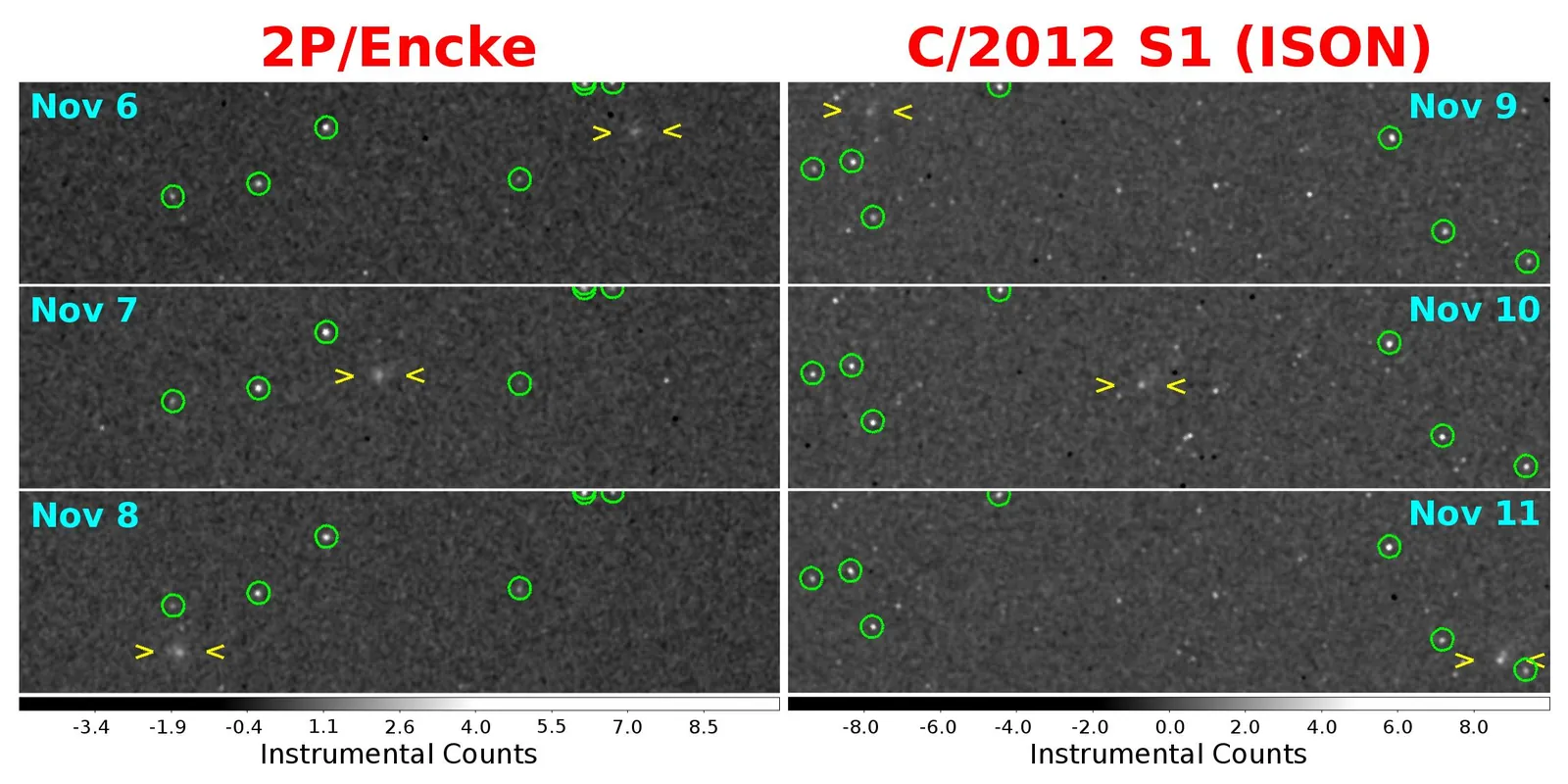
2P/Encke orbits the Sun every 3.30 years: the shortest orbital period of any reasonably bright comet in the solar system. It is named for Johann Franz Encke, who computed its orbit in 1819 — although Pierre Méchain was the first to record it, in 1786.
It is an old, darkened comet — it reflects only 4.6% of sunlight — and it is the parent of the Taurid meteor showers, famous for their October and November fireballs. In 2002 NASA launched the CONTOUR mission to visit it up close; the spacecraft was lost before arriving. No probe has ever visited it.
Measured data [DATO]
| Data | Value | State | Source |
|---|---|---|---|
| Orbital period | 3.30 years (3.304) — the shortest orbital period of any reasonably bright, well-known comet | [DATO] observed | NASA Science (2P/Encke) |
| Nucleus | Mean diameter ~4.8 km (4.86 km); geometric albedo 0.046 (reflects only 4.6% of sunlight); rotation 11.083 hours | [DATO] observed | Wikipedia (Comet Encke) |
| Orbit | Perihelion 0.339 AU; aphelion 4.097 AU; eccentricity 0.847; inclination 11.34° | [DATO] observed | Wikipedia (Comet Encke) |
| Discovery and orbit computation | First recorded by Pierre Méchain on 17-Jan-1786. Johann Franz Encke linked the sightings of 1786, 1795, 1805 and 1818, computed the orbit, published it in 1819, and predicted the 1822 return | [DATO] observed | NASA Science (2P/Encke) |
| Associated meteor showers | Parent comet of the Northern and Southern Taurids (peak October–November, famous for fireballs) and the daytime Beta Taurids (June–July) | [DATO] observed | NASA Science (2P/Encke); StarWalk |
| CONTOUR mission | NASA's CONTOUR launched 3-Jul-2002 (Delta II, Cape Canaveral); contact lost 15-Aug-2002 during the Star 30 motor burn; declared lost 20-Dec-2002. An Encke flyby at 100–160 km was planned for 12-Nov-2003. No spacecraft has ever visited Encke up close | [DATO] observed | NASA (informe de la junta de investigación del percance CONTOUR) |
| Perihelion dates | Last perihelion 22-Oct-2023; next perihelion 10-Feb-2027 | [DATO] observed | StarWalk |
| Taurid Complex / giant fragmented comet | [HYPOTHESIS] The 'coherent catastrophism' hypothesis (Clube and Napier) proposes that Encke and the Taurid stream are the remains of a giant comet (~100 km) that broke apart ~20,000 years ago. Not a fact: a hypothesis, not developed here | [MODELO] modeled | National Geographic (artículo sobre las Táuridas) |
Truths [DATO]
- [DATO] Orbital period of 3.30 years: the shortest among bright, well-known comets.
- [DATO] Its nucleus is ~4.8 km across and reflects only 4.6% of the light it receives (albedo 0.046).
- [DATO] It is not named for its discoverer: it is named for Johann Franz Encke, who computed its orbit (1819); the first to see it was Pierre Méchain (1786).
- [DATO] It is the parent comet of the Northern and Southern Taurids (October–November), known for their fireballs, and of the Beta Taurids (June–July).
- [DATO] NASA's CONTOUR mission was to fly by it in November 2003; the spacecraft was lost in August 2002. No spacecraft has visited it up close.
- [DATO] Its next perihelion is on 10 February 2027 (the last was 22 October 2023).
Marked myths [MITO]
[MITO] Comet Encke is named after its discoverer.
It is named for Johann Franz Encke, who computed its orbit and predicted its 1822 return. The first to record it was Pierre Méchain, in 1786; it was also seen by Caroline Herschel (1795) and Jean-Louis Pons (1805, 1818) without being recognized as the same object.
[MITO] Encke has the shortest orbital period of all comets.
It has the shortest period among reasonably bright, well-known comets. The faint main-belt comet 311P/PanSTARRS has a period of 3.2 years.
Fuente: Wikipedia (Comet Encke).
[MITO] The 1908 Tunguska explosion was caused by a fragment of Comet Encke.
That is a hypothesis proposed by Ľ. Kresák in 1978 and criticized by Z. Sekanina in 1983. The exact nature of the Tunguska object has never been determined; it is not an established fact that it was an Encke fragment.
Fuente: Hipótesis de Kresák (1978), crítica de Sekanina (1983); enciclopedia con el resumen del debate.
[MITO] A 'swarm' of giant Encke fragments is coming toward Earth (alarmist headlines, 2019).
In June 2019 Earth passed ~30 million km from the zone where the hypothetical Taurid swarm might be; astronomers used the pass to search for it with telescopes. The astronomical community has observed no concentrations of mountain-sized objects and rejects the catastrophic predictions.
Open questions [PREGUNTA]
- [PREGUNTA] How large are the biggest fragments of the Taurid swarm, if it exists as such?
- [PREGUNTA] Encke has been fading since 1786: how many more perihelia will it survive before going dark?
- [PREGUNTA] Will any future mission achieve the close flyby that CONTOUR never managed?