 Mathvsmyth
Solar System Series
16 Psyche
The metal world between Mars and Jupiter.
Author: Juan Carlos Euyoque Aguilera · October 7, 2026 · CC BY 4.0
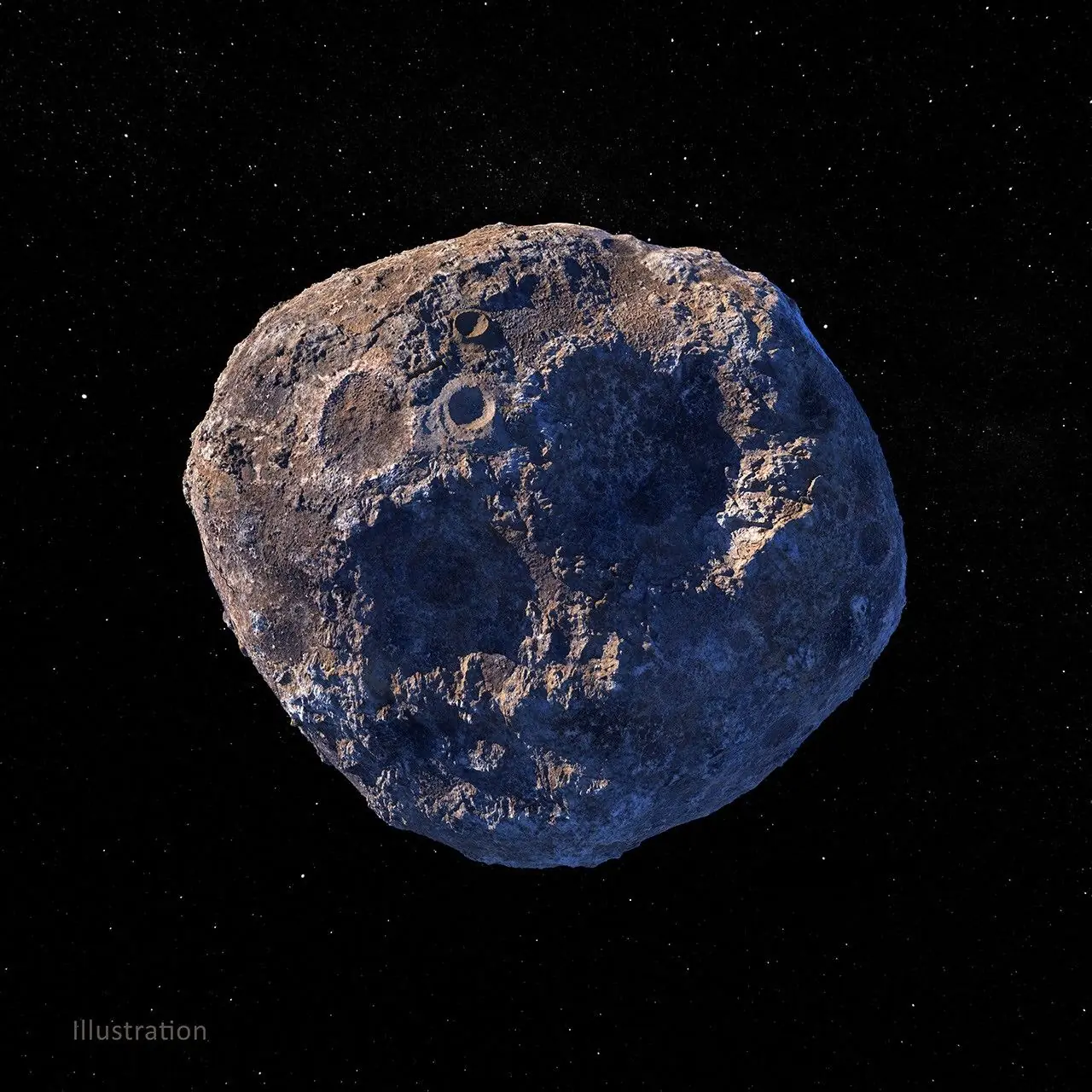
16 Psyche is one of the strangest objects in the main belt: an M-type, metal-rich asteroid that NASA describes as a mixture of rock and metal, with metal making up 30% to 60% of its volume. It measures about 280 km at its widest point and spins in just 4.2 hours.
In August 2029 NASA's Psyche mission will reach it: the first time a spacecraft visits a metallic asteroid. Until then, everything we know comes from Earth-based radar, spectroscopy, and adaptive optics — and much of what the press says about it is myth.
Measured data [DATO]
| Data | Value | State | Source |
|---|---|---|---|
| Diameter | ~222 km mean diameter (approx. 280 x 232 x 164 km; irregular, potato-like shape) | [DATO] observed | NASA Science / Wikipedia (16 Psyche) |
| Estimated mass | (2.29±0.14)×10¹⁹ kg (~1% of the asteroid belt's mass) | [DATO] observed | Wikipedia (16 Psyche), a partir de estudios de perturbaciones gravitacionales |
| Bulk density | 3.977±0.253 g/cm3 | [DATO] observed | Wikipedia (16 Psyche); la NASA estima 3.400–4.100 kg/m³ |
| Composition (observed) | M/Xk spectral type; radar albedo 0.22-0.52 (2-4x most main-belt asteroids); Hubble UV reflects like iron | [DATO] observed | Estudios de radar de Arecibo; observaciones UV del Hubble |
| Composition (interpretation) | Rock-metal mixture: NASA estimates 30-60% metal by volume (not pure iron) | [MODELO] modeled | NASA Science (resumen de la misión Psyche) |
| Discovery | March 17, 1852, by Annibale de Gasparis, Naples Observatory; the 16th asteroid discovered | [DATO] observed | NASA Science; Wikipedia (16 Psyche) |
| Location | Outer main belt, between Mars and Jupiter; 2.53-3.32 AU from the Sun (semi-major axis 2.92 AU) | [DATO] observed | Wikipedia (16 Psyche) |
| Orbital and rotation periods | 4.998-year orbit; 4.195948-hour rotation | [DATO] observed | Wikipedia (16 Psyche) |
| NASA Psyche mission | Launched October 13, 2023 (Falcon Heavy, Kennedy LC-39A); arrival at the asteroid August 2029; ~26 months orbiting it | [DATO] observed | NASA Science (resumen de la misión Psyche) |
| Origin hypothesis | Exposed core of a protoplanet stripped of its mantle by hit-and-run collisions — HYPOTHESIS, not fact; studies since 2020 have cast doubt on it | [MODELO] modeled | NASA Science; Wikipedia (16 Psyche) |
Truths [DATO]
- [DATO] It is the largest known metallic asteroid: ~222 km mean diameter and (2.29±0.14)x10^19 kg.
- [DATO] Its radar returns an echo 2 to 4 times stronger than a typical main-belt asteroid: there is metal at the surface.
- [DATO] It spins in 4.196 hours and takes 4.998 years to orbit the Sun.
- [DATO] NASA's Psyche spacecraft launched on October 13, 2023 and arrives in August 2029: the first encounter with a metallic asteroid.
Marked myths [MITO]
[MITO] 16 Psyche is worth $10,000 quadrillion: it could make every person on Earth a billionaire.
The number was calculated in 2017 by the mission's own principal investigator, Lindy Elkins-Tanton, using then-current metals-market prices — and she herself called it 'meaningless in every way': it assumes recovering all the metal and bringing it to Earth (no technology exists for that), and if it were done, the flood of supply would collapse metals prices. Current data also suggest a porous interior with more rock than once thought.
[MITO] Psyche is certainly the pure iron core of a planet that never formed.
That is only a hypothesis: NASA says the most likely picture is a rock-metal mixture (30-60% metal by volume), and studies published since 2020 have cast doubt on the remnant-core idea. The 2029 mission will have the final word.
Open questions [PREGUNTA]
- [PREGUNTA] Will the 2029 mission confirm that Psyche is an exposed planetary core, or will it tell a different origin story?
- [PREGUNTA] Is the metal concentrated in provinces, or intimately mixed with rock at fine scale?
- [PREGUNTA] Does it retain a fossil magnetic field? Its magnetometer will tell — the signature of a core that once had a dynamo.
The author's voice
His sealed position (psyche-16-correccion-v1, 2026-10-05): the theory does not fix a point but a requirement and a parameter space — mantle stripping by hit-and-run needs KE ≥ ~0.15U (threshold per Asphaug et al.); two velocity branches: local ~5 km/s (object already in that orbit) vs external ~26 km/s (objects coming from outside, via galactic tide or passing nebulae); diameter free within the set that satisfies the requirement. Demonstrative point (illustrative, not asserted by the author): 150 km at 5 km/s suffices (KE = 5.96x10^25 J, U = 9.91x10^24 J, ratio 6.02 >> 0.15); trade-off at equal energy d ∝ v^(-2/3) (at 26 km/s ~50 km suffice). The exact diameter determination is left to whoever discovers it (e.g., NASA Psyche mission data, arrival 2029).
The author's theory: 16 Psyche · Psyche: parameter calculation