 Mathvsmyth
Solar System Series
Neptune
The blue-green giant: the planet mathematics found first
Author: Juan Carlos Euyoque Aguilera · October 7, 2026 · CC BY 4.0
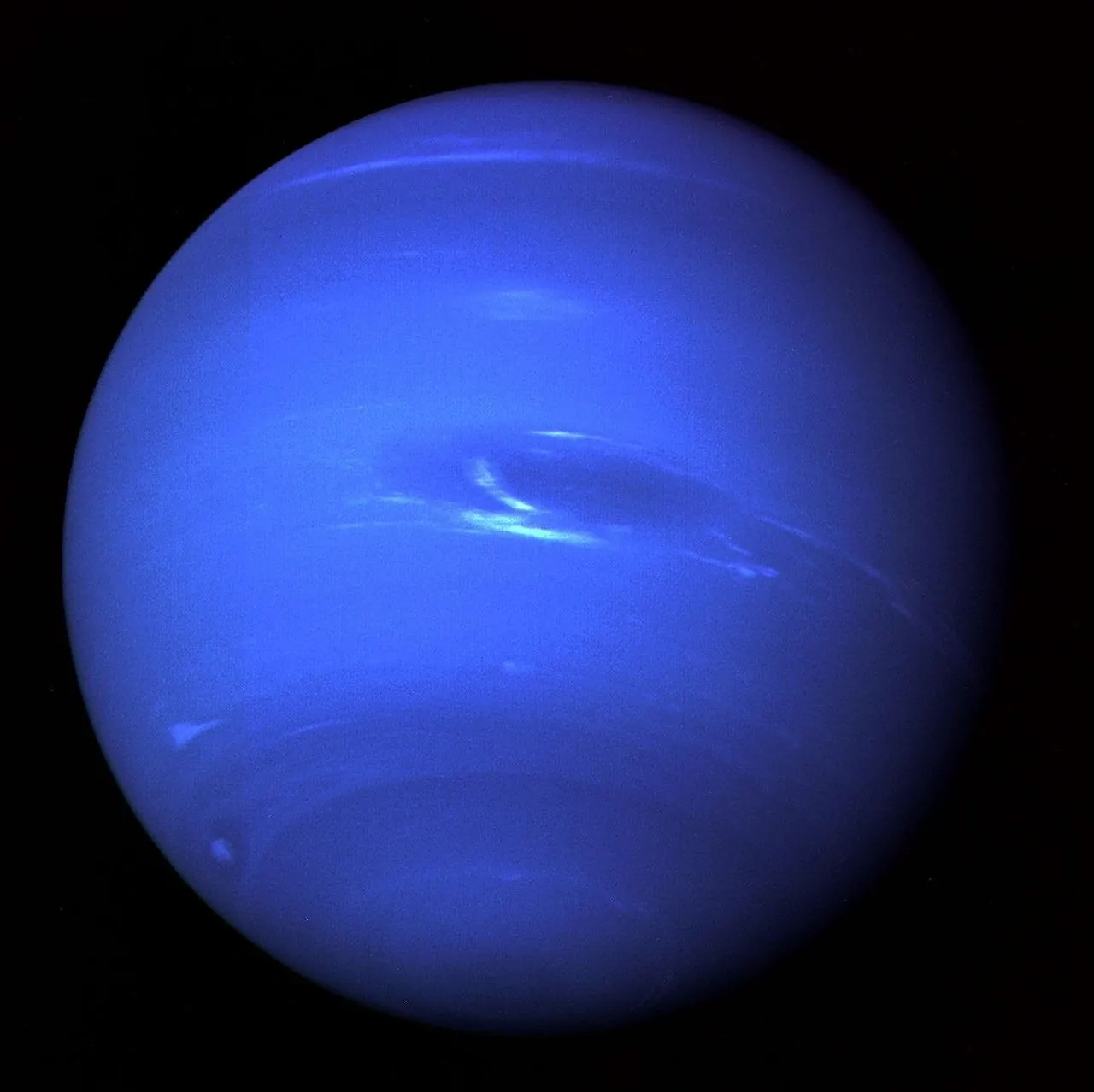
Neptune was discovered with pencil and paper before it was seen through a telescope: Le Verrier's calculations pointed to where to look in 1846. It is the windiest world in the solar system, with supersonic winds over 2,000 km/h, and the only planet invisible to the naked eye.
For decades we pictured it deep blue thanks to Voyager 2's enhanced photos; in 2024 we learned its true color is almost the same as Uranus's. Measured data, corrected myths, and open questions follow.
Measured data [DATO]
| Data | Value | State | Source |
|---|---|---|---|
| Diameter | 49,528 km | [DATO] observed | NASA Planetary Fact Sheet (NSSDCA) |
| Mass | 102 × 10²⁴ kg | [DATO] observed | NASA Planetary Fact Sheet (NSSDCA) |
| Mean density | 1,638 kg/m³ | [DATO] observed | NASA Planetary Fact Sheet (NSSDCA) |
| Surface gravity | 11.0 m/s² (at the 1-bar level) | [DATO] observed | NASA Planetary Fact Sheet (NSSDCA) |
| Escape velocity | 23.5 km/s | [DATO] observed | NASA Planetary Fact Sheet (NSSDCA) |
| Mean distance from the Sun | 4,515 × 10⁶ km (30.2 AU) | [DATO] observed | NASA Planetary Fact Sheet (NSSDCA) |
| Orbital period | 59,800 days (163.7 years) | [DATO] observed | NASA Planetary Fact Sheet (NSSDCA) |
| Rotation period | 16.1 hours | [DATO] observed | NASA Planetary Fact Sheet (NSSDCA) |
| Mean temperature | -200 °C (at the 1-bar level) | [DATO] observed | NASA Planetary Fact Sheet (NSSDCA) |
| Atmosphere / composition | Hydrogen (~80%), helium (~19%), and methane (~1%) | [DATO] observed | NASA NSSDC — Neptune Fact Sheet |
| Notable feature | The fastest winds in the solar system: over 2,000 km/h (supersonic); the 1989 Great Dark Spot, the size of Earth, has since disappeared | [DATO] observed | NASA Science — Neptune Facts |
| Rings | Yes — at least 5 main rings (Galle, Leverrier, Lassell, Arago, Adams) and 4 arcs (Liberté, Égalité, Fraternité, Courage); thought to be young and short-lived | [DATO] observed | NASA Science — Neptune Facts |
| Known moons | 16 (IAU Minor Planet Center / Scott Sheppard's team (Subaru, Magellan, VLT, Gemini telescopes), February 2024) 14 -> 16 on 23-Feb-2024 with S/2002 N5 (~23 km) and S/2021 N1 (~14 km). No new announcements since. | [DATO] observed | IAU Minor Planet Center / Scott Sheppard's team (Subaru, Magellan, VLT, Gemini telescopes) |
Truths [DATO]
- [DATO] It was the first planet located with mathematics: Le Verrier predicted its position and Galle found it in 1846; in 2011 it completed its first orbit since discovery.
- [DATO] It is the windiest world in the solar system: winds over 2,000 km/h, supersonic — three times stronger than Jupiter's and nine times stronger than Earth's.
- [DATO] The Great Dark Spot seen by Voyager 2 in 1989 — the size of Earth — has since disappeared, but new storms have appeared elsewhere.
- [DATO] Its largest moon, Triton, orbits in a retrograde direction — probably a captured object — and has ice geysers rising more than 8 km.
Marked myths [MITO]
[MITO] Neptune is a deep, intense blue, as seen in the Voyager 2 photos.
A 2024 reprocessing (Patrick Irwin, University of Oxford, Monthly Notices of the Royal Astronomical Society) showed that Voyager's Neptune images were stretched and enhanced to highlight clouds and storms: in true color, Uranus and Neptune are a very similar greenish blue.
Open questions [PREGUNTA]
- [PREGUNTA] What drives supersonic winds with so little solar energy? It is one of the great mysteries of planetary science.
- [PREGUNTA] Why do the giant dark spots appear and disappear?
- [PREGUNTA] How did Neptune capture Triton, its retrograde moon?