 Mathvsmyth
Solar System Series
Uranus
The sideways planet: the ice giant that rolls around the Sun
Author: Juan Carlos Euyoque Aguilera · October 7, 2026 · CC BY 4.0
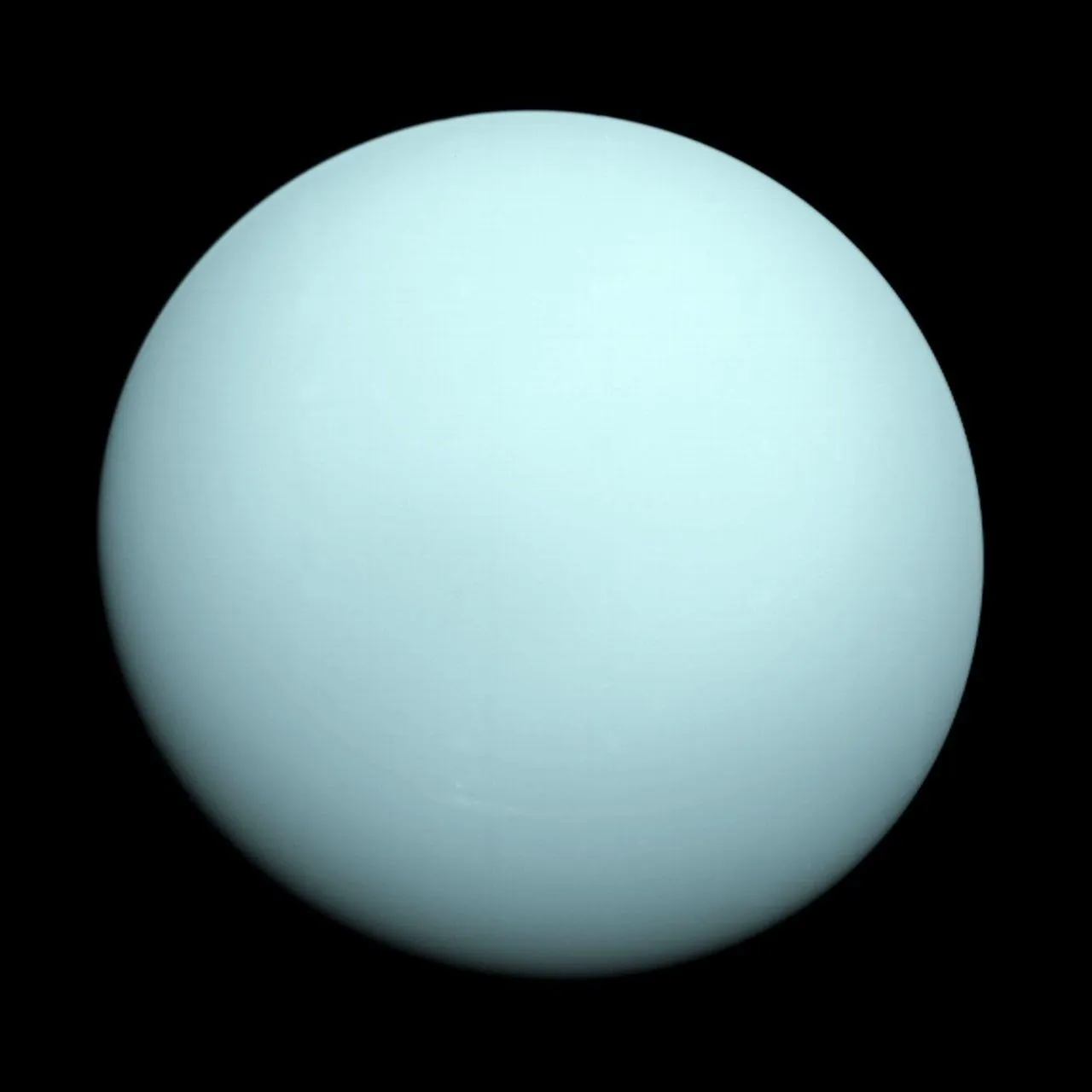
Uranus is the oddball of the solar system: it spins tilted at 97.8°, nearly lying on its side, so each pole spends about 21 straight years in sunlight and another 21 in darkness. Its methane atmosphere gives it a serene blue-green hue that hides winds of up to 900 km/h.
Only one spacecraft has visited it, Voyager 2, in January 1986. And yes — it has rings, discovered by accident in 1977. Here is what has been measured, what has been corrected, and what we still don't know.
Measured data [DATO]
| Data | Value | State | Source |
|---|---|---|---|
| Diameter | 51,118 km | [DATO] observed | NASA Planetary Fact Sheet (NSSDCA) |
| Mass | 86.8 × 10²⁴ kg | [DATO] observed | NASA Planetary Fact Sheet (NSSDCA) |
| Mean density | 1,270 kg/m³ | [DATO] observed | NASA Planetary Fact Sheet (NSSDCA) |
| Surface gravity | 8.7 m/s² (at the 1-bar level) | [DATO] observed | NASA Planetary Fact Sheet (NSSDCA) |
| Escape velocity | 21.3 km/s | [DATO] observed | NASA Planetary Fact Sheet (NSSDCA) |
| Mean distance from the Sun | 2,867 × 10⁶ km (19.2 AU) | [DATO] observed | NASA Planetary Fact Sheet (NSSDCA) |
| Orbital period | 30,589 days (83.7 years) | [DATO] observed | NASA Planetary Fact Sheet (NSSDCA) |
| Rotation period | 17.2 hours (retrograde) | [DATO] observed | NASA Planetary Fact Sheet (NSSDCA) |
| Mean temperature | -195 °C (at the 1-bar level) | [DATO] observed | NASA Planetary Fact Sheet (NSSDCA) |
| Atmosphere / composition | Hydrogen (~83%), helium (~15%), and methane (~2%); methane absorbs red light, giving it its blue-green color | [DATO] observed | NASA NSSDC — Uranus Fact Sheet; NASA StarChild (GSFC) |
| Notable feature | Axial tilt of 97.8°: it rolls on its side around the Sun; each pole spends about 21 straight years in sunlight and another 21 in darkness | [DATO] observed | NASA Planetary Fact Sheet (NSSDCA); NASA |
| Rings | Yes — 13 narrow, dark rings; discovered on March 10, 1977 by Elliot, Dunham, and Mink during the occultation of the star SAO 158687 | [DATO] observed | Nature (Elliot, Dunham & Mink, 1977); Britannica |
| Known moons | 29 (NASA / Maryame El Moutamid's team (SwRI), Webb Space Telescope (NIRCam), August 2025) 28 in February 2024 -> 29 with S/2025 U1 (~10 km, between Ophelia and Bianca), detected 2-Feb-2025 and announced 19-Aug-2025. Formal IAU confirmation and official name pending (April 2026). | [DATO] observed | NASA / Maryame El Moutamid's team (SwRI), Webb Space Telescope (NIRCam) |
Truths [DATO]
- [DATO] It spins on its side, with an axial tilt of 97.8°: it rolls around the Sun instead of spinning upright, producing the most extreme seasons in the solar system.
- [DATO] Its atmosphere — hydrogen, helium, and ~2% methane — absorbs red light, giving it its characteristic blue-green color.
- [DATO] A day lasts 17.2 hours and is retrograde; a year equals 83.7 Earth years.
- [DATO] The only spacecraft to visit it is Voyager 2 (January 1986); it has 28 known moons and a system of 13 narrow, dark rings.
Marked myths [MITO]
[MITO] Only Saturn has rings; Uranus has none.
Uranus has 13 narrow, dark rings, discovered on March 10, 1977 by James Elliot, Edward Dunham, and Jessica Mink, who detected five occultations of the star SAO 158687 before and after Uranus blocked it (published in Nature).
Open questions [PREGUNTA]
- [PREGUNTA] What tilted it 97.8°? The leading hypothesis is a collision with an Earth-sized object in its past, but there is no direct proof.
- [PREGUNTA] What is its interior really made of? We only have models: a hot mantle of water, ammonia, and methane over a rocky core.
- [PREGUNTA] How do its 13 dark rings stay so narrow, and where did they come from?