 Mathvsmyth
Solar System Series
Saturn
The lord of the rings: young beauty with an expiration date
Author: Juan Carlos Euyoque Aguilera · October 7, 2026 · CC BY 4.0
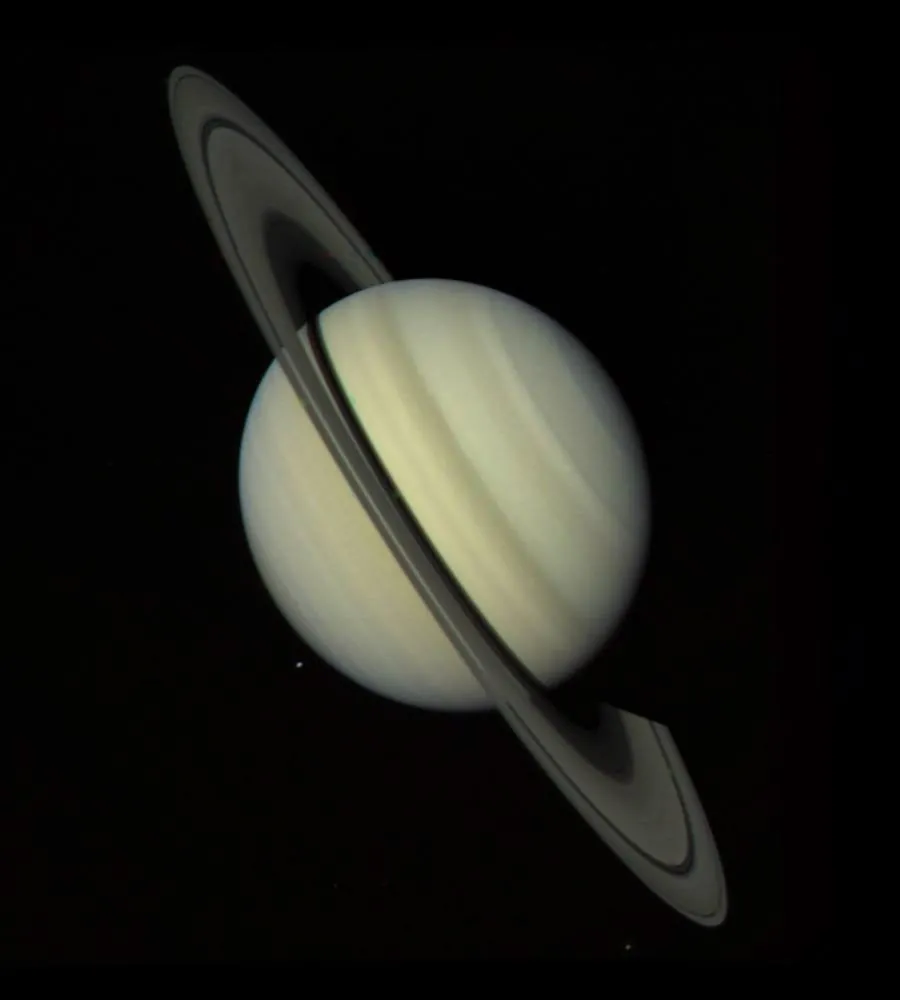
Saturn is the most photogenic planet in the solar system, but its rings hide a surprise: data from the Cassini mission indicate they are young and temporary. With 274 moons, 1,800 km/h winds, and a perfect hexagon at its north pole, Saturn is much more than a postcard.
Here we gather what Cassini and the Voyagers actually measured, we mark the myth of the eternal rings, and we leave open the questions not even NASA has closed.
Measured data [DATO]
| Data | Value | State | Source |
|---|---|---|---|
| Diameter | 120,536 km | [DATO] observed | NASA Planetary Fact Sheet (NSSDCA) |
| Mass | 568 × 10²⁴ kg | [DATO] observed | NASA Planetary Fact Sheet (NSSDCA) |
| Mean density | 687 kg/m³ | [DATO] observed | NASA Planetary Fact Sheet (NSSDCA) |
| Surface gravity | 9.0 m/s² (at the 1-bar level) | [DATO] observed | NASA Planetary Fact Sheet (NSSDCA) |
| Escape velocity | 35.5 km/s | [DATO] observed | NASA Planetary Fact Sheet (NSSDCA) |
| Mean distance from the Sun | 1,432 × 10⁶ km (9.6 AU) | [DATO] observed | NASA Planetary Fact Sheet (NSSDCA) |
| Orbital period | 10,747 days (29.4 years) | [DATO] observed | NASA Planetary Fact Sheet (NSSDCA) |
| Rotation period | 10.7 hours | [DATO] observed | NASA Planetary Fact Sheet (NSSDCA) |
| Mean temperature | -140 °C (at the 1-bar level) | [DATO] observed | NASA Planetary Fact Sheet (NSSDCA) |
| Atmosphere / composition | Hydrogen (~96%) and helium (~3%); traces of methane, ammonia, and other compounds | [DATO] observed | NASA NSSDC — Saturn Fact Sheet |
| Notable feature | The north-polar hexagon: a six-sided jet stream about 30,000 km wide with a central storm, seen by the Voyagers and studied by Cassini | [DATO] observed | NASA Science — Saturn Facts (misión Cassini) |
| Rings | Yes — the most spectacular ring system in the solar system: billions of chunks of ice and rock; it spans 282,000 km yet is only ~10 m thick in the main rings | [DATO] observed | NASA Science — Saturn Facts (misión Cassini) |
| Known moons | 285 (IAU Minor Planet Center / Edward Ashton's team (Academia Sinica), March 2026) 146 -> 274 on 11-Mar-2025 (128 new) -> 285 on 26-Mar-2026 (11 more: MPEC 2026-F14). | [DATO] observed | IAU Minor Planet Center / Edward Ashton's team (Academia Sinica) |
Truths [DATO]
- [DATO] It is the only planet less dense than water (687 kg/m³): it would float in a big enough bathtub, as NASA itself puts it.
- [DATO] It has 274 confirmed moons (March 2025), more than any other planet — including Titan, with lakes of liquid methane, and Enceladus, with water geysers at its south pole.
- [DATO] Its rings span 282,000 km yet are only about 10 meters thick in the main rings: they are made of billions of chunks of ice and rock.
- [DATO] Equatorial winds reach 500 m/s (1,800 km/h), and its north pole hosts a ~30,000 km hexagon discovered by the Voyagers.
Marked myths [MITO]
[MITO] Saturn's rings are eternal: they have existed since the planet formed, 4.5 billion years ago.
Cassini measured that the rings have very little mass (~0.4 times the mass of the moon Mimas) and are being darkened by micrometeorite dust, pointing to an age of 100 to 400 million years. They are also losing material as 'ring rain' at a rate that would deplete them in under 100 to 300 million years.
Open questions [PREGUNTA]
- [PREGUNTA] How were the rings born? Cassini data point to a shattered moon 100 to 400 million years ago, but the exact mechanism remains open.
- [PREGUNTA] What keeps the north-pole hexagon stable for decades?
- [PREGUNTA] Could there be life in Enceladus's subsurface ocean, which vents water into space through its geysers?